
Medium voltage (MV) switchgear is the complete assembly of switching, protection, control and measurement equipment used to distribute electrical power at voltage levels above 1 kV and up to about 40.5 kV, built as metal-enclosed or metal-clad panels to international standard IEC 62271-200.
This pillar guide explains the components inside an MV panel, the main types of switchgear — by insulation medium and by construction — how they compare, the classification and ratings you need to specify, the shift toward SF6-free equipment, and how to select the right panel. It is written for MV distribution projects across the Middle East and Gulf (including Egypt and Saudi Arabia), as well as North Africa, CIS and Sub-Saharan Africa.
What MV switchgear is
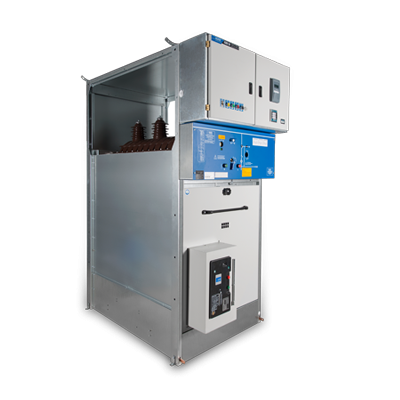
MV switchgear integrates several essential components into a single, safe, easy-to-operate unit. It provides safe operation, fault isolation, load switching and reliable supply in distribution substations, industrial plants, renewable plants and both step-up and step-down substations. A modern panel is built as a compact, modular metal-enclosed or metal-clad cubicle, and the main components are:
- Circuit breaker — the main switching and fault-interrupting device. Modern MV breakers are almost always vacuum (the arc is interrupted in a vacuum bottle), though SF6 interrupters are also used; the device follows IEC 62271-100.
- Disconnector and earthing switch — provide visible isolation and safe earthing of an isolated circuit; they follow IEC 62271-102. The earthing switch typically has a short-circuit making capacity, and mechanical interlocks make it impossible to earth a live circuit.
- Instrument transformers — current and voltage transformers that scale primary quantities down for metering and protection. See the dedicated guides on the current transformer and voltage transformer.
- Protection relay — the numerical protection relay that measures current and voltage and trips the breaker on a fault, with ANSI/IEC protection functions and IEC 61850 communication.
- Busbars, cable terminations and surge arresters — the busbars distribute current between panels, the cable terminations connect the MV cables (see plug-in cable termination), and surge arresters limit transient overvoltages.
- Low-voltage compartment — houses the control, protection and auxiliary circuits.
Types of MV switchgear — two independent axes
A common source of confusion is treating “GIS”, “AIS”, “metal-clad” and “RMU” as one list of alternatives. In fact they describe two independent things:
- Insulation medium — how the live parts are insulated: Air-Insulated (AIS) or Gas-Insulated (GIS).
- Construction format — how the panel is built and compartmented: metal-clad (compartmented, withdrawable), metal-enclosed cubicle, or ring main unit (RMU) (compact, usually sealed).
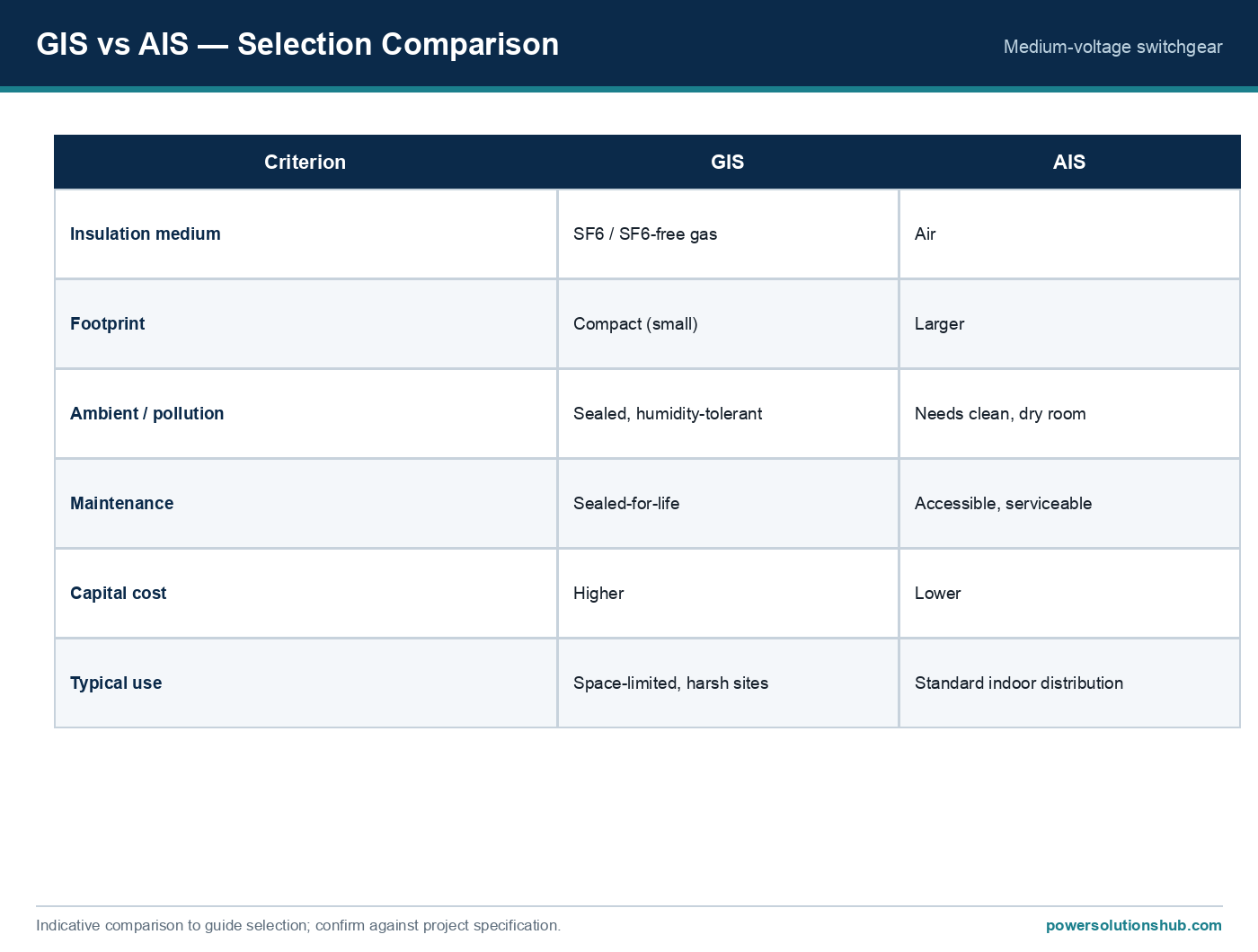
So a panel is described by both — for example a metal-clad panel is normally air-insulated, while a ring main unit is normally gas-insulated. The table below summarises the four terms you will meet most often.
| Type | Axis | Insulation | Construction | Typical level | Notes |
|---|---|---|---|---|---|
| Air-Insulated (AIS) | Insulation | Air | Cubicle or metal-clad | Primary & secondary | Larger, serviceable, lower cost; needs a clean, dry room |
| Gas-Insulated (GIS) | Insulation | SF6 / SF6-free | Sealed tank | Primary & secondary | Compact, sealed-for-life, humidity/pollution-tolerant |
| Metal-clad | Construction | Usually air | Compartmented, withdrawable (LSC2B, PM) | Primary | Earthed metal partitions, withdrawable breaker; e.g. ABB UniGear ZS1 up to 24 kV, 4000 A, 63 kA |
| Ring Main Unit (RMU) | Construction | Usually gas | Compact, sealed | Secondary | Ring switches + transformer feeder in one unit; e.g. Schneider RM6 |
Explore each family in depth: gas-insulated switchgear (GIS) ring main units (RMU), metal-clad switchgear and air-insulated switchgear (AIS).
Fixed-mounted vs withdrawable construction
A further construction choice is whether the circuit breaker is fixed-mounted or withdrawable. In a withdrawable (draw-out) design — typical of metal-clad primary switchgear — the breaker sits on a truck that can be racked between the service, test and isolated positions, and fully removed for maintenance or replacement while the busbar and cable compartments stay in their state. This maximises continuity of supply and makes maintenance safe and fast, at the cost of a larger, more expensive panel. In a fixed-mounted design — typical of compact secondary switchgear and gas-insulated RMUs — the breaker is built into the sealed unit; it is simpler and more compact, and because the unit is sealed-for-life it needs little internal maintenance in the first place. The right choice again follows the network level: withdrawable for high-current primary boards where serviceability is paramount, fixed-mounted for compact, sealed secondary units.
Primary vs secondary distribution
Another way to place a panel is by its role in the network:
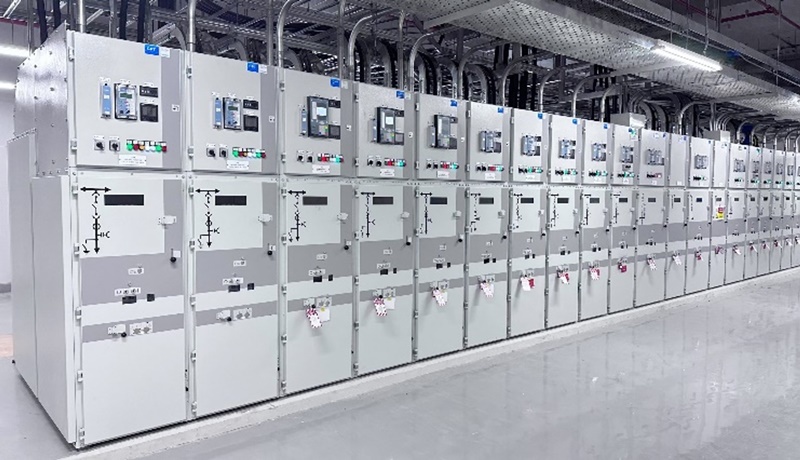
- Primary distribution switchgear sits close to the source — at the incoming substation feeding several outgoing feeders at high busbar current. It is typically an air-insulated, metal-clad, withdrawable line-up: for example ABB UniGear ZS1 handles up to 24 kV with busbar currents to 4000 A and short-circuit levels to 63 kA (at 12–17.5 kV). Withdrawable breakers allow a faulty unit to be racked out and replaced while keeping the rest of the board in service.
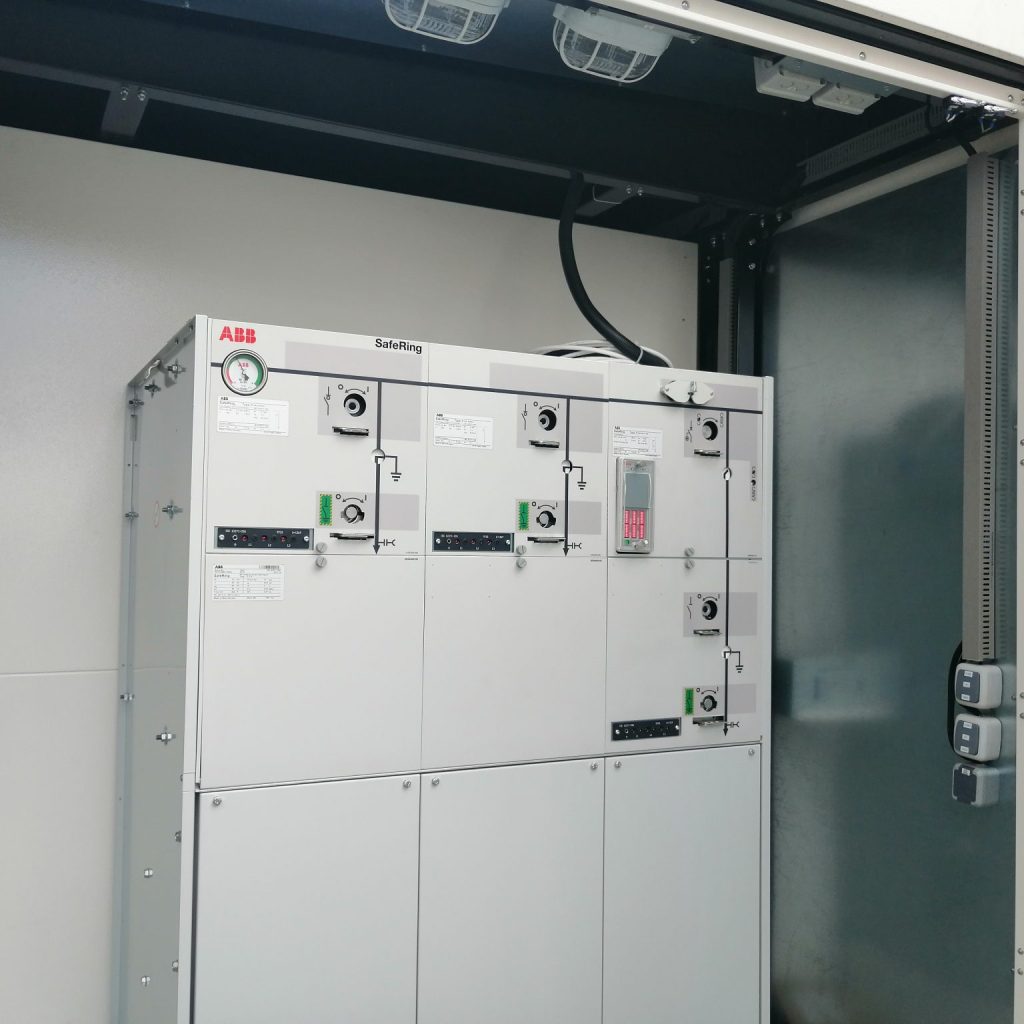
- Secondary distribution switchgear sits deeper in the network, at the many small substations that step MV down to LV. It is typically a compact ring main unit (usually gas-insulated), rated 400–630 A, combining ring switching and transformer protection in one sealed unit — see ring main units.
Choosing the level is usually obvious from the single-line diagram; the more nuanced choices are insulation medium, construction and classification, covered next.
How to choose
The choice between air-insulated and gas-insulated switchgear — and between a metal-clad line-up and a compact RMU — depends on:
- Space and environment. Space-limited, hot, dusty or humid sites favour compact, sealed GIS/RMU; standard indoor rooms with maintenance access suit AIS.
- Network level. Large primary substations with high busbar currents use metal-clad, withdrawable AIS; secondary distribution rings use compact RMUs. See ring main units.
- Maintenance strategy. Sealed-for-life GIS minimises internal maintenance; withdrawable metal-clad maximises serviceability and continuity of supply.
- Total cost of ownership. GIS has a higher capital cost but lower maintenance and footprint; AIS has a lower initial cost but needs the space and controlled environment.
- Regulatory constraints. Where SF6-free equipment is required, choose a dry-air or air-insulated family with equivalent ratings (see below).
Classification of MV switchgear
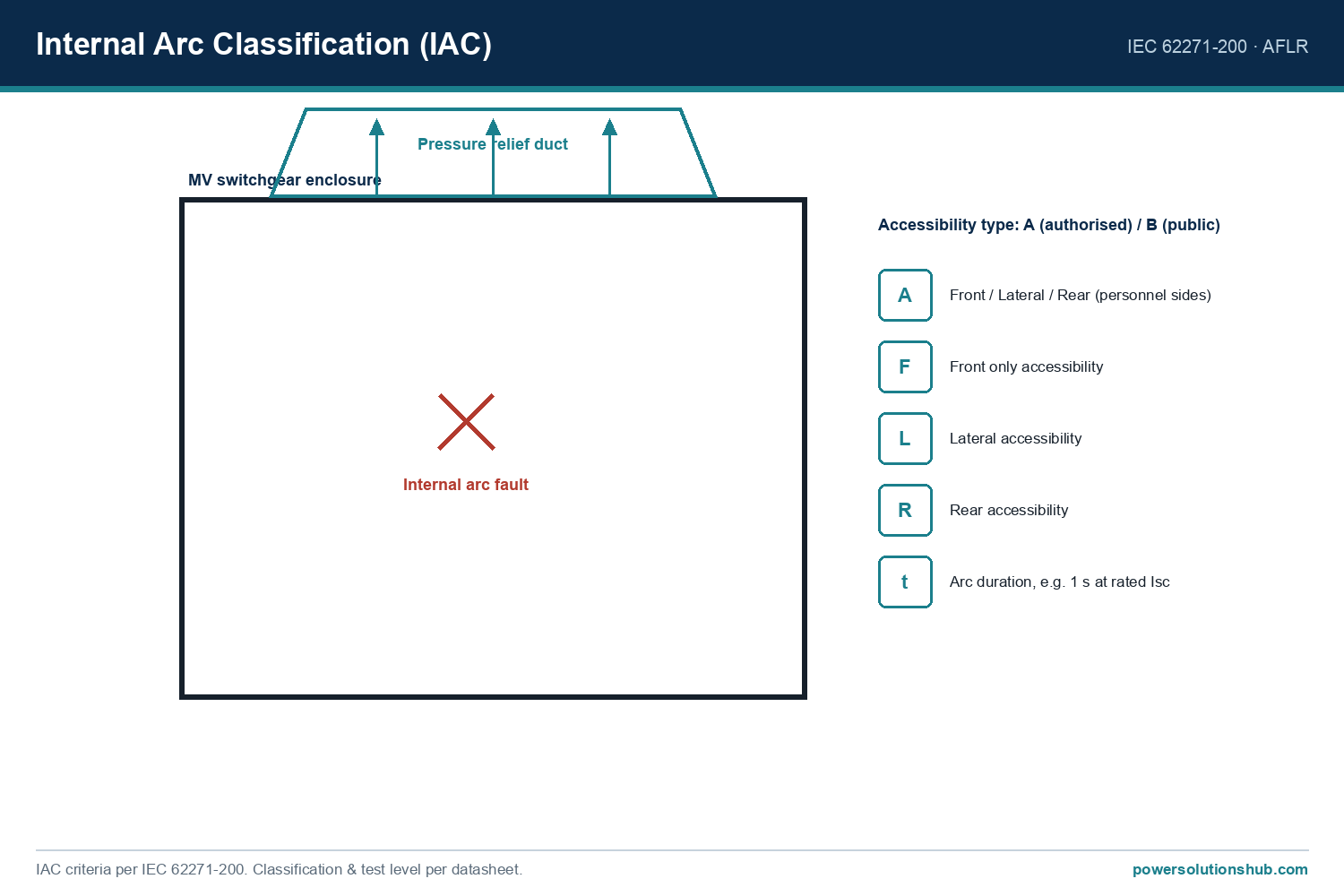
MV switchgear is classified to IEC 62271-200 using three key parameters — the same parameters that appear on every reputable datasheet:
- Internal Arc Classification (IAC): accessibility during an internal-arc fault, given as accessibility type A (authorised personnel) or B (public) and the accessible sides F (front), L (lateral) and R (rear), together with the tested arc current and duration (for example AFLR 20 kA, 1 s).
- Loss of Service Continuity (LSC): how much of the switchgear must be shut down to work on one part — LSC1 (all in one compartment), LSC2A (switching devices accessible with busbars live), LSC2B (both cable and busbar compartments can stay live while working on the device compartment).
- Partition class: PM (metal partitions) or PI (insulating partitions).
Reading a switchgear datasheet
Put together, a datasheet line such as “24 kV, 630 A, 25 kA 1 s, IAC AFLR 25 kA 1 s, LSC2B, PM” tells you: the panel is rated 24 kV and 630 A; it withstands a 25 kA short-circuit for 1 s; in an internal arc it is tested to 25 kA for 1 s with the front, lateral and rear sides protected for authorised personnel; both cable and busbar compartments can stay energised while working on the switching-device compartment (LSC2B); and the partitions between compartments are earthed metal (PM). Learning to read this line is the single most useful skill when comparing offers from different manufacturers.
Typical technical specifications
Typical MV switchgear ratings across the 12–40.5 kV range are:
| Parameter | Typical range |
|---|---|
| Rated voltage Ur | 12 / 24 / 36 kV (up to 40.5 kV) |
| Rated normal current | 630 A (up to ~4000 A on primary metal-clad) |
| Short-circuit breaking capacity | 16 / 20 / 25 kA (up to ~63 kA on primary) |
| Internal-arc withstand | e.g. 16–25 kA for 1 s |
| Standard | IEC 62271-200 |
Air-insulated switchgear needs larger clearances (for 36 kV systems the minimum busbar air clearance is typically 35–36 cm), whereas gas-insulated switchgear achieves the same insulation level in a much smaller volume thanks to the high dielectric strength of the gas.
SF6-free switchgear — the regulatory shift
For decades SF6 was the standard gas for compact MV switchgear, but it is a potent greenhouse gas (GWP roughly 23,000 times CO₂) now restricted by regulations such as the EU F-gas Regulation (EU 2024/573). The market response is SF6-free equipment that keeps the compact, sealed concept using dry / clean air with vacuum interruption — for example ABB SafeRing/SafePlus Air and Schneider SM AirSeT — with a global warming potential of 0 and comparable ratings. When specifying new switchgear, it is worth checking whether the project or utility mandates SF6-free equipment; the gas-insulated switchgear pillar covers the SF6-free options in detail.
Design and safety features
Quality MV switchgear from manufacturers such as ABB, Schneider, Siemens and others integrates: mechanical interlocks to prevent mis-operation; visible isolation and earthing; pressure-relief for internal-arc faults; integrated protection relays with IEC 61850 communication; a modular design for extending the line-up; and conformal coating on electronics for harsh environments. Together these ensure personnel safety, equipment protection and high reliability.
Applications
MV switchgear is used in primary and secondary distribution substations, industrial plants and factories, renewable energy plants (wind and solar), commercial buildings and infrastructure, and mining and oil & gas facilities. The choice between air- and gas-insulated switchgear depends on available space, maintenance strategy, environmental conditions and total cost of ownership.
Standards
Internationally, MV switchgear is designed and tested to the IEC 62271 series. The key parts are:
| Standard | Scope |
|---|---|
| IEC 62271-1 | Common specifications for high-voltage switchgear and controlgear |
| IEC 62271-100 | Alternating-current circuit-breakers |
| IEC 62271-102 | Disconnectors and earthing switches |
| IEC 62271-103 | Switches for above 1 kV up to 52 kV |
| IEC 62271-105 | Switch-fuse combinations |
| IEC 62271-200 | AC metal-enclosed switchgear and controlgear (1 kV–52 kV) |
| IEC 62271-202 | High-voltage/low-voltage prefabricated (compact) substations |
Individual markets add national specifications (for example TEDAŞ technical specifications in Türkiye), but the IEC 62271 series is the common global baseline. Selecting the right type, the correct classification (LSC and IAC) and a reputable manufacturer ensures long-term reliability, personnel safety and operational efficiency.
Related engineering guides
For related topics, see our guides on what a transformer is, short-circuit and transformer calculation, parallel operation of transformers, hermetically sealed / oil-type transformers, and mobile substations.
What is medium voltage switchgear?
MV switchgear is the assembly of switching, protection, control and measurement equipment used to distribute power above 1 kV up to about 40.5 kV, built as metal-enclosed or metal-clad panels to IEC 62271-200.
What is the difference between AIS and GIS?
AIS insulates the live parts with air and needs a larger, clean, dry room but is lower cost and serviceable; GIS encloses the live parts in a sealed gas tank, so it is compact, sealed-for-life and tolerant of humidity and pollution, at a higher capital cost.
Is a ring main unit the same as GIS?
Not exactly. “Ring main unit” describes the construction/role (compact secondary-distribution switchgear with ring switches and a transformer feeder), while “GIS” describes the insulation (sealed gas). Most RMUs are gas-insulated, but the two terms describe different things.
What is the difference between primary and secondary switchgear?
Primary switchgear sits at the incoming substation with high busbar currents (often metal-clad, withdrawable AIS up to ~4000 A), while secondary switchgear sits deeper in the network at compact MV/LV substations (usually ring main units, 400–630 A).
What do LSC and IAC mean on a switchgear datasheet?
LSC (Loss of Service Continuity) states how much must be shut down to work on one part (LSC1, LSC2A, LSC2B); IAC (Internal Arc Classification) states the accessibility and the tested arc current and duration during an internal-arc fault (e.g. AFLR 20 kA, 1 s).
Which standard governs MV switchgear?
The governing international standard is IEC 62271-200 (AC metal-enclosed switchgear for rated voltages above 1 kV up to 52 kV), supported by other parts of the IEC 62271 series and national specifications where they apply.
Is SF6-free MV switchgear available?
Yes. SF6-free families use dry/clean air with vacuum interruption (e.g. ABB SafeRing Air, Schneider SM AirSeT) to deliver the same compact, sealed performance with a global warming potential of 0, in line with regulations such as the EU F-gas Regulation.
Looking for MV Switchgear?
Looking for high-quality medium voltage switchgear — air-insulated, gas-insulated, metal-clad or ring main units — from leading brands? We provide expert engineering support and reliable products for all your medium voltage needs.
For quotations and requests: info@electricistanbul.com
WhatsApp: +90 501 076 69 91
[…] Air is an air-insulated, SF6-free medium-voltage switchgear from ABB built for secondary power distribution up to 24 kV, 1250 A, and 25 kA, replacing sulfur […]
[…] also our guides on medium voltage switchgear, gas-insulated switchgear and ring main […]
[…] conditioned power to every device. This is exactly the kind of resilient distribution and medium-voltage switchgear thinking used upstream in substations — only scaled down to a single cabinet. The same discipline […]
[…] Safeplus RMU switchgear refers to ABB’s SafePlus 36 platform — a sealed, gas-insulated medium-voltage switchgear built on the same secondary-distribution architecture as ABB SafeRing, but engineered for higher […]