
Metal-clad switchgear is a construction class of medium-voltage switchgear defined by IEC 62271-200, in which the main components — the withdrawable circuit breaker, the busbars and the cable connections — sit in separate compartments divided by earthed metal partitions, with the breaker mounted on a withdrawable (draw-out) truck. It is the standard format for primary distribution switchgear, and it is almost always air-insulated.
This pillar guide explains what “metal-clad” means, the withdrawable architecture and its service positions, the loss-of-service-continuity and partition classes, the main product families we supply, the key ratings, and how to select a panel — for MV distribution and industrial projects across the Middle East and Gulf (including Egypt and Saudi Arabia), as well as North Africa, CIS and Sub-Saharan Africa.
What “metal-clad” means
Metal-clad is a construction format, not an insulation medium — a distinction that matters (see the medium voltage switchgear pillar for the full insulation-vs-construction picture). A metal-clad panel is characterised by three things:
- Separate, earthed metal compartments for the busbar, the circuit breaker and the cables, so a fault or maintenance in one compartment is contained and does not expose the others.
- A withdrawable circuit breaker on a truck that can be racked in and out.
- Metal partitions (PM) between compartments that are earthed, giving a high level of operator safety.
This is distinct from a simpler metal-enclosed cubicle (where the parts are in one enclosure) and from a compact, sealed ring main unit. Metal-clad is the format chosen where high busbar current, high fault levels and maximum continuity of supply are required — typically the incoming substation of a large facility.
The withdrawable architecture
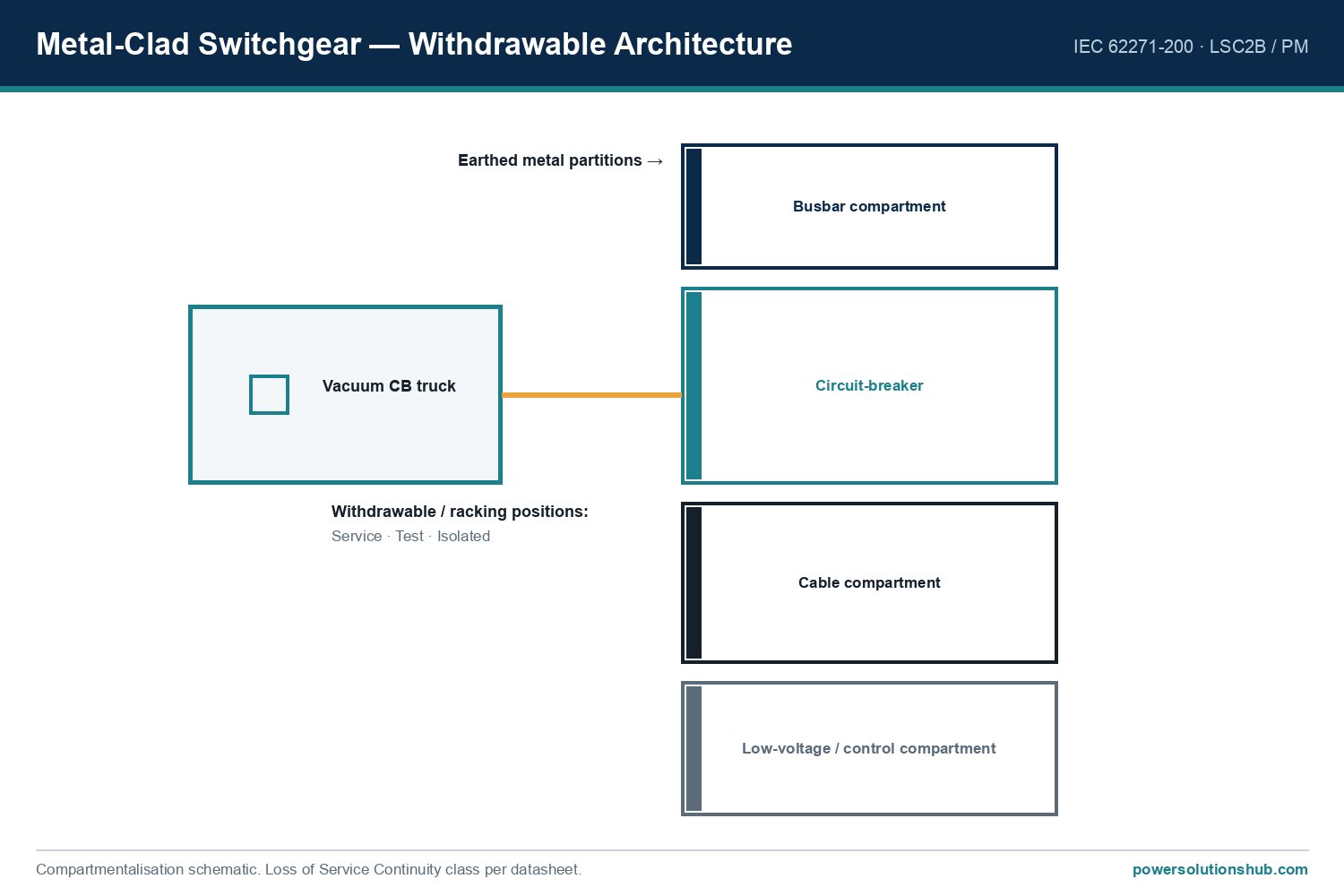
The defining feature of metal-clad switchgear is the withdrawable (draw-out) circuit breaker. The breaker sits on a truck that can be moved between three positions:
- Service — the breaker is fully engaged with the main and earthing contacts; the circuit is live and operational.
- Test — the breaker is disconnected from the main circuit but its control circuits are still connected, so it can be operated and tested safely without energising the primary circuit.
- Isolated / withdrawn — the breaker is fully disconnected and can be racked out and removed for maintenance or replacement, while the busbar and cable compartments remain in their state.
This is what gives metal-clad its continuity of supply advantage: a faulty breaker can be swapped for a spare in minutes without shutting down the whole board. Automatic shutters cover the live contacts when the breaker is withdrawn, maintaining the earthed-barrier safety.
Inside a metal-clad panel: the four compartments
The compartmented construction is what defines metal-clad, so it is worth seeing what each compartment does:
- Busbar compartment — carries the main three-phase busbars that run along the switchboard connecting all the panels. Isolated behind an earthed metal partition, it can stay energised while work is done on the breaker.
- Circuit-breaker compartment — houses the withdrawable breaker truck. This is the compartment that is opened for maintenance; the automatic shutters close over the live busbar and cable contacts as the truck is withdrawn.
- Cable compartment — where the MV power cables terminate, often with the current transformers and earthing switch. Separated from the breaker so cables can be worked on safely.
- Low-voltage (control) compartment — carries the protection relay, metering, control wiring and communications, physically separated from all the MV compartments.
Because these four zones are individually enclosed in earthed metal, a fault or an operator action in one compartment cannot propagate to the others — the safety principle at the heart of metal-clad design.
Vacuum circuit breakers and arc-resistant design
The switching device in a modern metal-clad panel is a withdrawable vacuum circuit breaker: the arc is interrupted in a sealed vacuum interrupter, which is compact, maintenance-light and has a long electrical life. The breaker truck’s racking mechanism, interlocks and shutters are all engineered so that the breaker can only be moved between service, test and isolated positions in a safe sequence — for example, it cannot be racked in or out while closed.
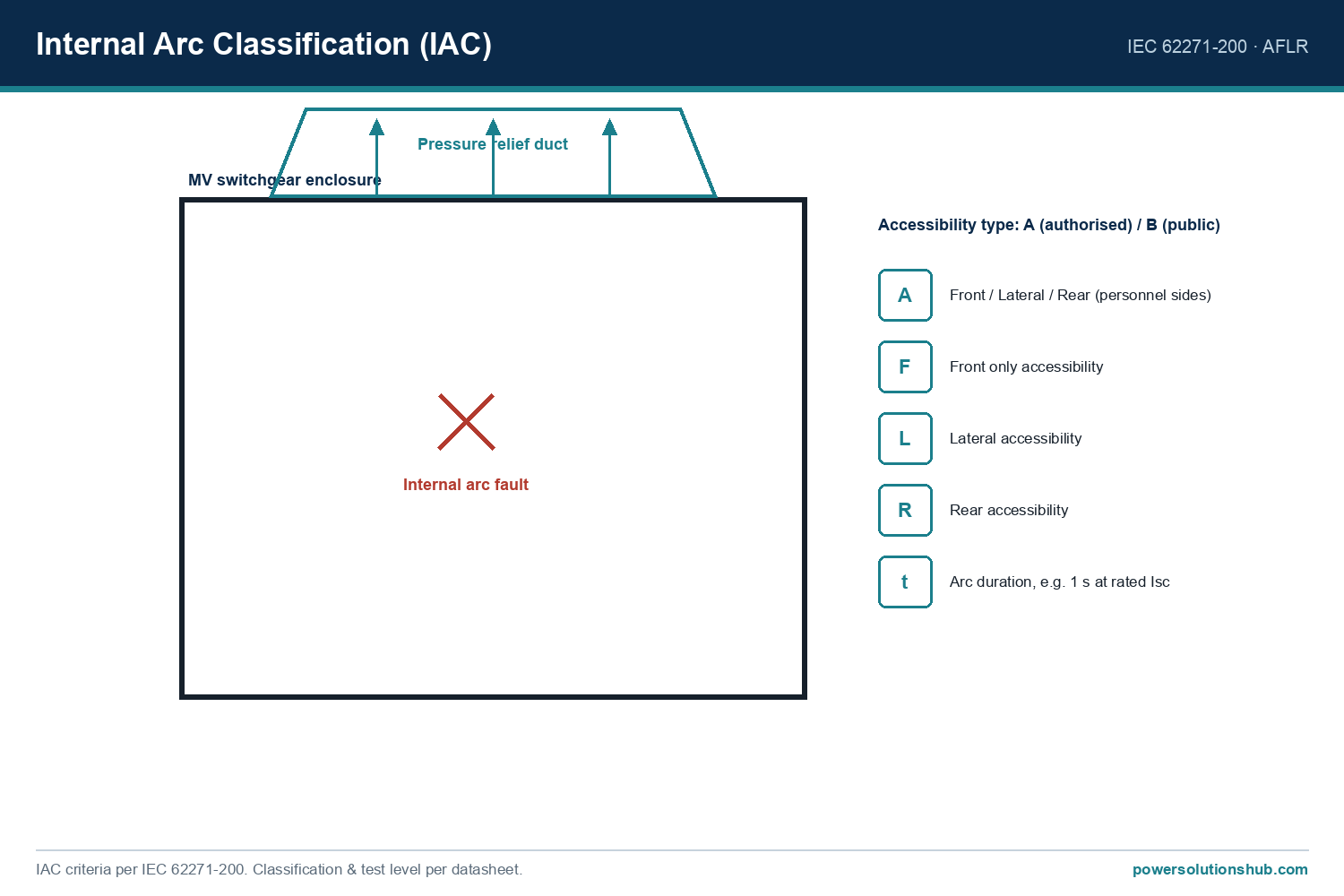
Metal-clad panels are also designed to be arc-resistant: if an internal arc fault occurs, the earthed compartments contain it and a pressure-relief path vents the hot gases safely away from the operator, as verified by the Internal Arc Classification (see below). This combination — compartmentalisation, withdrawable vacuum breaker and arc-resistant construction — is why metal-clad is specified where both high performance and operator safety are paramount.
Classification: LSC and partition class
Metal-clad panels are classified to IEC 62271-200 by how much stays in service during maintenance and by the type of partitions:
- Loss of Service Continuity — LSC2B: both the cable and busbar compartments can remain energised while working on the circuit-breaker compartment. This is the highest continuity class and the norm for metal-clad.
- Partition class — PM: the partitions between compartments are metal (earthed), as opposed to insulating partitions (PI). Metal partitions give the highest operator safety.
- Internal Arc Classification (IAC): metal-clad panels are internal-arc tested — for example ABB UniGear ZS1 and Schneider F400 carry IAC AFLR ratings, with F400 classified to withstand internal arcing as AFLR up to 31.5 kA for 1 s.
Metal-clad product families
The metal-clad families we most often supply:
| Family | Rated voltage | Rated current | Short-circuit | Notes |
|---|---|---|---|---|
| ABB UniGear ZS1 | up to 24 kV | up to 4000 A | up to 63 kA (12–17.5 kV) | Air-insulated metal-clad; LSC2B, PM; withdrawable |
| ABB UniGear ZS2 | up to 24 kV | high current | high | Metal-clad for demanding duties |
| Siemens NXAIR | 12 / 17.5 / 24 / 36 kV | high current | high | Air-insulated metal-clad, withdrawable vacuum CB |
| Schneider MCSet | up to 36 kV | high current | high | Air-insulated metal-clad |
| Schneider F400 | up to 36 / 40.5 kV | up to 2500 A | — | LSC2B, IAC AFLR up to 31.5 kA 1 s |
Metal-clad vs metal-enclosed vs RMU
| Criterion | Metal-clad | Metal-enclosed cubicle | Ring main unit (RMU) |
|---|---|---|---|
| Compartments | Separate, earthed metal | Fewer / shared | Single sealed tank |
| Circuit breaker | Withdrawable | Often fixed | Fixed / switch-fuse |
| Continuity (LSC) | LSC2B (highest) | LSC1 / LSC2A | Compact, sealed |
| Typical current | up to ~4000 A | moderate | 400–630 A |
| Typical level | Primary distribution | Secondary / primary | Secondary distribution |
For the compact, sealed alternative used deeper in the network, see the ring main unit pillar; for the gas-insulated option, see gas-insulated switchgear.
Key ratings to specify
Confirm these against the manufacturer’s datasheet for your configuration:
| Parameter | Typical metal-clad range |
|---|---|
| Rated voltage Ur | 12 / 17.5 / 24 / 36 kV (up to 40.5 kV) |
| Rated normal current | up to 4000 A (busbar) |
| Short-circuit breaking capacity | up to 63 kA |
| Internal-arc withstand | AFLR up to 31.5 kA for 1 s (family-dependent) |
| Construction | Withdrawable, LSC2B, PM |
| Standard | IEC 62271-200 |
How to choose
- Network level and current. Metal-clad suits primary distribution with high busbar currents (up to ~4000 A) and high fault levels; for secondary distribution use an RMU.
- Continuity of supply. If a faulty breaker must be replaced without shutting the board, the withdrawable LSC2B format is the answer.
- Voltage and fault level. Match the rated voltage (up to 40.5 kV) and the short-circuit rating (up to 63 kA) to the network.
- Internal-arc safety. Confirm the IAC class and accessibility (A/B, F/L/R) required by the installation.
- Insulation. Metal-clad is air-insulated; if a sealed, compact, humidity-tolerant panel is needed, consider gas-insulated switchgear instead.
Standards
Metal-clad switchgear is governed by IEC 62271-200 (AC metal-enclosed switchgear and controlgear for rated voltages above 1 kV up to 52 kV), which defines the metal-clad construction, the LSC categories, the partition classes (PM/PI) and the internal-arc classification (IAC). The withdrawable circuit breakers follow IEC 62271-100.
Digital and condition-monitored metal-clad
Modern metal-clad switchgear is increasingly a digital platform. The low-voltage compartment carries numerical protection relays with IEC 61850 communication, so the whole switchboard can be integrated into a substation-automation system with fast GOOSE interlocking, metering and event recording. Beyond protection, condition-monitoring options — temperature sensors on the busbar joints and cable connections, partial-discharge monitoring, and circuit-breaker operation counters — let operators move from fixed-interval maintenance to condition-based maintenance, catching a developing hot joint or insulation problem before it becomes a fault. For a critical primary substation, this monitoring capability is often specified alongside the raw electrical ratings.
Selecting metal-clad for hot and demanding climates
For Gulf, North-African and CIS projects, three points deserve attention when specifying metal-clad. First, temperature derating: the rated busbar current must be derated for high ambient temperatures, so a 4000 A busbar may be limited below its nameplate value in a hot switch room — confirm the derating before fixing the rating. Second, environment: because AIS relies on air clearances, the switch room must be kept clean, dry and dust-free (filtered ventilation or air-conditioning), otherwise pollution can degrade the insulation; where that environment is hard to guarantee, a sealed gas-insulated alternative may be better. Third, continuity: in facilities where an unplanned outage is very costly, the withdrawable LSC2B format pays for itself by allowing a breaker to be replaced without shutting the board.
Applications
Metal-clad switchgear is used at the primary distribution level: the incoming substations of industrial plants, power stations, large commercial and infrastructure projects, mining, and oil & gas facilities — anywhere high busbar current, high fault level and maximum continuity of supply are required. Its withdrawable design also simplifies maintenance over a long service life.
Extending and modernising a switchboard
Metal-clad switchboards are designed to be extended: because the panels share a common busbar behind earthed partitions, additional feeder panels can be added at the end of a line-up as a facility grows, subject to the busbar rating and the physical space. Existing boards can also be modernised — the withdrawable breaker trucks can be replaced with new vacuum breakers, and the low-voltage compartment’s electromechanical relays upgraded to numerical protection relays with IEC 61850 communication, extending the switchboard’s service life without replacing the whole installation. When specifying a new board, it is worth confirming the manufacturer’s extension and retrofit options up front, especially for a site that expects to grow.
What is metal-clad switchgear?
It is a construction class of MV switchgear to IEC 62271-200 with separate earthed metal compartments for the busbar, withdrawable circuit breaker and cables — the standard format for high-current primary distribution.
What is the difference between metal-clad and metal-enclosed switchgear?
Metal-clad has separate, earthed metal compartments and a withdrawable breaker (LSC2B, PM), giving the highest continuity and safety; metal-enclosed is a simpler cubicle with fewer compartments and often a fixed breaker.
Is metal-clad switchgear air-insulated or gas-insulated?
Metal-clad describes the construction (compartments, withdrawable breaker), and it is almost always air-insulated; the gas-insulated alternative is a sealed tank design — see the gas-insulated switchgear guide.
What do the service, test and isolated positions mean?
They are the three positions of the withdrawable breaker truck: service (fully engaged and live), test (control circuits connected but primary disconnected), and isolated (fully withdrawn for maintenance).
What is LSC2B?
Loss of Service Continuity class 2B means both the cable and busbar compartments can stay energised while working on the circuit-breaker compartment — the highest continuity class, typical of metal-clad switchgear.
What voltage and current does metal-clad switchgear cover?
Typical metal-clad panels cover 12 to 36 kV (up to 40.5 kV) with busbar currents up to about 4000 A and short-circuit ratings up to 63 kA.
Is metal-clad switchgear arc-resistant?
Yes — metal-clad panels are internal-arc tested to IEC 62271-200 (IAC), with earthed compartments and a pressure-relief path that contain an internal arc and vent the hot gases safely away from the operator; for example Schneider F400 is classified AFLR up to 31.5 kA for 1 s.
Can a metal-clad switchboard be extended?
Yes — because the panels share a common busbar, additional feeder panels can be added at the end of the line-up as a facility grows, subject to the busbar rating and available space, and the breakers and relays can be modernised over the board’s life.
Looking for Metal-Clad Switchgear?
Looking for high-quality metal-clad medium voltage switchgear — withdrawable, LSC2B primary distribution panels from leading brands? We provide expert engineering support and reliable products for all your medium voltage needs.
For quotations and requests: info@electricistanbul.com
WhatsApp: +90 501 076 69 91
[…] See also our guides on medium voltage switchgear, gas-insulated switchgear and metal-clad switchgear. […]