
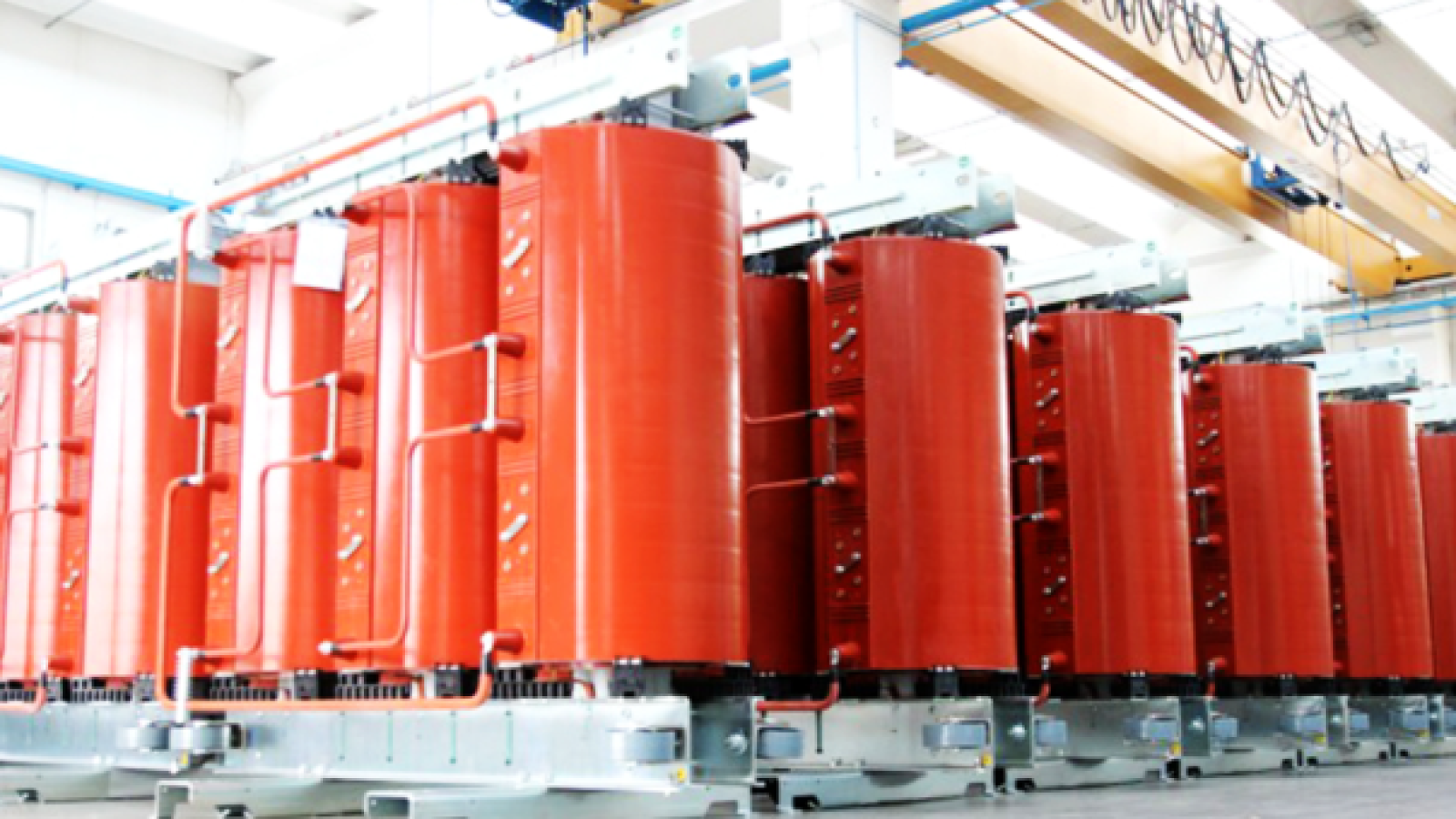
A dry type transformer is a medium voltage power transformer that insulates its windings with solid epoxy cast resin instead of mineral oil, relying on ambient or fan-assisted air for cooling rather than liquid dielectric. Because it carries no flammable insulating fluid, it is the reference technology for indoor substations where fire safety, personnel protection, and low maintenance outweigh the marginal cost premium over oil-filled units. This hub article walks through construction, cooling and insulation classes, sizing logic, applicable IEC and national standards, typical applications, and a side-by-side comparison with oil type transformers, so that procurement and design engineers across the Middle East and Gulf region including Egypt and Saudi Arabia, North Africa, CIS countries, and Sub-Saharan Africa can specify the correct unit with confidence.
What Is a Dry Type Transformer? Definition and Core Principle
In a dry type transformer — also called a cast resin dry type transformer or dry type power transformer — the high voltage windings are cast under vacuum in epoxy resin, forming a solid, void-free insulation block around the conductor. This vacuum-casting process gives the winding excellent dielectric strength, mechanical robustness, and resistance to moisture and chemical attack, without any need for oil-filled tanks, gaskets, or bushings that could leak.
The low voltage winding is produced either with the same cast-resin technique or with prepreg (pre-impregnated) insulation technology, depending on the manufacturer’s design. Unlike oil type units, the windings are not enclosed inside a sealed tank; they remain open to the surrounding atmosphere. This open construction allows straightforward visual inspection of the winding surface during maintenance and also improves natural heat dissipation because the resin block is in direct contact with the cooling air stream.
Dry Type vs Oil Type Transformer: Key Differences
Power transformers are broadly split into two families: oil type transformers and dry type transformers. Oil type units use mineral oil as both the dielectric insulation medium and the cooling fluid. Oil cooling performs very well outdoors and can support compact designs, but the flammable nature of mineral oil introduces an inherent risk of fire and explosion in the event of an internal fault, and any oil leak carries environmental contamination risk.
Dry type transformers eliminate this fluid entirely. Because there is no oil to leak, ignite, or contaminate soil and groundwater, the fire and explosion hazard associated with liquid-filled units is designed out of the equation. The trade-off is manufacturing cost: cast resin dry type transformers are generally more expensive to produce than equivalent oil-filled units, but this premium is routinely justified wherever the installation is indoors and shares space with people — hospitals, schools, commercial towers, and transport infrastructure.
Comparison Table: Dry Type vs Oil Type Transformer
| Criterion | Dry Type Transformer | Oil Type Transformer |
|---|---|---|
| Insulation medium | Epoxy cast resin (HV); resin or prepreg (LV) | Mineral oil |
| Cooling medium | Air (natural or forced) | Mineral oil (natural or forced circulation) |
| Fire/explosion risk | Self-extinguishing, flame-retardant design | Present, due to flammable oil |
| Leakage / environmental risk | None (no oil) | Oil leak can cause environmental pollution |
| Typical location | Indoor: hospitals, schools, malls, metro, data centers, high-rise, airports | Predominantly outdoor |
| Maintenance | Low, open windings allow visual inspection | Periodic oil sampling/testing needed |
| Relative manufacturing cost | Higher | Lower |
Cooling System: AN and AF Configurations
Dry type transformers rely exclusively on air rather than any liquid medium for cooling, and two configurations are standardized in practice:
- AN (Air Natural): heat is removed purely by natural convection around the resin-cast windings, with no mechanical assistance.
- AF (Air Forced): fans mounted at the bottom of the transformer actively push air through the winding ducts, increasing the thermal transfer rate.
Switching from AN to AF mode is not just a cooling upgrade — it is a genuine capacity boost. When the fans are activated, the same transformer can accept up to 40% additional load compared with its natural-cooling rating. This AN/AF flexibility lets a single physical unit cover two nameplate ratings, which is valuable where a facility’s load profile is expected to grow after commissioning.
Fan activation is not manual — temperature sensors embedded directly in the windings continuously track winding hot-spot temperature and automatically trigger the fans through a relay control system whenever a threshold is reached. This closed-loop thermal management protects the resin insulation from thermal aging while ensuring fans only run when genuinely needed, saving auxiliary power and extending fan service life.
Enclosure and Protection (IP) Ratings
The as-manufactured protection class for a standard cast resin dry type transformer is IP00, meaning the winding assembly itself has no built-in ingress protection and is intended to sit inside a switchgear room or dedicated enclosure. Where the installation is outdoors, or the indoor environment is humid or dusty, the transformer must be fitted inside a protective enclosure rated IP21, IP23, or IP31 to keep out solid objects and dripping/spraying moisture. Selecting the correct enclosure rating is as important as selecting the transformer itself — an IP00 unit placed in an unprotected outdoor yard will fail prematurely regardless of its electrical design margins.
Insulation Classes and IEC 60076-11 Environmental Categories
Cast resin dry type transformers are built with either F class insulation, rated for a maximum operating temperature of 155°C, or the higher-performance H class insulation, rated for 180°C. The choice between F and H class affects both the thermal aging margin of the winding and, in some designs, the achievable overload headroom.
Beyond thermal class, IEC 60076-11 defines three separate classification axes for dry type transformers: environmental class, climatic class, and fire behavior class. The most commonly specified combination in the field is E2–C2–F1.
Environmental Class (E)
| Class | Meaning |
|---|---|
| E0 | Operates in a clean, dry room; pollution ignored, no condensation. |
| E1 | Operates in an environment with low condensation and pollution. |
| E2 | May be exposed to both condensation and high pollution. |
Climatic Class (C)
| Class | Meaning |
|---|---|
| C1 | Cannot be energized below -5°C; can only be transported and stored down to -25°C. |
| C2 | Can be energized, transported, and stored down to -25°C. |
Fire Resistance Class (F)
| Class | Meaning |
|---|---|
| F0 | Probability of fire is not at the expected level; no condition for limiting the hazard. |
| F1 | Exposed to fire possibility; reduced flammability is mandatory, and any fire must self-extinguish within a specified time. |
For projects in humid coastal Gulf sites or high-pollution industrial zones, specifying E2 is typically the safe default, while C1 vs C2 should be matched to the actual minimum ambient/storage temperature the unit will experience on site.
Sizing and Power Ratings
Dry type transformers are manufactured across a wide power range, commonly starting at 250 kVA and extending up to 8 MVA. Within that range, the ratings most frequently selected on real projects cluster around 1600 kVA and 2500 kVA, reflecting typical building and industrial feeder loads.
A practical constraint arises when a dry type transformer is to be installed inside a concrete kiosk substation: ventilation and physical space inside the enclosure typically cap the recommended power at 1250 kVA, in line with TEDAŞ (Turkish state distribution) specifications. This is a useful rule of thumb for any project using compact prefabricated kiosk substations, even outside Turkey, since the underlying constraint — restricted air exchange volume — is a physical one rather than a purely regulatory one.
Selection Criteria Checklist
When specifying a dry type transformer for an indoor or semi-outdoor MV/LV substation, the engineer should confirm the following in order:
- Power rating — select within the 250 kVA–8 MVA production range, biasing toward proven 1600/2500 kVA platforms where the load profile fits, or de-rating to 1250 kVA maximum for kiosk installations.
- Cooling mode — decide between AN-only operation or AN/AF dual rating if a 40% future load growth allowance through forced-air cooling is required.
- Insulation thermal class — F class (155°C) for standard duty, or H class (180°C) where higher thermal margin or compact design is preferred.
- Environmental/climatic/fire class per IEC 60076-11 — E2-C2-F1 is the common baseline for humid, polluted, or fire-sensitive installations.
- Enclosure IP rating — IP00 for protected indoor rooms; IP21/IP23/IP31 enclosure required for outdoor or humid conditions.
- Governing technical specification — confirm compliance with the applicable national distribution utility specification and IEC 60076-11.
Applications
Because dry type transformers eliminate the flammable oil hazard, they are the default choice wherever transformers must sit close to people or sensitive equipment: hospitals, schools, shopping malls, metro stations, data centers, high-rise buildings, airports, and general commercial complexes. Across the Middle East and Gulf region including Egypt and Saudi Arabia, North Africa, CIS countries, and Sub-Saharan Africa, this same logic applies to any indoor substation embedded in an occupied building, transit facility, or dense urban plot where fire code compliance and space constraints make oil-filled units impractical.
Standards and Compliance
Internationally, dry type transformers are designed, tested, and classified according to IEC 60076-11, which governs the environmental (E), climatic (C), and fire behavior (F) classification system described above. In Turkey specifically, any dry type transformer supplied for a project that will be handed over to a distribution company must additionally comply with the TEDAŞ-MLZ/99-031.B technical specification. Buyers outside Turkey should verify the equivalent local distribution-utility specification while treating IEC 60076-11 as the common international baseline. Leading global manufacturers such as ABB and Schneider Electric offer dry type transformer lines with published technical datasheets and catalogue documentation that reference this same IEC framework.
Related guides
See also our guides on medium voltage switchgear, gas-insulated switchgear and ring main units.
What is a dry type transformer used for?
A dry type transformer is used for indoor MV/LV power distribution wherever fire safety and human proximity are critical, including hospitals, schools, shopping malls, metro stations, data centers, high-rise buildings, and airports.
How is a dry type transformer different from an oil type transformer?
A dry type transformer insulates and cools its windings with epoxy cast resin and air, eliminating the oil found in oil type transformers and, with it, the associated fire, explosion, and leakage risks — at the cost of a higher manufacturing price.<!– 🔴 iddia: dry type transformers eli
Looking for Dry-Type Transformers?
Looking for high-quality dry-type transformers? We provide expert engineering support and reliable products for all your medium voltage needs.
For quotations and requests: info@electricistanbul.com
WhatsApp: +90 501 076 69 91