
A ring main unit (RMU) is a compact medium-voltage switchgear assembly used to switch and protect secondary distribution networks: it connects a substation into the MV ring, switches the incoming and outgoing ring cables, and protects the MV/LV distribution transformer — typically rated up to 24 kV (families to 40.5 kV).
This pillar guide covers what an RMU does and how it works in a ring network, the main types and brand families, how a unit is configured from functional blocks, the key ratings to specify, and how to select one — for MV distribution projects across the Middle East and Gulf (including Egypt and Saudi Arabia), as well as North Africa, CIS and Sub-Saharan Africa.
What a ring main unit does
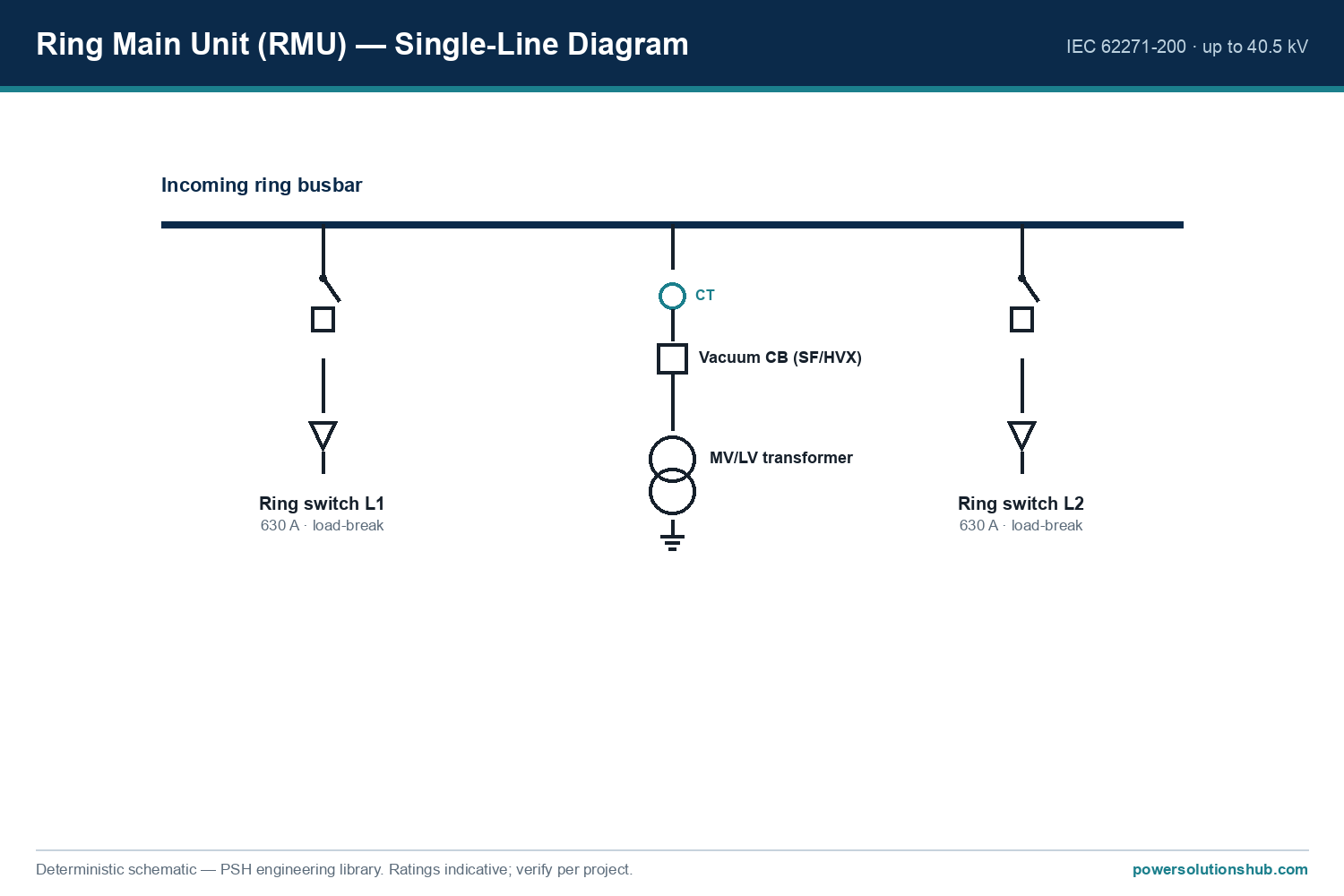
An RMU sits at the secondary distribution level. In a distribution “ring”, each substation is fed from two directions so a fault or maintenance on one section does not cut supply; the RMU provides the two ring load-break switches (incoming and outgoing) plus a transformer feeder that protects the local MV/LV transformer. Combining these functions in one compact, usually sealed enclosure is what distinguishes an RMU from a full primary switchgear line-up.
It links up to the wider medium-voltage switchgear family: where primary switchgear feeds large loads, the RMU is the workhorse of compact secondary substations and kiosks.
How an RMU works in a ring network
Secondary distribution is usually built as an open ring. Substations are connected in a loop that runs from one primary source, through a string of distribution substations, back to another source — but the ring is deliberately left open at one point (a normally-open switch) so it operates radially. Each substation’s RMU carries two ring load-break switches, one for each direction of the ring cable.
The value of this arrangement is continuity of supply. If a cable section faults or needs maintenance, the operator opens the load-break switches on either side of that section to isolate it, then closes the normally-open point to feed the affected substations from the other direction. Supply is restored to almost all customers within minutes, without waiting for the cable repair. The RMU is the device that makes this switching possible at every node of the ring, which is why it is the standard building block of urban and industrial MV distribution.
The third function at each node is the transformer feeder: a tee-off from the ring that protects and supplies the local MV/LV distribution transformer, either through a switch-fuse combination or a circuit breaker with a protection relay (see below).
RMU types
RMUs are distinguished mainly by insulation medium and transformer-protection method:
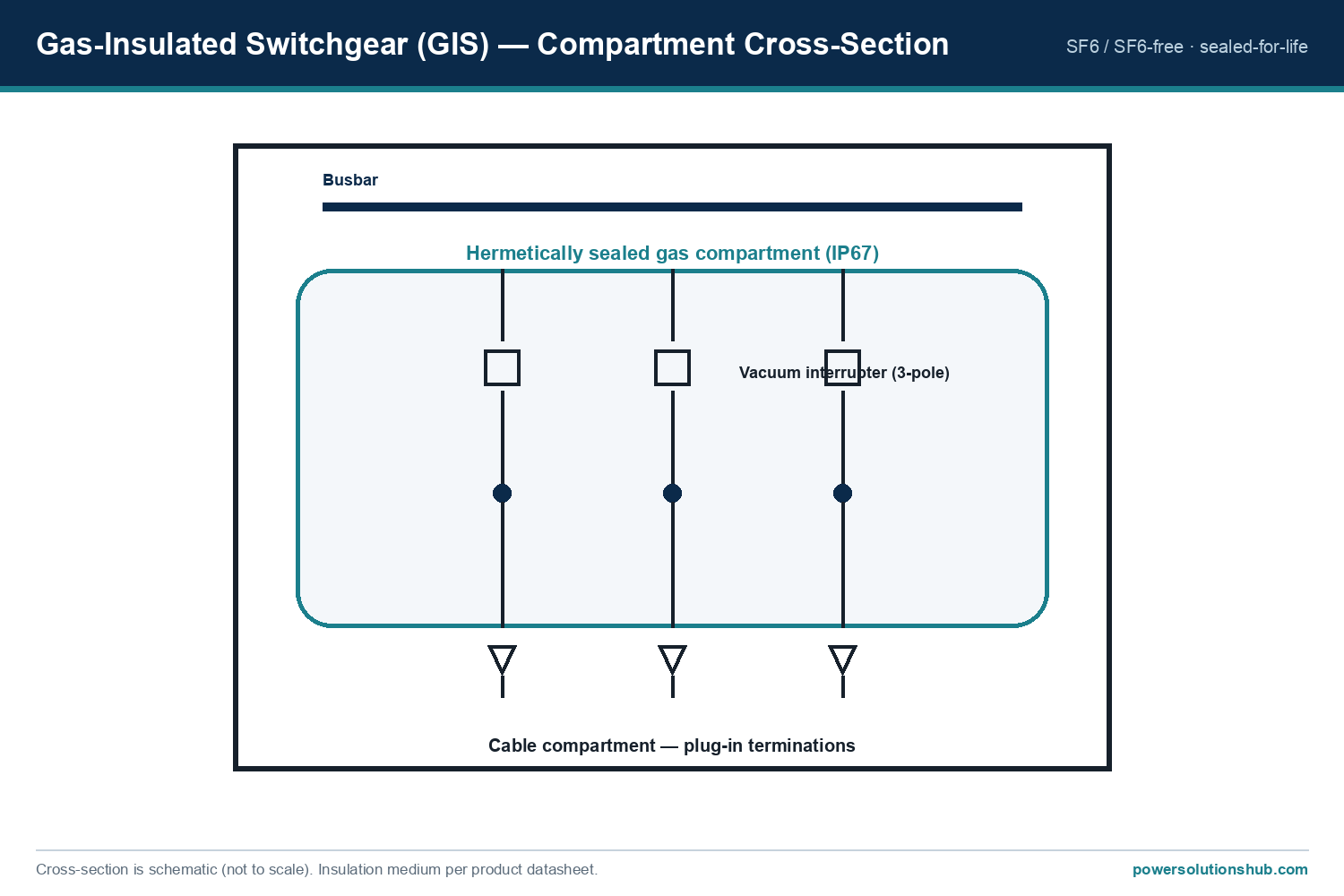
- Gas-insulated RMUs: the live parts sit in a sealed SF6 (or SF6-free) tank — compact and maintenance-free for life. Examples: Schneider RM6, ABB SafeRing / SafePlus and Siemens 8DJH. See the gas-insulated switchgear pillar for the insulation detail.
- SF6-free RMUs: sealed units that use dry/clean air with vacuum interruption instead of SF6 — for example ABB SafeRing/SafePlus Air, a sealed dry-air ring main unit up to 24 kV with a global warming potential of 0 and a vacuum circuit-breaker with disconnector.
- Air-insulated / modular RMUs: modular cubicles such as Schneider SM6 provide the same ring-plus-transformer function in an air-insulated, serviceable format, up to 36 kV.
- Fixed vs extensible: an RMU can be a fixed, factory-set configuration or an extensible unit that can be enlarged on site as the network develops (for example SafeRing’s extendable version, or the RM6’s extensibility codes NE/RE/LE/DE).
How an RMU is configured — functional units
A modern RMU is specified as a string of functional units (modules), so the single-line matches the substation exactly. Using the Schneider RM6 nomenclature as an example, the core functions are:
- I — line (ring) switch: a switch-disconnector for an incoming or outgoing ring cable, rated 400 A or 630 A.
- Q — fuse-switch combination: transformer protection by a switch plus MV fuses, for smaller transformers (up to about 2 000 kVA).
- D / B — circuit-breaker function: transformer or feeder protection by a circuit breaker with a protection relay, for larger transformers (up to about 8 000 kVA).
A typical two-incomer, one-transformer substation is therefore an I-I-Q string (two ring switches plus a fuse-switch transformer feeder), while a substation whose transformer needs relay protection is an I-I-D (two ring switches plus a circuit-breaker feeder). The extensibility code chosen at order time decides whether more modules can be added later without replacing the unit — a double-extensible unit can grow on either side as the network develops. This “build what you need, extend later” approach is a large part of why RMUs dominate secondary distribution.
RMU brand families at a glance
The ring-main-unit families we most often supply:
| Family | Insulation | Rated voltage | Typical current | Notes |
|---|---|---|---|---|
| Schneider RM6 | SF6, sealed-for-life | 12 / 17.5 / 24 kV | 400 / 630 A | Modular I/Q/D/B units; Isc up to 25 kA; extensible |
| ABB SafeRing / SafePlus | SF6, sealed-for-life | 12 / 24 kV (also 36 kV) | up to 630 A | RMU + extensible; fuse-switch or vacuum CB feeder |
| ABB SafeRing / SafePlus Air | Dry air (SF6-free) | up to 24 kV | up to 630 A | GWP = 0; vacuum CB with disconnector |
| Siemens 8DJH | SF6, sealed-for-life | up to 24 kV | up to 630 A | Vacuum CB; internal fault tested up to 21 kA |
| Schneider SM6 | Air-insulated, modular | 12–36 kV | up to 630 A | Serviceable modular cubicles; internal arc 12.5 / 16 / 20 kA 1 s |
RMU vs primary switchgear
| Criterion | Ring main unit (RMU) | Primary switchgear |
|---|---|---|
| Network level | Secondary distribution | Primary distribution |
| Function | Ring switching + transformer protection, combined | Full incomer/feeder/coupler line-up |
| Construction | Compact, often sealed gas tank | Larger, often withdrawable metal-clad |
| Typical current | 400–630 A | up to ~4000 A |
| Maintenance | Sealed-for-life (gas) or serviceable (air) | Serviceable, withdrawable devices |
| Typical use | Compact substations, kiosks, MV rings | Large substations, high-current busbars |
For the full construction/insulation taxonomy, see the medium voltage switchgear pillar.
Transformer protection in an RMU
The transformer feeder is where the protection choice is made, and it is the point most worth getting right:
- Switch-fuse combination (fuse-switch). For smaller distribution transformers — up to about 2 000 kVA — a load-break switch in series with MV fuses is a compact, economical and fast solution. The fuses clear high fault currents very quickly, and the standard governing this device is IEC 62271-105 (AC switch-fuse combinations for above 1 kV up to 52 kV).
- Circuit breaker with a protection relay. For larger transformers — up to about 8 000 kVA — or where adjustable, selective protection and remote control are required, a circuit-breaker feeder with a numerical protection relay is used. This gives full overcurrent and earth-fault protection with settable curves and communications.
Choosing between them is mainly a question of transformer rating, the required selectivity with upstream and downstream devices, and whether remote control and metering are needed. Getting the fuse rating or the relay settings wrong is a common cause of nuisance tripping or, worse, unprotected faults — so the transformer feeder should always be coordinated with the rest of the protection scheme.
Key ratings to specify
Confirm these against the manufacturer’s datasheet for your configuration:
| Parameter | Typical RMU range |
|---|---|
| Rated voltage Ur | 12 / 17.5 / 24 kV (families to 36–40.5 kV) |
| Rated normal (busbar) current | 400 A / 630 A |
| Short-circuit breaking capacity | up to ~25 kA (e.g. RM6 up to 25 kA) |
| Transformer protection | switch-fuse (≤ ~2 000 kVA) or circuit breaker (larger) |
| Insulation | SF6 / SF6-free sealed tank, or air-insulated modular |
| Standards | IEC 62271-200; -105 (switch-fuse); -202 (compact substation) |
Ambient-temperature derating
Rated current derates with ambient temperature — a key point for hot-climate projects. For a 630 A gas-insulated busbar, usable current falls as the ambient rises: for example, from 630 A at 40 °C down to about 575 A at 45 °C, 515 A at 50 °C, 460 A at 55 °C and 425 A at 60 °C. In Gulf and North-African installations where indoor temperatures routinely exceed 45 °C, this derating should be applied before confirming the rated current.
Selection criteria
- Insulation medium: gas-insulated (compact, sealed, harsh-environment), SF6-free sealed, or air-insulated modular (serviceable). See GIS vs AIS.
- Transformer rating → protection type: switch-fuse for smaller transformers (up to about 2 000 kVA), circuit breaker with a relay for larger ratings.
- Rated current: 400 A or 630 A busbars, then apply ambient-temperature derating for hot climates.
- Short-circuit level: confirm the network’s prospective fault current against the RMU’s rated breaking and making capacity.
- Extensibility: fixed or extensible, depending on whether the substation will be enlarged later.
- Regulatory: where SF6-free equipment is mandated, choose a dry-air or air-insulated family with equivalent ratings.
Standards
Ring main units are metal-enclosed switchgear to IEC 62271-200 (above 1 kV up to 52 kV). The transformer-protection switch-fuse combination follows IEC 62271-105, disconnectors and switches follow IEC 62271-102 / -103, circuit-breakers follow IEC 62271-100, and a compact secondary substation enclosure may be type-tested to IEC 62271-202. Sealed gas-insulated RMUs are “sealed-for-life” (sealed pressure system) designs.
Applications
RMUs are used in compact secondary substations, kiosks and building distribution — utilities, industry, infrastructure and renewable connection points — anywhere a compact unit is needed to ring-connect and protect an MV/LV transformer. Because the enclosure is compact and (for gas types) sealed, RMUs are also the natural choice for packaged and prefabricated substations to IEC 62271-202. A concrete example is the Schneider RM6 ring main unit, whose functional-unit range shows how a substation is built as a string of ring switches and transformer feeders.
RMUs in compact and prefabricated substations
One of the most common ways an RMU is deployed is inside a compact (packaged) substation — a factory-built enclosure, kiosk or concrete housing that contains the RMU, the MV/LV distribution transformer and the low-voltage board in one prefabricated unit, type-tested to IEC 62271-202. The RMU is the MV heart of this package: it brings the ring cables in, switches them, and protects the transformer, while the whole assembly is delivered ready to connect on site. Because gas-insulated RMUs are compact and sealed, they let the entire substation shrink to a footprint that fits an urban plot, a basement, an industrial yard or a renewable-plant collection point. For utilities rolling out many identical substations across a network — a frequent pattern in Gulf, North-African and CIS distribution projects — this standardised RMU-plus-transformer package shortens delivery and simplifies maintenance across the fleet.
What is a ring main unit (RMU)?
An RMU is a compact medium-voltage switchgear assembly that connects a substation into the MV ring, switches the incoming and outgoing ring cables and protects the MV/LV distribution transformer, typically up to 24 kV.
How does a ring main unit work?
In an open-ring network each substation is fed from two directions through the RMU’s two ring load-break switches; if one cable section faults, the operator isolates it and restores supply from the other direction, while the transformer feeder protects the local transformer.
What is the difference between an RMU and primary switchgear?
An RMU combines ring switching and transformer protection in one compact (often sealed) unit for secondary distribution, while primary switchgear is a larger line-up of incomer, feeder and coupler panels for high-current primary distribution.
Are ring main units gas-insulated or air-insulated?
Both exist: gas-insulated RMUs (e.g. Schneider RM6, ABB SafeRing/SafePlus, Siemens 8DJH) use a sealed SF6 or SF6-free tank, while air-insulated modular RMUs (e.g. Schneider SM6) provide the same function in a serviceable air-insulated format.
How is the transformer protected in an RMU?
Smaller transformers (up to about 2 000 kVA) are protected by a switch-fuse combination to IEC 62271-105; larger transformers use a circuit breaker with a protection relay for adjustable, selective protection.
What voltage and current are RMUs rated for?
Typical RMUs are rated 12, 17.5 and 24 kV with 400 A or 630 A busbars and short-circuit breaking capacity up to about 25 kA; some families extend to 36–40.5 kV.
Is there an SF6-free ring main unit?
Yes. Dry-air sealed RMUs such as ABB SafeRing/SafePlus Air deliver the same sealed, compact function up to 24 kV with a global warming potential of 0, using vacuum interruption instead of SF6.
Looking for Ring Main Units (RMU)?
Looking for high-quality medium voltage ring main units? We provide expert engineering support and reliable products for all your medium voltage needs.
For quotations and requests: info@electricistanbul.com
WhatsApp: +90 501 076 69 91
[…] switchgear refers to the ABB SafeRing/SafePlus 36 family of gas-insulated, secondary medium-voltage ring main units, built around a sealed stainless-steel SF6 tank that houses all live switching parts to protect […]