
SF6-free switchgear is medium-voltage switching and distribution equipment that achieves insulation and current interruption using a dielectric medium other than sulphur hexafluoride — typically vacuum interruption combined with clean (dry) air, solid/cast-resin insulation, or a fluoronitrile-based gas mixture with a substantially lower global warming potential. This guide is written for MV engineers, procurement teams, and specifiers who need to understand why SF6 is being phased out, how to quantify the environmental trade-off, and how to compare alternative insulating/interrupting media against a real project’s rated current and insulation requirements. It also gives a worked calculation showing how gas-leakage impact is quantified in CO2-equivalent terms. Utilities and industrial buyers across the Middle East and Gulf region (including Egypt and Saudi Arabia), North Africa, the CIS, and Sub-Saharan Africa are increasingly asked by regulators, IFC/EBRD-linked financing conditions, or corporate ESG policy to specify SF6-free MV switchgear on new substation and ring-main-unit projects, making this comparison a practical procurement issue, not just an environmental one.
Why SF6-free matters: the method behind the decision
SF6 has been the default arc-interruption and insulation medium in MV/HV switchgear for decades because of its excellent dielectric strength and arc-quenching behaviour in a compact volume. The driver to move away from it is not performance but climate impact: SF6 is a extremely potent, long-lived greenhouse gas, and leakage from switchgear over its service life (nameplate leakage rate, handling during maintenance, end-of-life disposal) contributes disproportionately to a piece of equipment’s carbon footprint compared with its physical size.
The standard method engineers use to compare the climate impact of a gas-insulated component is a simple mass-times-potency calculation:
CO2-equivalent emission (kg CO2e) = mass of gas released (kg) × Global Warming Potential (GWP, 100-year basis)
This lets a specifier translate “how many kilograms of gas is inside this switchgear” into “how many tonnes of CO2-equivalent does a full-volume leak represent” — a figure that is directly comparable across different insulating media once each medium’s GWP factor is known.
Worked example 1 — quantifying the SF6 leakage impact
Assume a sealed MV switchgear compartment contains a nameplate gas fill of 5 kg of SF6, and SF6’s widely published 100-year GWP factor is approximately 23,500 (a figure derived from IPCC greenhouse-gas assessment work, not a manufacturer rating).
Applying the formula:
CO2e = 5 kg × 23,500 = 117,500 kg CO2e ≈ 117.5 tonnes CO2e
This is the equivalent atmospheric impact of a complete, uncontained release of that single compartment’s gas fill — illustrating why even a “sealed-for-life” design with a very low annual leakage rate still carries a large latent climate liability that has to be managed at end-of-life (recovery, not venting).
Now compare the same 5 kg fill using an illustrative fluoronitrile-based gas mixture with a GWP roughly an order of magnitude lower, say a factor of ~500 for the worked comparison:
CO2e = 5 kg × 500 = 2,500 kg CO2e ≈ 2.5 tonnes CO2e
Even though the mass of gas handled is identical, the CO2-equivalent liability drops by roughly 98% in this illustrative comparison — the arithmetic reason regulators and financiers increasingly favour non-SF6 media, independent of any single vendor’s product figures.
Worked example 2 — rated current still governs the electrical design
Choosing an SF6-free dielectric medium does not change the basic sizing calculation for a feeder. Rated current is still:
I = S / (√3 × V)
For example, for a 1000 kVA distribution transformer feeder at 11 kV:
I = 1000 / (1.732 × 11) ≈ 52.5 A
This is the same calculation used regardless of whether the switchgear panel is SF6, vacuum/clean-air, or vacuum/solid-dielectric insulated — the interrupting medium affects dielectric withstand and arc-quenching design margins, not the load-current arithmetic. Rated short-circuit breaking current, busbar rating, and protection coordination are sized from the network fault-level study in the same way as for any switchgear — see our [medium voltage switchgear](/what-is-mv-switchgear-medium-voltage-switchgear/) hub and [protection relay](/what-is-a-medium-voltage-protection-relay-mv-protection-relay/) guide for the coordination side of that calculation, and our distribution transformer resources for the feeder-sizing side.
Comparison table — SF6-free insulating/interrupting media (qualitative)
| Dielectric/interruption approach | Relative GWP vs SF6 | Relative dielectric strength | Typical MV application note |
|---|---|---|---|
| Vacuum interruption + clean (dry) air insulation | Effectively negligible (air has ~zero GWP) | Lower than SF6 per unit volume; compensated by larger insulation clearances | Common in air-insulated and some GIS-type MV panels; larger footprint than SF6-GIS |
| Vacuum interruption + solid/cast-resin insulation | Effectively negligible | High, achieved via solid dielectric rather than gas pressure | Widely used in cast-resin MV switchgear and RMUs; no gas handling at all |
| Vacuum interruption + fluoronitrile-based gas mixture (with CO2/O2 carrier) | Substantially lower than SF6 (order-of-magnitude reduction, mixture-dependent) | Close to SF6 in mixture form, enabling compact GIS-style enclosures | Positioned as a near-drop-in replacement for compact SF6-GIS designs |
| Vacuum interruption + CO2-based gas mixtures | Very low (CO2 itself has low GWP) | Generally lower than SF6; larger enclosure or higher pressure needed | Emerging option for compact secondary switchgear |
| Conventional SF6-insulated switchgear (reference case) | Reference (very high GWP) | Reference (high dielectric strength, compact volume) | Long-established, being phased down under environmental policy |
Table entries are qualitative and directional; always confirm project-specific dielectric strength, clearance, and pressure figures against the switchgear manufacturer’s type-test certificates, not generic guides.
Selection criteria and common pitfalls
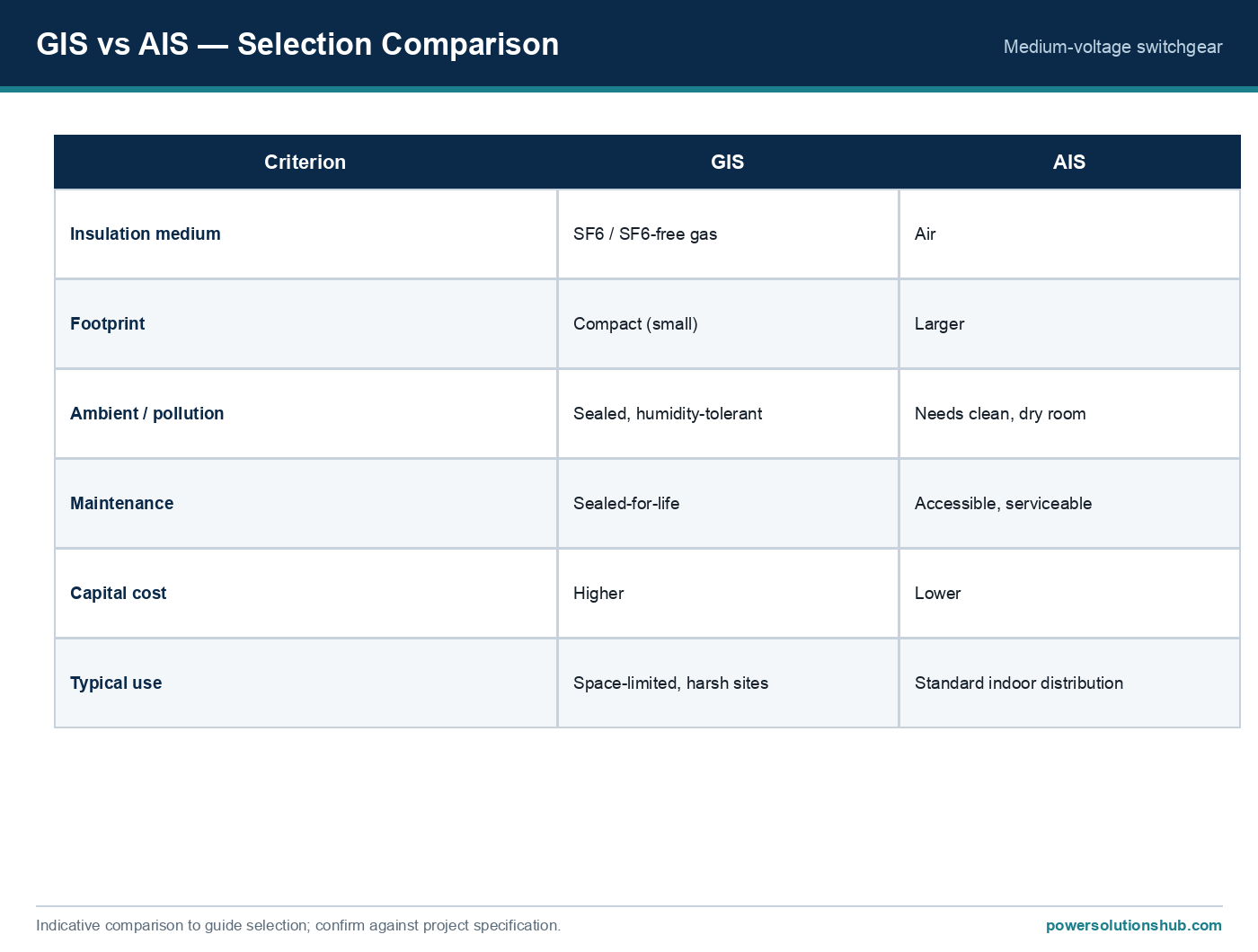
- Match the medium to the enclosure design, not just the label. “SF6-free” covers several distinct technologies (air-insulated vacuum, solid-insulated vacuum, alternative-gas GIS). Confirm which one is being offered and how it affects panel footprint, since air- and solid-insulated designs are typically larger than SF6-GIS at the same voltage class.
- Check gas-handling and end-of-life procedures even for “low-GWP” mixtures. Fluoronitrile- and CO2-based mixtures still require controlled filling, leak-testing, and recovery — they are not zero-impact, only lower-impact.
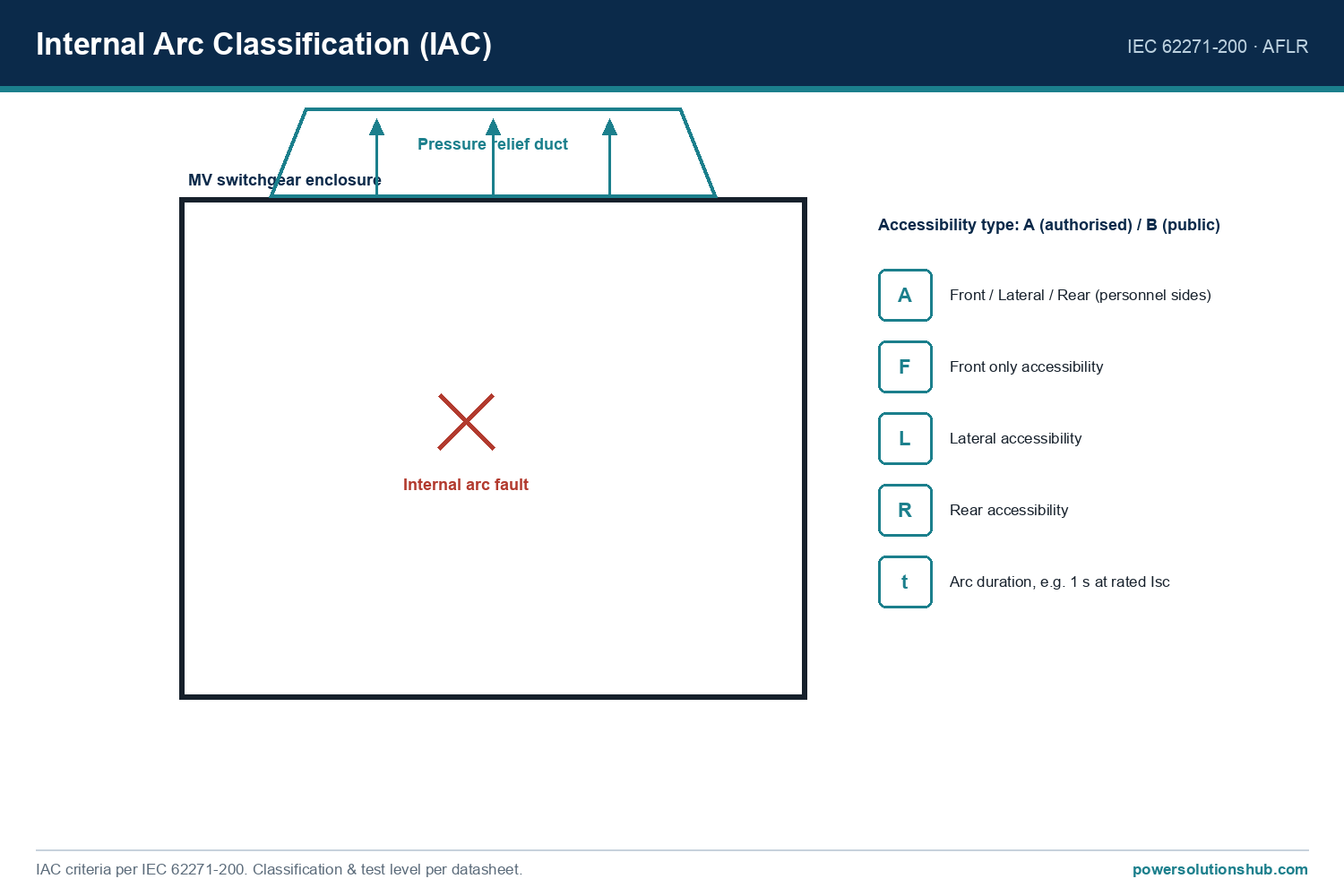
- Verify arc-flash and internal-arc classification (IAC) is tested for the specific medium, not carried over from an SF6 datasheet — arc behaviour differs by dielectric medium and enclosure design.
- Re-check short-circuit withstand and rated current against your fault-level study, exactly as you would for SF6 switchgear — the interruption medium does not change the network calculation, only the equipment design that satisfies it. See our protection relay coordination guide for the fault-current side of this check.
- Confirm operating temperature range and altitude derating — some gas-mixture alternatives have different pressure/temperature behaviour than SF6 and may need enclosure or heater adjustments in hot climates typical of Gulf and North African installations.
- Ask for retrofit/compatibility data if replacing SF6 gear in an existing switchboard — physical interfaces, cable boxes, and busbar connections must still match the installed system.
- Do not assume a lower-GWP gas mixture automatically qualifies as “SF6-free” in a strict sense — some mixtures still contain a small percentage of SF6 or fluorinated components; ask for the exact gas composition if zero-SF6-content is a contractual requirement.
Standards governing SF6-free MV switchgear
Design, testing, and classification of both SF6 and SF6-free MV switchgear sit under the same family of IEC switchgear standards, with a dedicated part addressing gas handling:
- IEC 62271-1 — Common specifications for high-voltage switchgear and controlgear (applies regardless of insulating medium).
- IEC 62271-100 — Alternating-current circuit-breakers, covering rated short-circuit breaking current and interruption performance testing.
- IEC 62271-200 — AC metal-enclosed switchgear and controlgear for rated voltages above 1 kV up to and including 52 kV, including internal-arc classification (IAC) testing.
- IEC 62271-203 — Gas-insulated metal-enclosed switchgear for rated voltages above 52 kV, relevant where alternative-gas GIS is used at higher voltage classes.
- IEC 62271-4 — Handling procedures for SF6 and its alternative gases and gas mixtures, covering filling, recovery, leak-testing, and disposal practice specifically written to cover non-SF6 media.
Where a project specifies “SF6-free,” always ask which of these standards the offered equipment has been type-tested against, since alternative-gas and solid/air-insulated designs must meet the same interruption and IAC performance requirements as SF6 equipment — the standards do not relax performance just because the medium changed.
Related guides
See also our guides on gas-insulated switchgear, ring main units and metal-clad switchgear.
Is SF6-free switchgear as reliable as SF6 switchgear?
Vacuum interruption — the core switching technology in most SF6-free designs — has decades of proven MV service history independent of the surrounding insulating medium, so reliability is primarily a function of design and type-testing quality, not the presence or absence of SF6.
Does SF6-free switchgear need a larger footprint?
Often yes for air- or solid-insulated designs, since air and cast resin have lower dielectric strength per unit volume than SF6, requiring larger clearances; alternative-gas GIS designs can approach SF6-GIS compactness more closely.
Can existing SF6 switchgear be retrofitted with an SF6-free gas mixture?
Some alternative-gas mixtures are designed as near-drop-in replacements for existing SF6-GIS enclosures, but this must be validated against the original type-test data and manufacturer approval — it is not a universal retrofit.
What happens to the gas in SF6-free switchgear at end of life?
Reputable practice still requires controlled recovery rather than venting, even for lower-GWP mixtures, following procedures aligned with IEC 62271-4.
Does rated current or short-circuit rating change with the insulating medium?
No — rated current, rated short-circuit breaking current, and busbar rating are determined by the network’s load and fault-level study exactly as with SF6 switchgear; only the physical design achieving those ratings differs.
Why are financiers and regulators pushing SF6-free specifications now?
Because SF6’s very high GWP means even modest leakage volumes translate into large CO2-equivalent liabilities (as shown in the worked example above), making it a target for climate-policy-linked procurement conditions on new MV projects.
Is SF6-free switchgear more expensive?
It can carry a cost premium today depending on technology and voltage class, but the gap is narrowing as vacuum/air and vacuum/alternative-gas designs scale up in production.
Looking for SF6-free MV switchgear?
Looking for high-quality SF6-free MV switchgear? We provide expert engineering support and reliable products for all your medium voltage needs.
For quotations and requests: info@electricistanbul.com
WhatsApp: +90 501 076 69 91