
Air-insulated switchgear (AIS) is medium-voltage switchgear in which the busbars and main current-carrying parts are insulated by air, rated for systems above 1 kV up to about 40.5 kV and built to IEC 62271-200. It is the most widely used MV switchgear type, spanning compact secondary-distribution cubicles up to large withdrawable primary panels, and — because it uses air — it is inherently SF6-free in its insulation.
This pillar guide explains what air insulation means, how AIS spans the network from secondary cubicles to primary metal-clad, how it compares with gas-insulated switchgear, the product families we supply, the key ratings, the SF6-free picture, and how to select — for MV distribution and industrial projects across the Middle East and Gulf (including Egypt and Saudi Arabia), as well as North Africa, CIS and Sub-Saharan Africa.
What “air-insulated” means
In an air-insulated panel the dielectric between live parts, and between live parts and earth, is air at atmospheric pressure. Because air has a lower dielectric strength than insulating gas, AIS needs larger phase-to-phase and phase-to-earth clearances — for a 36 kV system the minimum busbar air clearance is typically 35–36 cm — which makes an AIS panel physically larger than an equivalent gas-insulated one. In return, AIS is lower in capital cost, easy to inspect visually, straightforward to maintain, and needs no gas handling. The arc interruption itself is normally done by a vacuum interrupter inside the panel; it is the standing insulation that is air.
“Air-insulated” describes the insulation medium, not the construction. An AIS panel can be a simple secondary-distribution cubicle or a fully compartmented, withdrawable metal-clad primary panel — both are air-insulated. See the medium voltage switchgear pillar for the full insulation-vs-construction picture.
AIS across the network
Air insulation is used at every level of MV distribution, in two broad construction formats:
- Secondary-distribution cubicles. Compact, modular, often fixed-mounted air-insulated panels for the many small MV/LV substations — for example Schneider SM6 (12–36 kV modular cubicles) and ABB UniSec (up to 24 kV, 1250 A, 25 kA). These provide incomer, feeder, transformer-protection and bus-coupler functions in an air-insulated, serviceable format.
- Primary metal-clad panels. For high busbar current and fault level, the air-insulated panel takes the withdrawable, compartmented metal-clad form (ABB UniGear ZS1 up to 24 kV, 4000 A, 63 kA). The construction detail is covered in the metal-clad switchgear pillar.
So AIS and metal-clad are not alternatives on the same axis: metal-clad is one (primary, withdrawable) construction of air-insulated switchgear.
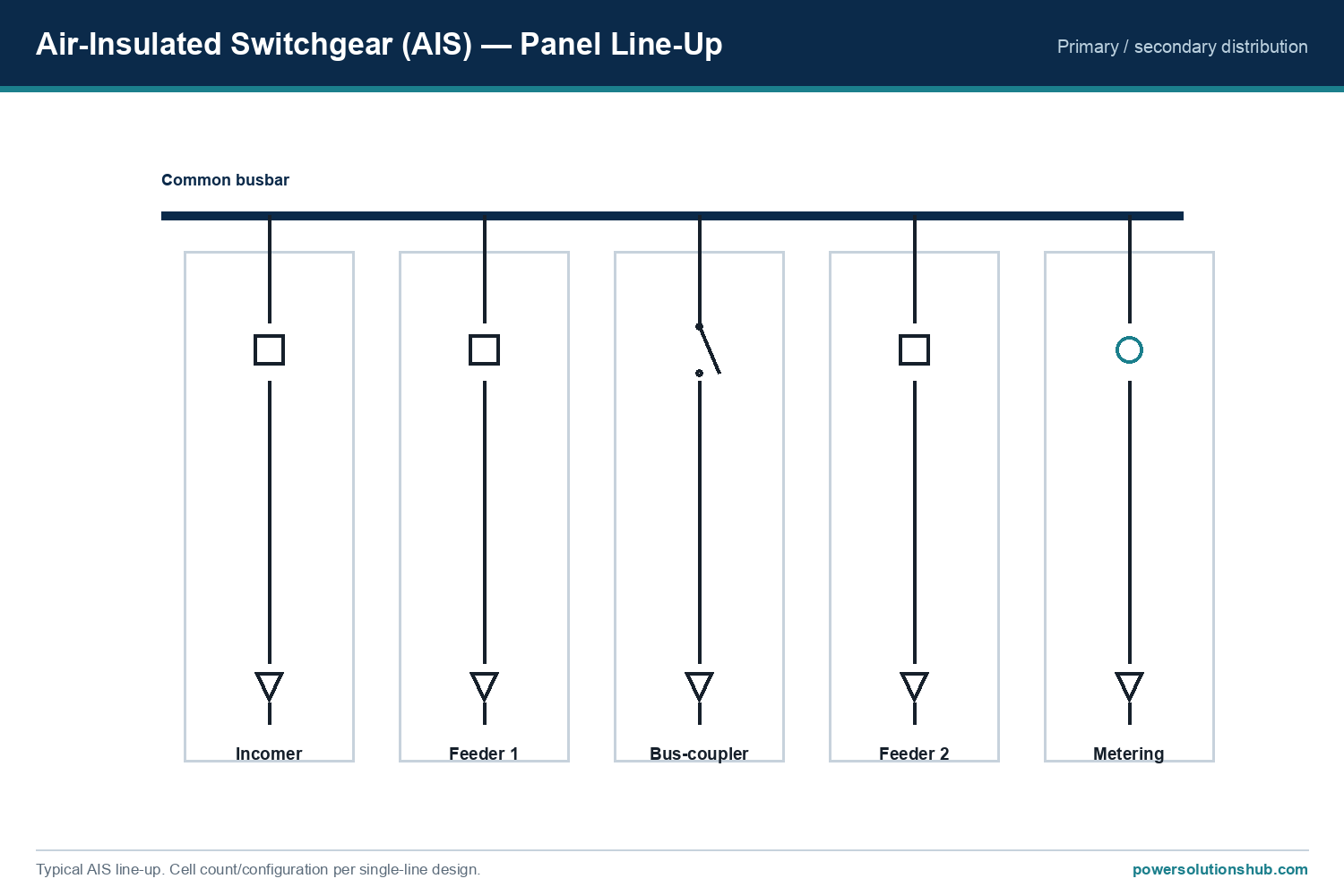
Functional units in an AIS line-up
An air-insulated switchboard is assembled from standard functional panels sharing a common busbar, so the single-line matches the installation. The usual functions are:
- Incomer panel — brings the supply into the switchboard, usually with a circuit breaker and protection.
- Feeder panels — the outgoing circuits to transformers, motors or sub-boards, each with its own breaker or switch and protection.
- Bus-coupler / bus-section panel — links two busbar sections, allowing the board to be split or joined for maintenance and redundancy.
- Transformer-protection panel — protects a distribution transformer, by a switch-fuse combination for smaller ratings or a circuit breaker with a relay for larger ones.
- Metering panel — houses the current and voltage transformers for measurement and revenue metering.
Because the panels are modular, a board can be extended later by adding units to the busbar — one of the practical advantages of air-insulated construction. This modularity, and the ability to see and inspect the equipment directly, is a large part of why AIS remains the most common MV switchgear worldwide.
Construction formats and solid insulation
Air-insulated switchgear comes in more than one construction:
- Fixed-mounted cubicles — the breaker or switch is built into the panel; simple and compact, typical of secondary distribution (e.g. Schneider SM6, ABB UniSec).
- Withdrawable metal-clad — the compartmented, draw-out primary format (see the metal-clad switchgear pillar).
- Shielded solid-insulation systems — some compact modular families, such as Schneider Premset (up to 17.5 kV), combine air insulation with shielded solid-insulated components and vacuum interruption, shrinking the footprint while keeping the serviceability of an air system.
The right format depends on the network level, the available space and the maintenance strategy — the same trade-offs that run through the whole medium voltage switchgear family.
AIS vs GIS — how to choose
The core selection question is insulation medium: air-insulated (AIS) or gas-insulated (GIS).
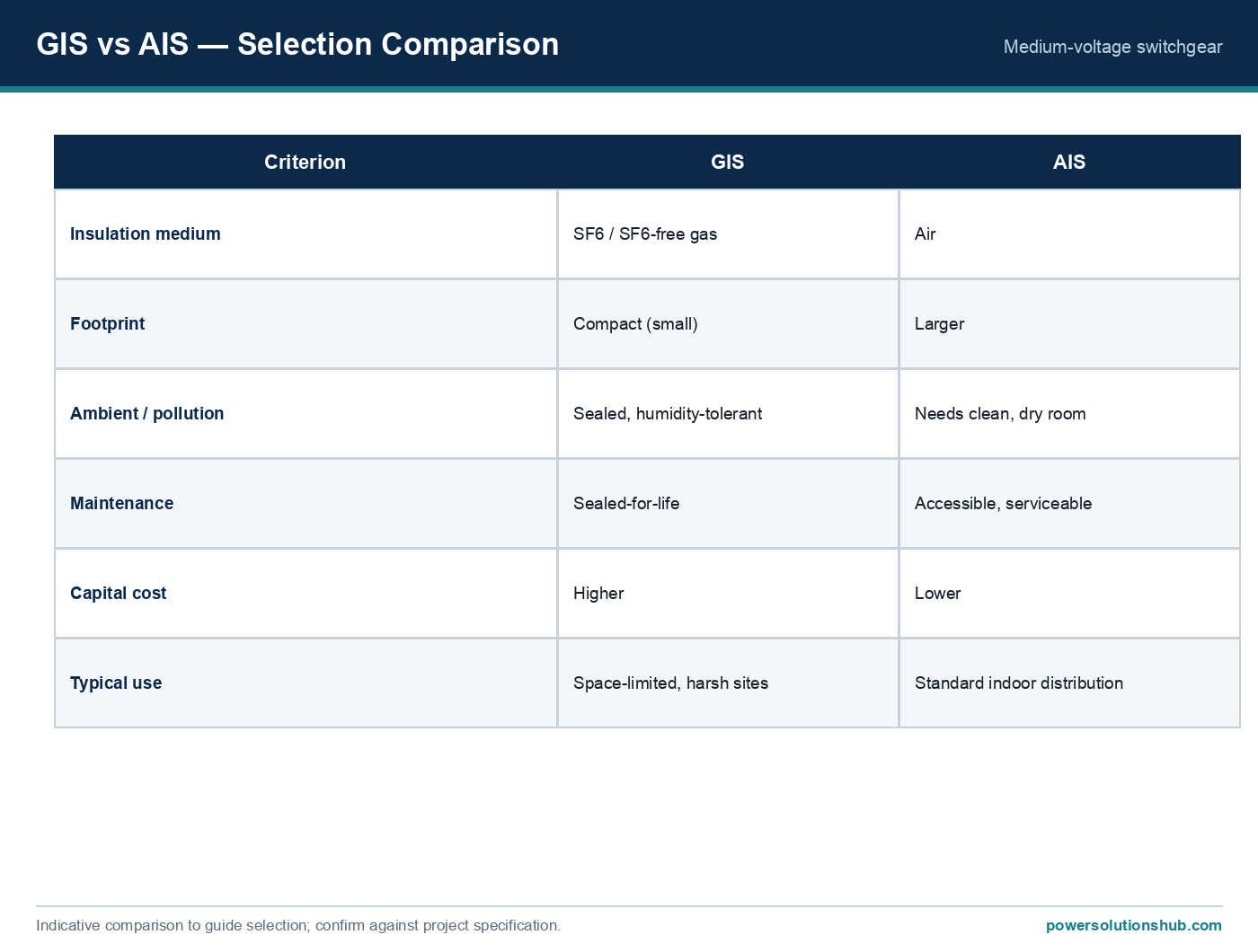
| Criterion | Air-insulated (AIS) | Gas-insulated (GIS) |
|---|---|---|
| Insulation medium | Air | SF6 or SF6-free gas, sealed tank |
| Footprint | Larger (needs clearances) | Compact |
| Ambient / pollution | Needs a clean, dry, controlled room | Sealed, humidity- and pollution-tolerant |
| Maintenance | Accessible, serviceable | Sealed-for-life, minimal |
| Capital cost | Lower | Higher |
| Typical use | Standard indoor distribution, primary metal-clad | Space-limited, hot or harsh sites |
AIS is the default where space and a controlled indoor environment are available and where low capital cost and easy servicing matter. GIS wins where the site is space-limited, hot, dusty or humid.
Air-insulated product families
The AIS families we most often supply:
| Family | Type | Rated voltage | Rated current | Notes |
|---|---|---|---|---|
| Schneider SM6 | Secondary cubicle | 12 / 24 / 36 kV | up to 630 A | Modular; internal arc 12.5 / 16 / 20 kA 1 s |
| ABB UniSec | Secondary | up to 24 kV | up to 1250 A | 25 kA; SF6-free (UniSec Air) option |
| ABB UniGear ZS1 | Primary metal-clad | up to 24 kV | up to 4000 A | 63 kA; withdrawable, LSC2B |
| Schneider Premset | Compact modular | up to 17.5 kV | — | Compact modular vacuum switchgear |
SF6-free and air insulation
Because AIS uses air as its insulation, its busbar and main insulation are inherently SF6-free. The remaining question is the interrupter: modern AIS uses vacuum interruption, so a fully SF6-free air-insulated panel is readily available. Families such as ABB UniSec Air are explicitly SF6-free, compliant with the EU F-gas Regulation (EU 2024/573), with a global warming potential of 0. Where a project mandates SF6-free equipment, air-insulated switchgear with vacuum interruption is a natural fit. See the gas-insulated switchgear pillar for the SF6-free gas alternatives.
Key ratings to specify
Confirm these against the manufacturer’s datasheet for your configuration:
| Parameter | Typical AIS range |
|---|---|
| Rated voltage Ur | 12 / 24 / 36 kV (up to 40.5 kV) |
| Rated normal current | up to 1250 A (secondary); up to 4000 A (primary metal-clad) |
| Short-circuit breaking capacity | up to 25 kA (secondary); up to 63 kA (primary) |
| Internal-arc withstand | e.g. 12.5 / 16 / 20 kA for 1 s (secondary) |
| Insulation | Air (SF6-free); vacuum interruption |
| Standard | IEC 62271-200 |
How to choose
- Space and environment. AIS suits installations with room for clearances and a clean, dry, controlled environment; for space-limited or harsh sites choose GIS.
- Network level. Secondary distribution uses compact air-insulated cubicles (SM6, UniSec); primary distribution uses withdrawable metal-clad AIS.
- Cost and maintenance. AIS has a lower capital cost and is easy to inspect and service.
- SF6-free requirement. Air insulation with vacuum interruption is inherently SF6-free; confirm the family (e.g. UniSec Air) if the project mandates it.
- Maintenance strategy. If a local team will inspect and service the equipment directly, the accessible, repairable air-insulated design suits that model; if minimal-maintenance, sealed operation is preferred, weigh a gas-insulated alternative.
- Fault level and current. Match the short-circuit rating (up to 25 kA secondary, up to 63 kA primary) and the rated current to the network; high-current primary duty points to withdrawable metal-clad.
Standards
Air-insulated switchgear is governed by IEC 62271-200 (AC metal-enclosed switchgear 1 kV–52 kV), with the switching devices following the matching parts of the IEC 62271 series (-100 circuit-breakers, -102 disconnectors, -103 switches). Compact secondary substations may also be type-tested to IEC 62271-202.
Maintenance and inspection advantages
One of the enduring reasons AIS remains the most common MV switchgear is serviceability. Because the insulation is air, the live parts and connections are — with the panel safely isolated and earthed — directly accessible for visual inspection, cleaning, thermographic checks and component replacement. There is no sealed gas system to monitor or handle at end of life, and spare parts and repairs are straightforward. This makes AIS attractive where a local maintenance team looks after the installation and where the total cost of ownership favours a serviceable, repairable design over a sealed one. The trade-off is that this accessibility depends on keeping the switch room clean and dry, which in turn drives the environmental requirements below.
Air-insulated switchgear in hot and dusty climates
Because AIS relies on air clearances, the installation environment matters more than for a sealed panel. In Gulf, North-African and CIS projects, two points are decisive. First, ambient temperature: the rated current derates as the switch-room temperature rises, so the busbar and feeder ratings must be confirmed against the actual ambient — often meaning air-conditioning or a higher-rated busbar. Second, cleanliness and humidity: dust, salt and condensation can reduce the effective air insulation and cause tracking, so AIS switch rooms are kept filtered, dry and, where needed, climate-controlled. Where those conditions are difficult or expensive to maintain — a compact plot, a harsh outdoor-adjacent site, high pollution — a sealed gas-insulated panel is often the better long-term choice. Matching the switchgear type to the real site conditions is exactly the selection judgement this guide is built to support.
Applications
Air-insulated switchgear is used across MV distribution: secondary MV/LV substations, industrial plants, commercial buildings and infrastructure (compact cubicles), and the primary incoming substations of large facilities (metal-clad). Typical sectors include utilities and distribution networks, manufacturing and process industry, renewable energy plants (wind and solar collector substations), commercial and public buildings, water and infrastructure, and mining and oil & gas. It is the default MV switchgear where space and a controlled environment allow, and where low capital cost and easy maintenance are priorities — which is why it remains the most widely installed MV switchgear worldwide, complemented by gas-insulated panels where space or environment demand a sealed solution.
What is air-insulated switchgear (AIS)?
AIS is MV switchgear whose busbars and main current-carrying parts are insulated by air, built to IEC 62271-200; it spans compact secondary cubicles up to large withdrawable metal-clad primary panels and is inherently SF6-free in its insulation.
What is the difference between AIS and GIS?
AIS insulates with air and needs a larger, clean, dry room but is lower cost and serviceable; GIS encloses the live parts in a sealed gas tank, so it is compact, sealed-for-life and tolerant of humidity and pollution at a higher capital cost.
Is metal-clad switchgear the same as AIS?
Metal-clad is one construction of air-insulated switchgear (compartmented, withdrawable, primary distribution). All metal-clad is air-insulated, but not all AIS is metal-clad — secondary cubicles are AIS too.
Is air-insulated switchgear SF6-free?
Its insulation (air) is inherently SF6-free, and modern AIS uses vacuum interruption, so fully SF6-free families such as ABB UniSec Air are available, compliant with the EU F-gas Regulation with a GWP of 0.
What voltage and current does AIS cover?
AIS covers 12 to 36 kV (up to 40.5 kV), with currents up to about 1250 A in secondary cubicles and up to 4000 A in primary metal-clad panels, and short-circuit ratings up to 63 kA.
When should I choose AIS over GIS?
Choose AIS when space and a clean, dry, controlled indoor environment are available and low capital cost and easy servicing matter; choose GIS for space-limited, hot, dusty or humid sites.
Can an air-insulated switchboard be extended later?
Yes. AIS panels share a common busbar, so additional functional panels (feeders, couplers) can be added at the end of the line-up as the installation grows, subject to the busbar rating and available space — one of the practical advantages of air-insulated construction.
Does AIS need a special room?
AIS relies on air clearances, so the switch room should be kept clean, dry and, in hot climates, temperature-controlled; dust, humidity and high ambient temperature must be managed to preserve the insulation and the rated current.
Looking for Air-Insulated Switchgear (AIS)?
Looking for high-quality air-insulated medium voltage switchgear — secondary cubicles or primary metal-clad panels from leading brands? We provide expert engineering support and reliable products for all your medium voltage needs.
For quotations and requests: info@electricistanbul.com
WhatsApp: +90 501 076 69 91