
Withdrawable (draw-out) MV switchgear is a design in which the circuit breaker or contactor truck can be racked between service, test, and disconnected positions without removing the main busbar connections, while fixed (non-withdrawable) switchgear permanently bolts the switching device to the busbar and cable circuit. This guide walks through the engineering logic behind choosing one architecture over the other — isolation philosophy, maintenance access, fault-loop interruption, and a worked numerical example on service continuity and outage-time trade-offs — framed around IEC switchgear standards. It is written for specifying engineers, utility planners, and EPC buyers across the Middle East and Gulf region including Egypt and Saudi Arabia, North Africa, CIS, and Sub-Saharan Africa, where both panel types are widely deployed depending on network criticality and maintenance culture.
Readers evaluating this decision alongside related equipment should also review our hub pages on [medium voltage switchgear](/what-is-mv-switchgear-medium-voltage-switchgear/), [protection relays](/what-is-a-medium-voltage-protection-relay-mv-protection-relay/), and power transformers, since breaker type, relay coordination, and transformer protection all interact with the withdrawable/fixed choice.

Why the Architecture Choice Matters
The core engineering question is not “which is better” in absolute terms but “what does the installation need from isolation, maintainability, and footprint.” Three first-principles factors drive the decision:
- Isolation integrity — can the breaker be physically separated from live busbar/cable conductors with a visible, lockable gap, without de-energizing adjacent panels?
- Mean time to repair (MTTR) — how fast can a faulted or tripped unit be swapped out and the feeder restored?
- Footprint and cost per bay — withdrawable mechanisms (racking rails, shutters, auxiliary/control plug contacts) add width, height, and component count compared to a fixed bolted connection.
These three variables are traded off against each other in every MV panel specification, and the correct answer changes with feeder criticality, spare-breaker availability, and operator skill level on site.
The Method: How to Evaluate the Trade-off
There is no single formula that outputs “withdrawable” or “fixed” — instead, the selection method is a structured comparison across four calculable or rateable dimensions:
1. Isolation distance and dead-time. For withdrawable gear, isolation is achieved by racking the truck from “service” to “test/disconnected,” opening an air gap that meets the rated insulation level without de-energizing the busbar. For fixed gear, isolation of the same bay requires either upstream disconnection or use of a separate disconnector/earthing switch, which may require switching adjacent circuits off as well.
2. Restoration time (MTTR) after a fault or scheduled maintenance. MTTR_withdrawable ≈ t_rack-out + t_inspect/replace + t_rack-in MTTR_fixed ≈ t_de-energize-bus + t_unbolt + t_replace + t_rebolt + t_re-energize
3. Spare-unit economics. Withdrawable systems allow one spare truck to serve multiple bays of the same rating, because the truck is a modular, interchangeable unit. Fixed breakers are typically bay-specific once terminated, so spares must often be dedicated per bay type.
4. Footprint and civil cost per bay, since the racking mechanism, shutters, and auxiliary plug/socket contacts increase cubicle width and depth relative to a fixed design.
Worked Example: Outage-Time Comparison for a Feeder Bay Swap
Assume a distribution substation feeder bay needs its circuit breaker replaced after a protection trip (e.g., internal mechanical fault, not a busbar fault), and the crew must restore supply as quickly as possible.
Withdrawable case: – Time to isolate (rack breaker from service to test position): t₁ = 5 minutes – Time to withdraw faulty truck and insert spare truck: t₂ = 15 minutes – Time to rack spare truck back to service position and close: t₃ = 5 minutes – Total MTTR_withdrawable = t₁ + t₂ + t₃ = 5 + 15 + 5 = 25 minutes
Fixed case (same fault, no draw-out mechanism): – Time to de-energize and earth the busbar section serving that bay (may also affect adjacent bays sharing the section): t₁ = 20 minutes – Time to unbolt busbar/cable terminations from the faulty breaker: t₂ = 30 minutes – Time to fit, align, and rebolt the replacement breaker: t₃ = 40 minutes – Time to remove earths, re-energize, and confirm: t₄ = 15 minutes – Total MTTR_fixed = 20 + 30 + 40 + 15 = 105 minutes
Interpretation: In this illustrative scenario, the withdrawable architecture reduces restoration time by roughly (105 − 25) / 105 ≈ 76% for this specific maintenance event. This is a first-principles worked example to illustrate why withdrawable gear is specified for critical feeders — actual times vary by site access, crew training, and whether adjacent circuits must also be de-energized. The saving is largest precisely where an outage has the highest cost: hospitals, data centers, process industries, and interconnection points feeding multiple downstream transformers.
This same logic extends to rated-current sizing checks that engineers run alongside the MTTR comparison. For example, for a 1000 kVA transformer feeding the bay at a system voltage of 11 kV, the rated secondary-side current is:
I = S / (√3 × V) = 1,000,000 / (1.732 × 11,000) ≈ 52.5 A
Confirming that the replacement breaker/truck’s rated continuous current comfortably exceeds this 52.5 A feeder demand (with margin for growth) is a standard check performed regardless of whether the gear is withdrawable or fixed — the architecture choice affects how fast you can act, not what current rating you need.
Selection and Comparison Table
| Criterion | Withdrawable (Draw-out) | Fixed (Non-withdrawable) |
|---|---|---|
| Isolation method | Racking to test/disconnected position; visible air gap | Bus/cable de-energization or separate disconnector needed |
| Typical MTTR for breaker swap (illustrative) | ~25 min (see worked example) | ~105 min (see worked example) |
| Spare-unit strategy | One spare truck can serve multiple identical bays | Spares generally bay-specific |
| Footprint per bay | Larger (racking rails, shutters, aux contacts) | Smaller, more compact |
| Mechanical complexity | Higher (racking mechanism, interlocks, shutters) | Lower (bolted, fewer moving parts) |
| Maintenance skill required on site | Moderate (racking procedure, interlock awareness) | Can be lower for routine ops, higher for breaker R&R |
| Best suited to | Critical/continuous-process feeders, utility substations, hospitals, data centers | Smaller distribution feeders, cost-sensitive projects, ring main units |
| Initial capital cost per bay | Generally higher | Generally lower |
Note: the MTTR figures above are illustrative, scenario-specific numbers from the worked example, not vendor-published specifications — actual times depend on site layout, crew competency, and whether the gear includes remote racking or motorized mechanisms.
Selection Criteria and Common Pitfalls
When withdrawable gear is the right call: – Feeders where unplanned outage cost is high (hospitals, data centers, oil & gas, continuous process lines). – Substations where fast fault recovery and minimal disturbance to adjacent bays are operational requirements. – Sites with trained maintenance crews familiar with racking interlocks and safe isolation procedures.
When fixed switchgear is acceptable or preferable: – Smaller distribution substations or ring main units where simplicity, lower footprint, and lower capital cost outweigh fast-swap convenience. – Applications where the switching device (e.g., ring main unit with load-break switches) is not expected to be frequently removed for maintenance. – Projects where budget constraints dominate and planned maintenance windows are acceptable.
Common pitfalls: – Specifying withdrawable gear without budgeting for spare trucks — the fast-MTTR benefit disappears if no spare unit exists on site. – Ignoring interlock design: racking interlocks must prevent insertion/withdrawal under load or with earthing switches closed, in line with IEC safety interlocking requirements. – Assuming withdrawable gear is always “better” — for small, non-critical feeders, the added footprint and cost of draw-out mechanisms may not be justified. – Overlooking shutter and IP-rating details: withdrawable compartments rely on automatic safety shutters to cover live busbar contacts when the truck is withdrawn, and this shutter mechanism itself needs maintenance. – Failing to coordinate the breaker’s rated short-circuit breaking current, rated current, and insulation level with the actual network study — architecture (withdrawable vs fixed) does not substitute for correct electrical rating selection, which should follow IEC 62271-100 (high-voltage alternating-current circuit-breakers) and the general common specifications of IEC 62271-1 (common specifications for high-voltage switchgear and controlgear).
Standards
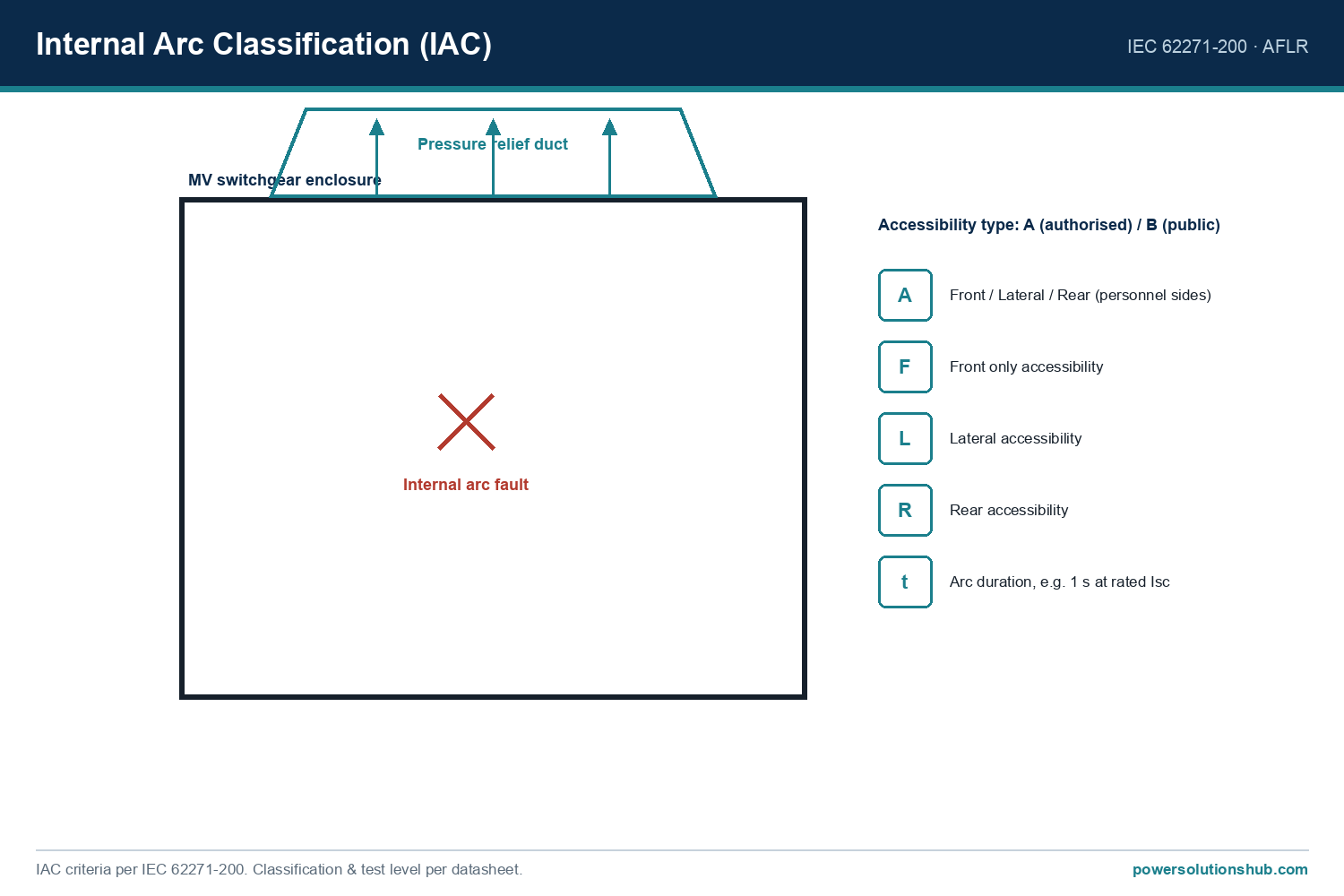
MV switchgear construction, type testing, and classification — including requirements relevant to withdrawable (draw-out) and fixed-mounted circuit-breaker assemblies — fall under the IEC 62271 series: IEC 62271-1 sets common specifications for high-voltage switchgear and controlgear, and IEC 62271-100 covers high-voltage alternating-current circuit-breakers including their rated characteristics and type tests. Internal arc classification (IAC) and metal-enclosed switchgear requirements are addressed within the same family of standards and should be confirmed against the specific equipment datasheet rather than assumed generically.
Related guides
See also our guides on gas-insulated switchgear, metal-clad switchgear and air-insulated switchgear.
What is the main functional difference between withdrawable and fixed MV switchgear?
Withdrawable switchgear allows the circuit breaker or contactor truck to be racked out to a test or disconnected position for maintenance without de-energizing the busbar, while fixed switchgear has the switching device permanently bolted in place, requiring upstream isolation to work on it safely.
Does withdrawable switchgear always have a shorter outage time than fixed switchgear?
In the general case, yes, for breaker replacement or maintenance events, because racking avoids unbolting live connections — as illustrated in the worked MTTR example above — but actual times depend on site conditions, crew skill, and whether a spare truck is available.
Is withdrawable switchgear more expensive than fixed switchgear?
Generally yes, per bay, because of the added racking mechanism, interlocks, shutters, and auxiliary plug/socket contacts; the extra cost is justified when fast restoration and operational flexibility have high value, such as on critical feeders.
Can fixed switchgear still meet high reliability requirements?
Yes — fixed switchgear can be highly reliable for its intended duty, particularly in smaller distribution networks or ring main units where the switching device is rarely removed; reliability depends more on correct electrical rating, protection coordination, and maintenance regime than on architecture alone.
What interlocks are required for withdrawable switchgear?
Racking interlocks must prevent the truck from being inserted into or withdrawn from the service position while the breaker is closed or carrying load, and must coordinate with earthing-switch position to prevent unsafe operation — interlock philosophy is governed by the general switchgear standards referenced above.
How do I decide between withdrawable and fixed for a new substation design?
Compare feeder criticality, available maintenance skill and spare-unit budget, footprint constraints, and capital cost against the illustrative MTTR method shown in this guide, then confirm the final electrical ratings (current, short-circuit, insulation level) independently of the architecture decision.
Does the withdrawable vs fixed choice affect protection relay coordination?
Not directly — protection relay settings are determined by fault-current studies and time-current coordination, not by breaker mounting type; however, withdrawable designs often include auxiliary contacts that signal truck position to the protection and control system, which should be accounted for in the relay’s interlocking logic. See our [protection relays](/protection-relays) hub page for related coordination guidance.
Looking for medium voltage switchgear?
Looking for high-quality medium voltage switchgear? We provide expert engineering support and reliable products for all your medium voltage needs.
For quotations and requests: info@electricistanbul.com
WhatsApp: +90 501 076 69 91