
The ABB SafePlus is a sealed, gas-insulated medium-voltage ring main unit (RMU) for secondary distribution. Safeplus RMU switchgear refers to ABB’s SafePlus 36 platform — a sealed, gas-insulated medium-voltage switchgear built on the same secondary-distribution architecture as ABB SafeRing, but engineered for higher flexibility, modularity, and higher ratings within a ring main unit (RMU) configuration. This article covers the design philosophy, functional variants, technical specifications, applicable IEC standards, and buyer selection criteria for the SafePlus range, drawn directly from ABB’s official SafeRing/SafePlus 36 catalog. For procurement teams sourcing medium-voltage distribution equipment across the Middle East and Gulf (including Egypt and Saudi Arabia), North Africa, CIS, and Sub-Saharan Africa, understanding the SafePlus platform’s construction and compliance basis is essential before specifying it into a substation or compact secondary substation (CSS) project.
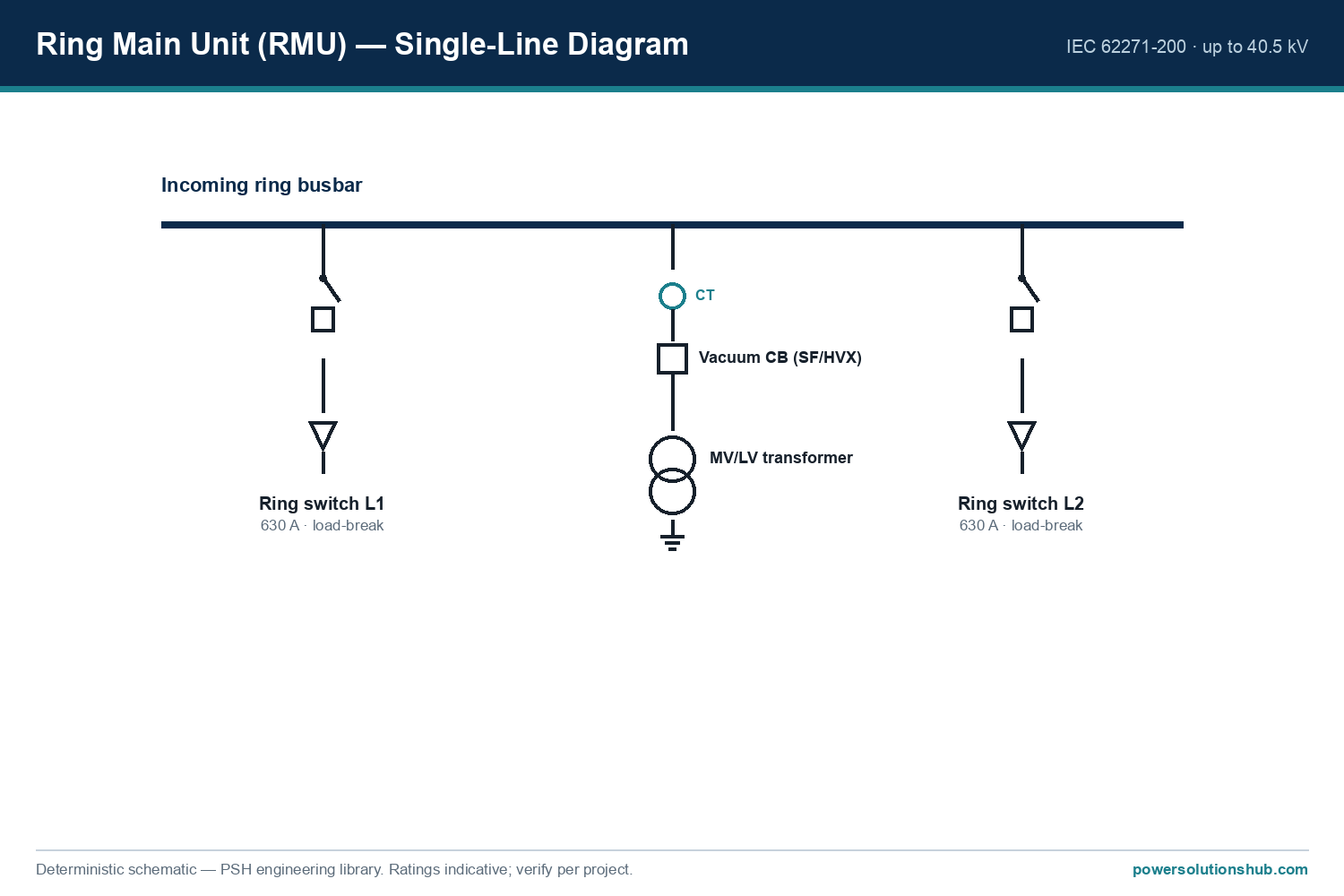
What Is Safeplus RMU Switchgear?
SafePlus is part of the SafeRing/SafePlus product family, originally developed by ABB in Skien, Norway, and introduced to the market in 2000, replacing the earlier SF6-insulated RGC and CTC product lines. Since then, the combined installed base of SafeRing and SafePlus switchgear has grown to more than 150,000 units deployed across more than 100 countries worldwide.
Both SafeRing and SafePlus share the same user interface and the same underlying philosophy: functions such as earthing, disconnecting, cable connection, busbar extension, protection, and switching are integrated into compact, sealed functional units rather than built from traditional open switching cells. The key distinction is that SafeRing is delivered in standardized, high-volume, pre-defined RMU configurations intended for fast delivery, while SafePlus is the flexible, modular version of the same platform, offering customized switchgear configurations and higher electrical capacity, including smart RMU configurations for advanced grid automation.
Design and Construction
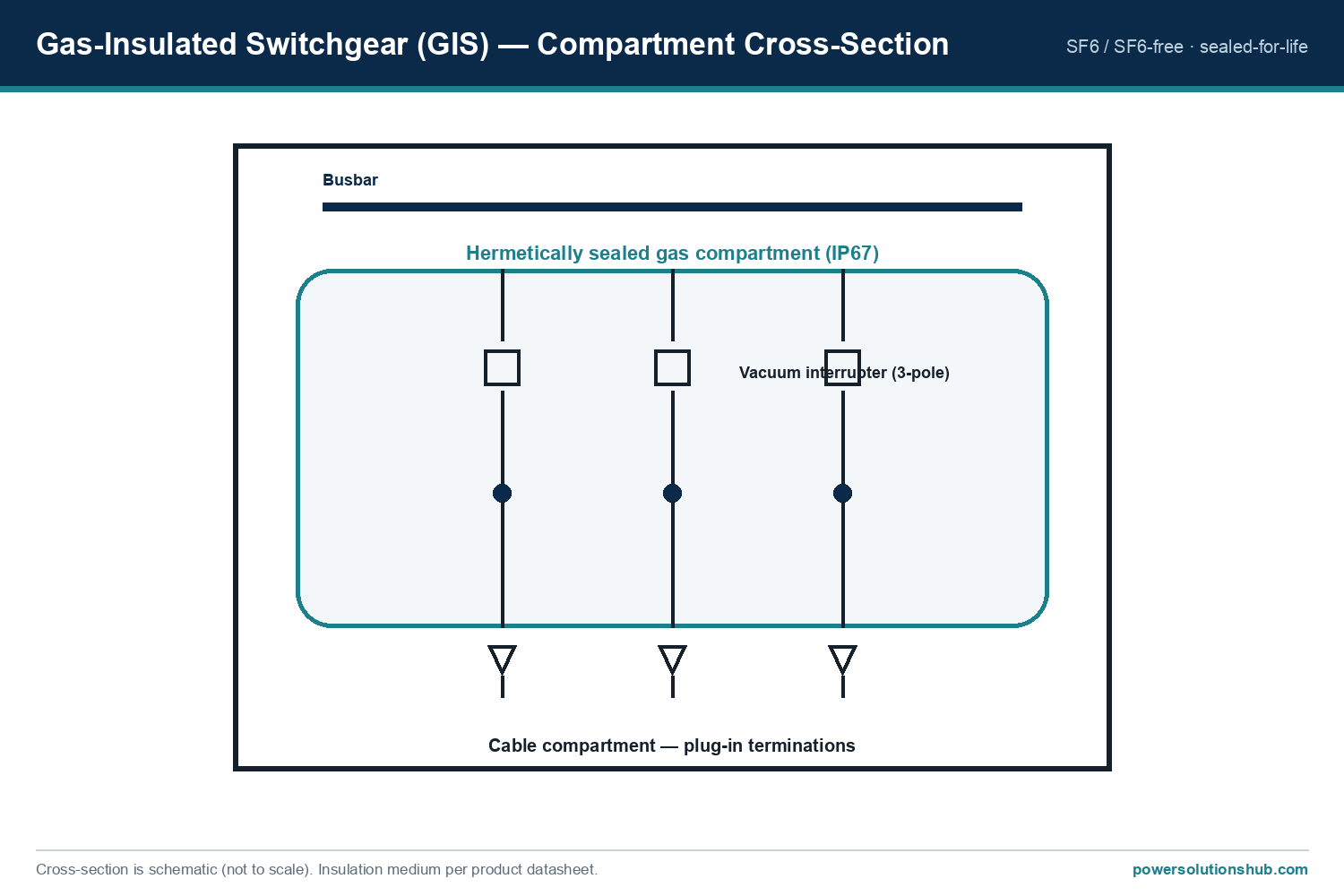
The defining characteristic of SafePlus is its completely sealed switchgear tank. All live parts and switching functions are contained inside a welded stainless steel enclosure filled with SF6 gas, which serves as both the insulation and arc-quenching medium. This sealed-for-life design is rated for an operating lifetime better than 30 years, with a gas leakage rate of less than 0.1% per year. Every enclosure is helium-leak-tested inside a vacuum chamber before being filled with SF6, and all welding is carried out by computer-controlled robots to guarantee a reliable, tight seal.
The SF6 enclosure itself carries a degree of protection of IP67, meaning it can be immersed in water and still maintain full functionality. This makes the switchgear well suited to humid, coastal, or climatically demanding environments typical of GEO export markets.
Externally, the upper and lower front covers are made of 1.5 mm aluzink sheet finished with a polycarbonate foil carrying the mimic diagram and switch position indicators, while side covers are made of 1.25 mm hot-rolled steel, powder-painted in RAL 7035. Cable compartments are separated by partition walls, and in switchgear with the IAC AFL arc-proof classification, a vertical partition wall keeps hot gases from an internal arc away from the cable compartment; in the AFLR classification, hot gases are permitted to reach the cable compartment.
Low-voltage compartments are available in three configurations — integrated with the front cover, integrated with a hinged door, or a high version with a hinged door. In the high LV compartment version, the total switchgear height reaches 2180 mm, rising to 2280 mm when a metering module is included.
SafeRing vs SafePlus: Positioning Within the Range
| Attribute | SafeRing | SafePlus |
|---|---|---|
| Configuration philosophy | Standardized, pre-defined, high-volume | Flexible, modular, customized |
| Typical use case | Fast-delivery transformer/switching stations, DSO consumer switchgear | Advanced distribution needs, including smart RMUs / grid automation |
| Electrical capacity | Standard ratings | Higher ratings, more functional flexibility |
| User interface | Same as SafePlus | Same as SafeRing |
| Sealed system | Yes, stainless steel, sealed-for-life | Yes, stainless steel, sealed-for-life |
Both products come from the same engineering platform, and buyers should treat the choice between them as a question of standardization versus configurability rather than a difference in core safety technology.
Key Technical Data
| Parameter | Value |
|---|---|
| Installed base | >150,000 units, >100 countries |
| Sealed system operating lifetime | Better than 30 years |
| SF6 leakage rate | Less than 0.1% per year |
| SF6 enclosure protection degree | IP67 |
| Minimum ambient temperature | -25°C |
| Maximum ambient temperature | +40°C |
| Max. 24h average relative humidity | 95% |
| Max. 24h average water vapour pressure | 2.2 kPa |
| Max. monthly average relative humidity | 90% |
| Max. monthly average water vapour pressure | 1.8 kPa |
| Normal operational altitude | Up to 1500 m above sea level |
| High LV compartment total height | 2180 mm (2280 mm with metering module) |
| End-of-life recycling capability | 88.8% |
Beyond ambient conditions and altitude, buyers should confirm project-specific voltage, current, and short-circuit ratings directly with ABB’s technical data sheets, since exact rated values vary by ordering code and market variant and were not itemized as a single universal figure in the general catalog overview referenced here.
Personnel Safety and Internal Arc Classification (IAC)
SafeRing/SafePlus was designed and tested to withstand a range of internal arc fault scenarios at the same current level as the maximum short-circuit current, with the objective of protecting personnel standing close to the switchgear during such an event. Internal arc classification (IAC) testing follows IEC 62271-200 and defines two accessibility categories:
- Accessibility A — accessible to authorized personnel only, tested with a 300 mm safety distance on accessible sides.
- Accessibility B — public access, tested with a 100 mm safety distance on accessible sides.
Access directions are denoted F (front), L (lateral/sides), and R (rear), and switchgear variants are further differentiated as IAC AFL or IAC AFLR depending on whether hot arc gases are prevented from, or permitted to, enter the cable compartment.
Additional safety features built into the design include touch-proof construction with no exposed MV live parts, padlockable operating handles, cover interlocks, and gas pressure relief functions, all intended to make installation and maintenance safer for field personnel.
Standards and Factory Testing
SafeRing/SafePlus is tested according to a defined set of IEC standards for high-voltage switchgear and controlgear:
- IEC 62271-1 – Common specifications for high-voltage switchgear and controlgear
- IEC 62271-100 – Alternating current circuit-breakers
- IEC 62271-102 – Alternating current disconnectors and earthing switches
- IEC 62271-103 – Switches for rated voltages above 1 kV up to and including 52 kV
- IEC 62271-105 – Alternating current switch-fuse combinations for rated voltages above 1 kV up to and including 52 kV
- IEC 62271-200 – AC metal-enclosed switchgear and controlgear for rated voltages above 1 kV and up to and including 52 kV
- IEC 60529 – Degrees of protection provided by enclosures (IP code)
The switchgear is additionally tested in combination with Compact Secondary Substations (CSS) according to IEC 62271-202, with tests performed on CSS units from various manufacturers. Every manufactured unit undergoes standard IEC routine testing per IEC 62271-200, covering visual inspection, mechanical and electrical sequence operation checks, power-frequency withstand voltage testing, partial discharge measurement, main circuit resistance measurement, secondary insulation testing, and gas tightness control.
Applications and Industries
SafePlus RMU switchgear is deployed across a broad span of sectors, reflecting its role as general-purpose secondary distribution equipment. Industrial applications include pulp and paper, cement, textiles, chemicals, food processing, automotive, petrochemical, quarrying, oil and gas pipelines, rolling mills, and mining. In the utility and generation sector, it is used in power generation stations, transformer stations and metering, main and auxiliary switchgear, wind turbines, solar/PV plants, and hydro power plants. Transport-sector deployments cover airports, ports, railways, and underground transport, while infrastructure applications include hotels, shopping centers, hospitals, commercial buildings, and large civil works projects.
Selection Criteria for Buyers
When specifying SafePlus RMU switchgear for an export or turnkey substation project, procurement and engineering teams should evaluate the following:
- Configuration flexibility vs. standardization — SafeRing suits fast-delivery, standardized RMU requirements; SafePlus suits projects needing customized functional unit combinations or smart-grid automation features.
- Arc-proof classification — confirm whether IAC AFL or IAC AFLR is required based on cable compartment access and site safety philosophy.
- Environmental envelope — verify the ambient temperature range, altitude, and humidity limits against actual site conditions, particularly for hot, humid, or high-altitude GEO deployment sites.
- Ingress protection needs — the IP67-rated sealed gas enclosure is a relevant factor for coastal, flood-prone, or high-humidity installations.
- Integration with CSS — projects using compact secondary substations should confirm CSS-level IEC 62271-202 test compatibility.
- Maintenance philosophy — the sealed-for-life gas system reduces routine maintenance needs but requires confirming the manufacturer’s leak-rate and lifetime data align with the project’s asset-management horizon.
- Environmental/end-of-life requirements — for projects with sustainability reporting obligations, the documented recycling capability of the platform may be a relevant procurement criterion.
Related guides
See also our guides on gas-insulated switchgear, metal-clad switchgear and air-insulated switchgear.
What is the difference between SafeRing and SafePlus?
SafeRing is offered in standardized, pre-defined RMU configurations intended for fast delivery and high-volume utility use, while SafePlus is the more flexible and modular version of the same platform, offering higher electrical capacity and customized configurations, including smart RMU grid-automation options. Both share the same user interface and sealed switchgear technology.
What insulation medium does SafePlus RMU switchgear use?
SafePlus uses SF6 gas as both the insulation and arc-quenching medium, contained inside a welded stainless steel enclosure that is sealed for life.<!– 🔴 iddia: SF6 gas used as ins
Looking for Safeplus RMU Switchgear?
Looking for high-quality safeplus rmu switchgear? We provide expert engineering support and reliable products for all your medium voltage needs.
For quotations and requests: info@electricistanbul.com
WhatsApp: +90 501 076 69 91