
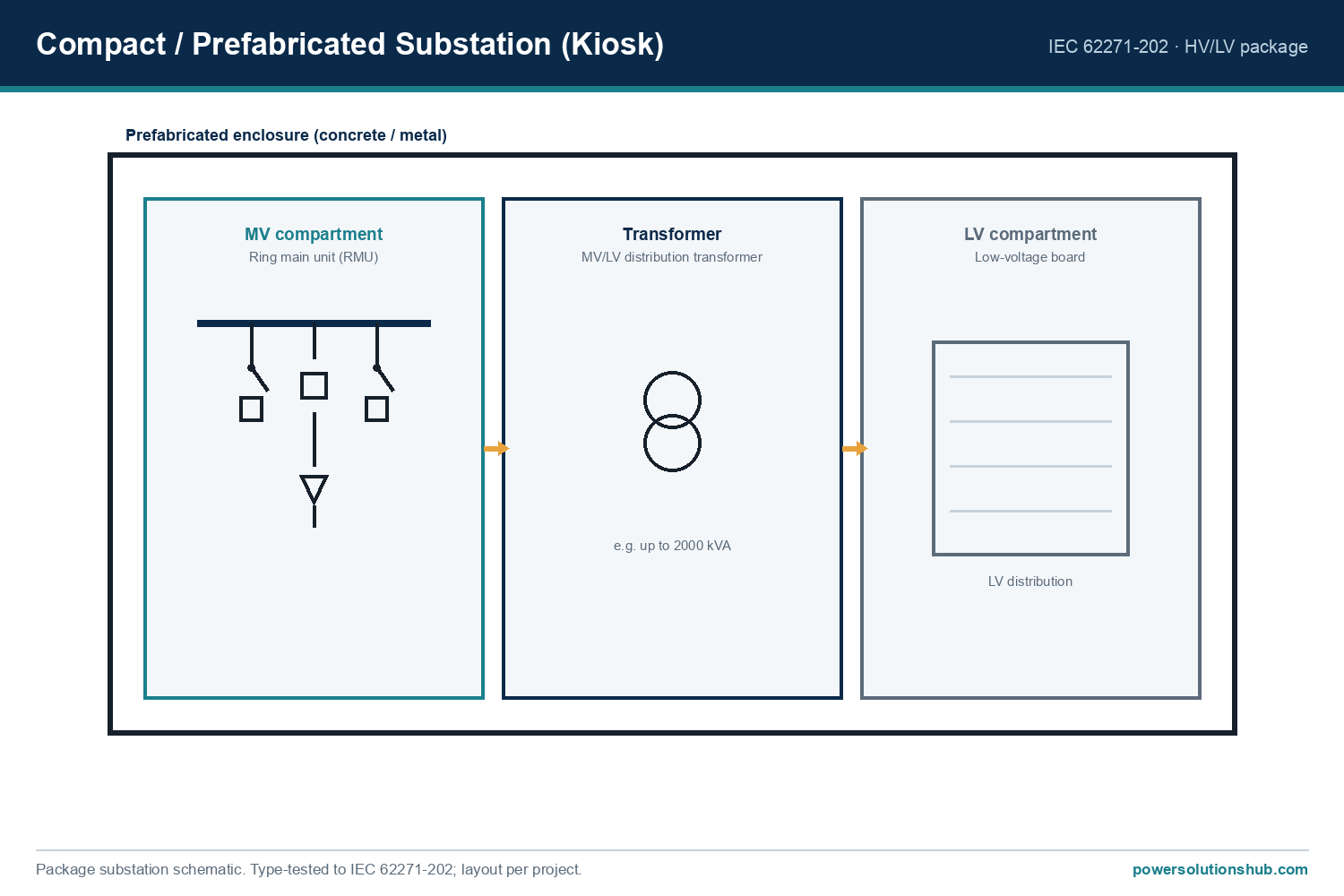
A compact substation (also called a kiosk substation or package substation) is a factory-assembled, self-contained enclosure that integrates a medium-voltage switchgear compartment, a distribution transformer, and a low-voltage panel into a single weatherproof metal housing designed for fast, low-footprint installation in urban, industrial, or commercial distribution networks. This guide covers the main construction types of compact substations, how they compare with other fixed and mobile substation formats, the criteria buyers should use to specify one, typical application segments, and the governing standards framework. It is written for procurement engineers, EPC contractors, and utility planners across the Middle East and Gulf region (including Egypt and Saudi Arabia), North Africa, CIS countries, and Sub-Saharan Africa who need to source reliable, standards-compliant equipment quickly.
What Is a Kiosk / Compact Substation?
In distribution engineering, a kiosk substation is essentially a “substation in a box.” Instead of building a dedicated masonry substation room, the utility or industrial customer installs a pre-fabricated steel enclosure that already houses the MV switching cells, the transformer, and the LV distribution board, minimizing civil works and commissioning time. This format sits alongside several other recognized substation architectures used in modern grids: building-type (masonry) substations, gas-insulated switchgear (GIS) substations, metal kiosk substations, open-type substations, and step-up/step-down substations.
Because a kiosk substation is delivered largely pre-tested from the factory, it dramatically shortens the on-site installation period compared with conventional open-type or building-type substations, which require dedicated civil construction, cable trenching, and extended site commissioning before energization.
Types and Variants of Compact Substations
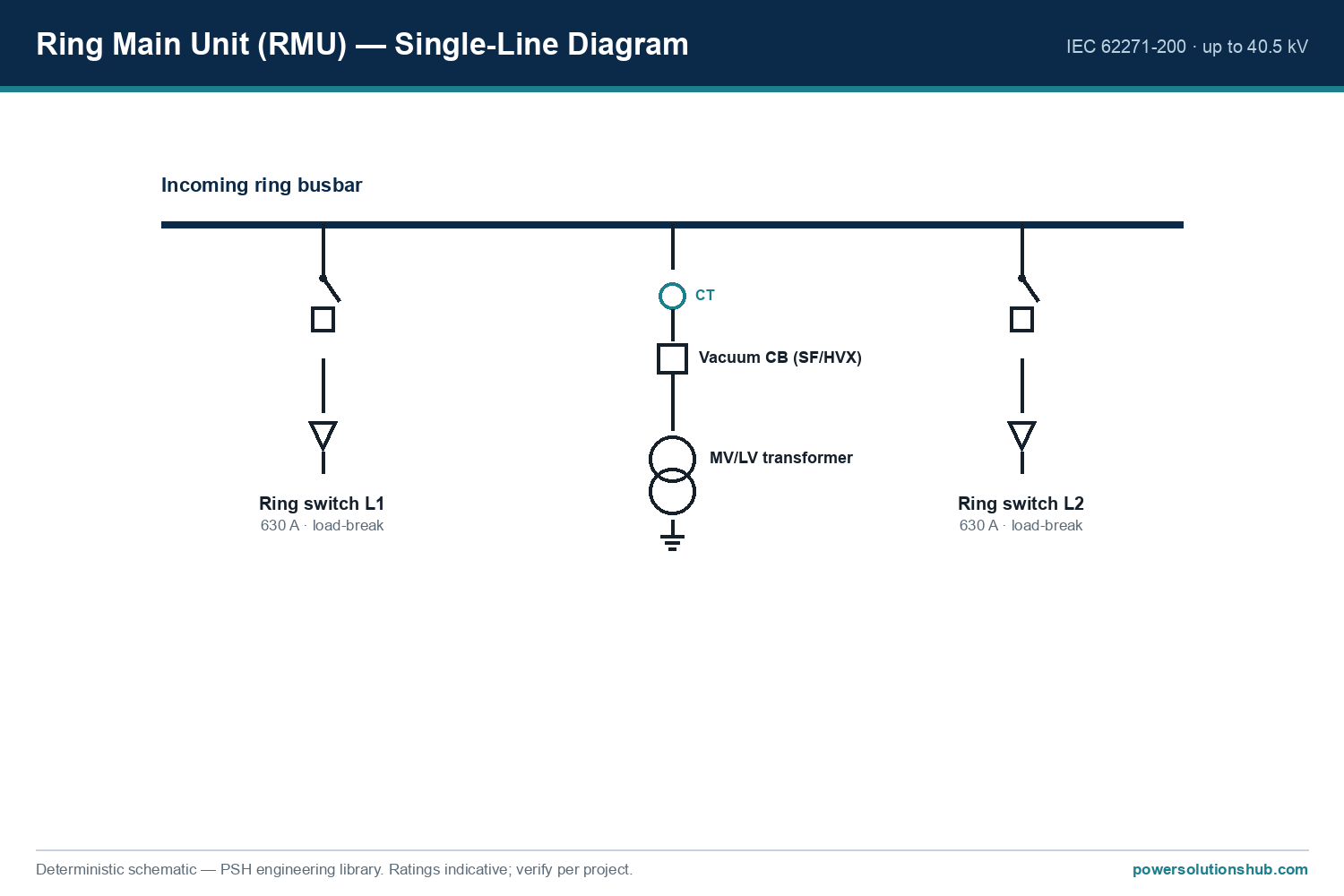
Metal-enclosed kiosk substations are the most common compact format, combining ring main unit (RMU)-style MV switching, a distribution transformer, and an LV panel inside a single galvanized or painted steel housing suitable for outdoor or semi-outdoor placement.
Building-type (masonry) substations are the traditional alternative — a dedicated brick or concrete room housing separate MV switchgear, transformer, and LV panels. They offer flexibility for larger transformer ratings but require significant civil works and space, and are generally slower to commission than a factory-built kiosk.
GIS (Gas Insulated Switchgear) substations replace air-insulated busbars with SF6 or alternative gas-insulated compartments, giving a very small footprint and high reliability in constrained or polluted environments. GIS technology is also used in some higher-voltage transmission applications and mobile substation platforms.
Open-type substations are older-generation installations with exposed busbars and equipment in an open switchyard. Many utilities, including TEDAŞ-regulated networks, are actively replacing legacy open-type substations with modern modular or GIS-type substations to improve safety and reduce footprint.
Mobile (transportable) substations are a related but distinct category — wheel-mounted transformer and switchgear packages used for temporary power during maintenance, emergencies, or sudden demand growth, rather than as a permanent installation. A compact kiosk substation is normally installed once and remains in place, whereas a mobile substation is designed to be moved between sites.
Step-up/step-down substations refer to the transformation direction (raising or lowering voltage) rather than the enclosure format, and can be built using any of the above physical constructions, including compact kiosk designs.
Selection Criteria for Compact Substations
When specifying a kiosk or compact substation, buyers should evaluate the following:
- Footprint and site constraints — compact kiosk units are the preferred choice where land is limited, such as dense urban feeders, shopping centers, or industrial plots where a dedicated substation building is not feasible.
- Equipment integration quality — a well-engineered unit should combine properly rated circuit breakers, disconnectors, measuring transformers, protection relays, surge arresters, and modular MV cells within the enclosure, alongside correctly sized cable cross-sections.
- LV integration — buyers should confirm whether LV distribution panels and, where required, battery-rectifier systems for protection and control power are included as part of the package.
- Enclosure robustness and layout — the metal enclosure should be engineered for optimal equipment layout and durability in the target climate, whether coastal, desert, or high-humidity environments common across GEO markets.
- Grounding system design — an advanced, properly engineered grounding scheme is essential for personnel safety and equipment protection, and should be verified as part of the technical offer.
- Short-circuit withstand verification — the switchgear and transformer combination should be validated for worst-case fault conditions, ideally supported by short-circuit analysis rather than assumed ratings.
- Speed of deployment vs. building-type substations — because factory assembly and pre-testing are completed before shipment, kiosk substations typically reach energization faster than masonry substations that require full on-site civil works.
- Compliance and modularity — where applicable, confirm compliance with local distribution utility technical specifications and modular design principles, which support easier future upgrades or capacity changes.
Comparative Overview Table
| Substation format | Typical footprint | Installation speed | Primary use case |
|---|---|---|---|
| Metal kiosk / compact substation | Small, single enclosure | Fast (factory pre-assembled) | Urban/industrial distribution, limited land |
| Building-type (masonry) substation | Larger, dedicated room | Slower (civil works required) | Larger capacity, flexible layout |
| GIS substation | Very small | Moderate-fast | Constrained or polluted sites |
| Open-type substation | Large, open switchyard | Slower, legacy design | Being phased out under modernization programs |
| Mobile substation | Transportable, wheeled platform | Very fast deployment | Temporary/emergency power during outages or upgrades |
Note: the table above compares construction formats qualitatively; specific transformer capacity or voltage class should always be confirmed against the buyer’s actual load and network requirements rather than assumed from a generic table.
Applications of Compact Substations
Compact kiosk substations are widely used wherever fast deployment and minimal civil works are priorities:
- Urban and commercial distribution — retail centers, residential complexes, and mixed-use developments where space for a masonry substation building is not available.
- Industrial facilities — factories and processing plants that need a dedicated, secure MV/LV interface close to the load without constructing a separate substation room.
- Utility network modernization — replacing aging open-type substations as part of broader grid upgrade programs.
- Construction and infrastructure projects — large sites such as tunnels, dams, and mining operations often combine compact substations with temporary mobile units during the build phase, before a permanent installation is commissioned.
- Emergency and disaster response — while mobile substations handle the acute emergency phase (earthquakes, floods, storms, conflict-zone damage), compact kiosk substations are frequently the permanent replacement installed once the network stabilizes.
- Remote and military facilities — where a compact, easily transportable enclosure simplifies logistics compared to constructing a full masonry substation on-site.
A relevant engineering reference illustrates how compact substation packages are validated for real-world performance: a published technical study designed a 1600 kVA, 34.5/0.4 kV mobile substation and analyzed its short-circuit behavior in MATLAB Simulink, testing both a direct connection to an infinite bus with 100 MVA short-circuit power and integration into an actual distribution network fed from a 380/34.5 kV GIS substation in Beykoz, Istanbul. Both symmetrical (three-phase) and asymmetrical (phase-to-ground, phase-to-phase) fault scenarios were simulated, and the selected equipment successfully withstood the worst-case short-circuit currents, demonstrating the value of rigorous short-circuit analysis when specifying any compact or mobile substation package.
This type of validation matters for compact substation buyers too: even though the enclosure is smaller, the internal switchgear, transformer, and protection coordination must be engineered to the same fault-current withstand principles as a full-size fixed substation.
Standards and Compliance Notes
Compact and kiosk substations should be specified with reference to the relevant national or utility technical specifications governing MV switchgear, transformers, and enclosure protection for the target market. Utilities in several regions require modular or GIS-type replacements for older open-type installations as part of formal compliance programs. Buyers should request documentation confirming factory testing of the assembled package, short-circuit withstand verification, and grounding system design before shipment, rather than relying on generic catalog claims.
Related guides
See also our guides on medium voltage switchgear, metal-clad switchgear and air-insulated switchgear.
What is the difference between a kiosk substation and a mobile substation?
A kiosk substation is a permanently installed, factory-assembled enclosure combining MV switchgear, a transformer, and LV panels in one location. A mobile substation is a wheel-mounted, transportable version of similar equipment used specifically for temporary or emergency power while a fixed substation is under maintenance, repair, or replacement.
Why choose a compact kiosk substation over a building-type substation?
Kiosk substations require far less civil works because the MV switchgear, transformer, and LV panel arrive largely pre-assembled and factory-tested, which shortens on-site installation and commissioning time compared with constructing a dedicated masonry substation room.
Can a compact substation be used to replace an old open-type substation?
Yes. Utilities frequently replace legacy open-type substations with modern modular or GIS-type substations as part of grid modernization and compliance upgrades, and compact kiosk formats are a common choice for this replacement.
What equipment should be included inside a compact substation enclosure?
A properly engineered unit should include appropriately rated circuit breakers, disconnectors, measuring transformers, protection relays, surge arresters, modular MV cells, correctly sized cable cross-sections, LV distribution panels, and, where needed, battery-rectifier systems for control power.
How is short-circuit performance verified for a compact substation design?
Short-circuit performance can be validated through simulation studies covering both symmetrical (three-phase) and asymmetrical (phase-to-ground, phase-to-phase) fault conditions, confirming that the selected switchgear and transformer withstand worst-case fault currents before the design is finalized.
Are compact substations suitable for temporary construction site power?
Compact substations are generally used as permanent installations, while temporary needs at large construction sites (tunnels, dams, mining operations) are typically served by mobile substations until a permanent compact or building-type substation is commissioned.
What role does grounding play in compact substation safety?
An advanced grounding system is a core design requirement for any substation package, whether kiosk, building-type, or mobile, and should be reviewed carefully as part of the technical offer to ensure personnel and equipment safety.
Looking for Kiosk / Compact Substations?
Looking for high-quality kiosk / compact substations? We provide expert engineering support and reliable products for all your medium voltage needs.
For quotations and requests: info@electricistanbul.com
WhatsApp: +90 501 076 69 91