
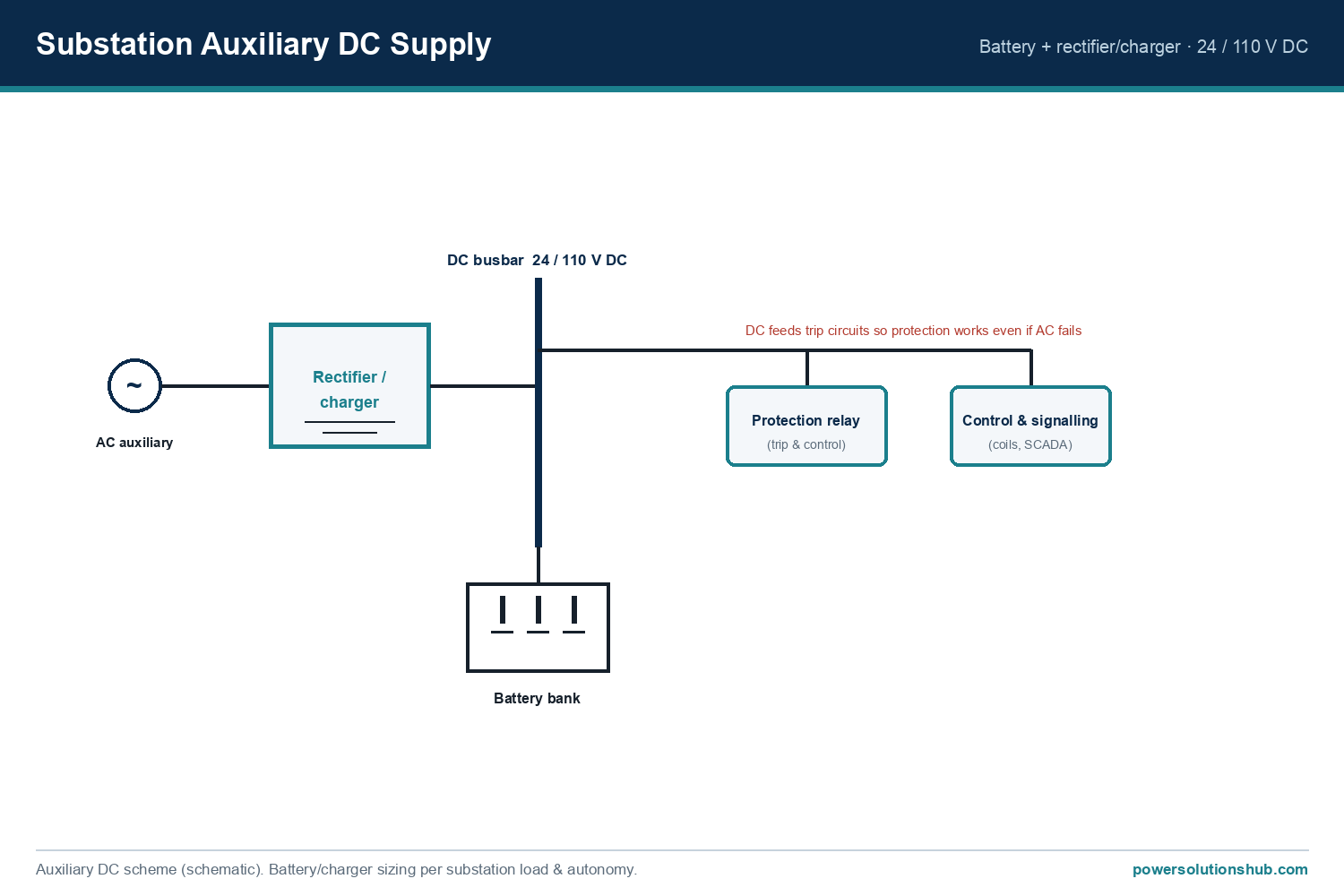
A DC power system is the independent, battery-backed low-voltage supply that keeps protection relays, circuit-breaker trip/close coils, SCADA/RTU equipment, and emergency indication energized during a loss of the incoming AC auxiliary supply, so that a substation can still trip a faulted feeder or close a breaker even in a total blackout. In practical terms, a DC power system is built around three elements: a rectifier/charger that converts incoming AC to regulated DC, a stationary battery bank that stores autonomy, and a DC distribution board that fans this power out to the protection, control and communication loads of the substation. This pillar article walks through the main architectures, battery technologies, selection criteria, typical applications, and the standards framework that governs this equipment, so that procurement and engineering teams across the Middle East and Gulf region (including Egypt and Saudi Arabia), North Africa, CIS countries, and Sub-Saharan Africa can specify a DC system correctly for their substation or industrial facility.
Why Every MV Substation Needs a Dedicated DC Power System
Medium-voltage switchgear itself is normally passive equipment — it does not generate the energy needed to trip a breaker on fault, to hold a protection relay awake, or to keep a SCADA gateway reporting status. All of that control energy comes from the station’s DC power system. If the AC auxiliary supply that feeds the rectifier is lost — for example during a wide-area outage — the battery bank must be able to carry the full protection, tripping and monitoring load on its own until either the AC supply returns or an operator intervenes. This is why DC systems are engineered as dedicated, redundant assets rather than treated as an afterthought to the switchgear order.
Typical loads fed from a substation DC bus include:
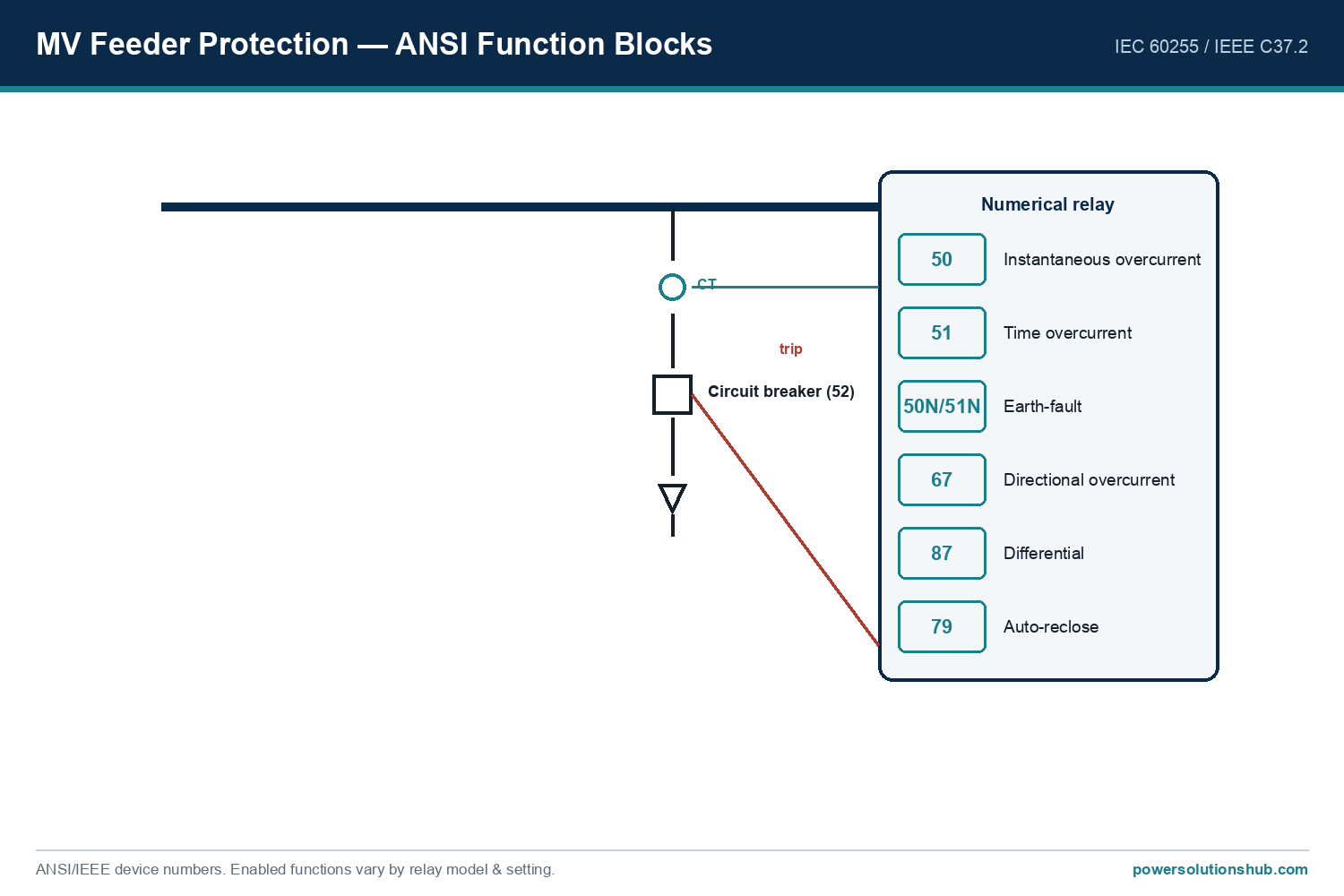
- Protection relay logic and trip circuits for MV/HV circuit breakers
- Spring-charging motors and closing/opening solenoids on withdrawable circuit breakers
- SCADA, RTU, and communication gateway power supplies
- DC emergency lighting and alarm/annunciation panels
- Motor operators on disconnectors, earthing switches and ring main unit switches
A well-designed DC power system therefore sits at the intersection of protection engineering, power electronics, and battery technology — which is why buyers should evaluate rectifier, battery and distribution components together rather than as separate purchases.
Core Architecture: Rectifier, Battery Bank, and DC Distribution
Battery charger / rectifier module — Converts incoming single- or three-phase AC into regulated DC output, both to float-charge the battery continuously and to directly supply the connected DC loads under normal conditions. Modern rectifier modules are typically modular and hot-swappable, allowing redundant units to be added for N+1 style resilience without shutting down the DC bus.
Stationary battery bank — Provides ride-through autonomy when the AC supply to the rectifier is interrupted. The battery must be sized so it can support the connected protection, control and communication load for a defined autonomy period, plus a momentary high-current pulse for breaker tripping or closing operations.
DC distribution board — Fans the regulated DC output to individual protection and control circuits through fuses or miniature circuit breakers, with insulation monitoring to detect earth faults on the DC network before they can cause a mis-operation or loss of protection.
Monitoring and alarm module — Continuously supervises battery voltage, charging current, insulation resistance and rectifier health, raising alarms for the operator well before a fault condition could compromise the substation’s protection scheme.
Battery Technology Options for DC Power Systems
Selecting the right battery chemistry is one of the most consequential decisions in a DC power system, because it drives maintenance regime, footprint, expected service conditions, and total cost of ownership.
Valve-Regulated Lead-Acid (VRLA) batteries — Sealed-for-life design, low maintenance, compact footprint, and widely used where ambient temperature can be reasonably controlled. VRLA batteries are a common default choice for standard substation and switchgear auxiliary supply applications due to their favorable balance of cost and ease of installation.
Vented (flooded) Nickel-Cadmium (Ni-Cd) batteries — Recognized for robustness in wide temperature swings and harsh industrial environments, tolerant of deep discharge cycling, and generally associated with a longer service life than VRLA in demanding conditions, at the cost of a periodic topping-up maintenance regime and a larger installation footprint.
Lithium-based stationary batteries — Increasingly specified where space is constrained and where lower weight and faster recharge are priorities; adoption in MV substation DC systems is growing but still requires careful attention to protection, monitoring and thermal management design.
The table below summarizes the qualitative trade-offs buyers should weigh — no fabricated numeric ratings are used here; actual voltage, capacity and autonomy figures must always be confirmed against the manufacturer’s project-specific datasheet.
| Attribute | VRLA (sealed lead-acid) | Vented Ni-Cd | Lithium-based |
|---|---|---|---|
| Maintenance regime | Sealed-for-life, minimal upkeep | Periodic electrolyte/topping maintenance | Low maintenance, BMS-managed |
| Footprint | Compact | Larger, heavier | Most compact |
| Temperature tolerance | Moderate, sensitive to heat | Wide tolerance, robust | Requires thermal management |
| Typical duty | Standard substation/switchgear auxiliary supply | Harsh industrial/utility environments, deep cycling | Space-constrained, modern retrofits |
| Recharge characteristic | Standard float/boost charging | Slower recharge, robust cycling | Faster recharge capability |
Selection Criteria: How to Specify a DC Power System
1. Load profile and duty cycle — List every DC-fed device (relays, trip coils, motor operators, SCADA, lighting) and separate the continuous “standing” load from the momentary high-current pulses needed for breaker operation, since the rectifier and battery must be sized for both.
2. Required autonomy — Define how long the battery bank must support the full load with no AC input, based on the site’s realistic restoration time and the criticality of the installation (a remote unmanned substation typically demands longer autonomy than a manned industrial plant with fast standby generation).
3. Redundancy level — Decide whether a single rectifier module is acceptable or whether an N+1 configuration of hot-swappable rectifier modules is required so that a single module failure does not interrupt battery charging.
4. Battery chemistry vs. environment — Match VRLA, Ni-Cd, or lithium technology to the expected ambient temperature range, ventilation, available floor space, and the site’s ability to perform periodic maintenance.
5. Monitoring and communication — Confirm the DC system can report battery voltage, insulation status, and rectifier alarms back to the station SCADA/RTU, ideally with remote diagnostics for unmanned or hard-to-access sites.
6. Insulation and earth-fault supervision — Verify the distribution board includes continuous insulation monitoring, since an undetected earth fault on the DC bus can defeat protection tripping exactly when it is needed most.
7. Physical integration with switchgear — Coordinate cabinet dimensions, cable entries and communication interfaces with the MV switchgear or RMU supplier so the DC system integrates cleanly into the substation control building or outdoor kiosk.
Applications of DC Power Systems
Utility MV/HV substations — Feeding protection relays, breaker trip circuits, and SCADA at grid substations where uninterrupted control power is essential for fault clearance and remote operation.
Industrial plants with MV switchgear — Supporting motor control centers, ring main units and MV switchboards in oil & gas, mining, cement, water treatment and heavy manufacturing facilities.
Renewable energy substations — Providing DC control power for collector substations at solar and wind farms, where sites are often unmanned and rely heavily on remote monitoring.
Data centers and critical infrastructure — Backing up MV/LV switching equipment where any loss of protection or control power carries a high operational risk.
Rail and transit traction substations — Supplying signaling, protection and control loads that must remain energized independent of the traction supply status.
Standards and Compliance Notes
DC power systems for substations are engineered against equipment-specific standards covering stationary battery design, charger performance, and DC distribution safety, which are distinct from the switchgear standards that govern the MV breakers and busbars themselves. Because DC systems, batteries and rectifiers form a different equipment class from AC switchgear, buyers should ask suppliers to confirm the specific product standards applicable to the battery chemistry and charger design selected for their project, rather than assuming that MV switchgear standards automatically extend to the DC auxiliary supply. A reputable supplier will document compliance for the rectifier module, the battery bank, and the DC distribution board as separate, traceable items within the overall substation compliance file.
Related guides
See also our guides on gas-insulated switchgear, metal-clad switchgear and air-insulated switchgear.
What is the difference between a battery charger and a rectifier in a DC power system?
In substation terminology the two terms are often used interchangeably: the rectifier module converts AC to DC and also performs the charging function for the battery bank, maintaining it in a float-charged, ready-to-discharge state while simultaneously supplying the connected DC loads.
How long should a substation battery bank be able to support the load without AC input?
Required autonomy is project-specific and depends on the criticality of the site, the realistic time to restore AC supply, and the load profile; this figure should be defined in the project specification and confirmed with the battery manufacturer rather than assumed from a generic industry default.
Can lithium batteries replace VRLA or Ni-Cd batteries in existing substations?
Lithium-based stationary batteries can be used in retrofit or new-build DC systems where compact footprint and lower weight are priorities, but the battery management system, protection and thermal design must be engineered specifically for the application rather than swapped in as a drop-in replacement.
Why is insulation monitoring important on a DC distribution board?
An undetected earth fault on an ungrounded DC bus can, in some fault combinations, prevent a protection relay from tripping a breaker correctly; continuous insulation monitoring allows the operator to detect and clear a first earth fault before it compounds into a protection failure.
What is N+1 redundancy in a battery charger/rectifier system?
N+1 redundancy means installing one more rectifier module than the number strictly required to carry the load, so that if a single module fails, the remaining modules continue to charge the battery and supply the DC bus without interruption.
Does a DC power system need to be sized for momentary high-current pulses, not just steady load?
Yes — circuit breaker tripping and closing operations, and spring-charging motors, draw short but significant current pulses on top of the continuous standing load, and both the rectifier and battery must be sized to handle these pulses without an unacceptable voltage dip.
How should a DC power system be integrated with existing MV switchgear or ring main units?
Integration should be coordinated early with the switchgear supplier so that cabinet dimensions, cable routing, communication protocols and control voltage levels are aligned, avoiding costly rework once the switchgear and DC system arrive on site separately.
Looking for Battery Rectifier / DC Systems?
Looking for high-quality battery rectifier / dc systems? We provide expert engineering support and reliable products for all your medium voltage needs.
For quotations and requests: info@electricistanbul.com
WhatsApp: +90 501 076 69 91