
A dry-type transformer is a medium-voltage power transformer whose winding insulation is cooled and insulated by air or a solid cast-resin system rather than by a liquid dielectric, while an oil-immersed transformer uses mineral oil or a synthetic ester fluid as both coolant and insulating medium — the choice between the two is driven by fire-safety classification, installed environment, loss economics, and maintenance strategy rather than by voltage class alone. This guide walks through the underlying physics of transformer losses and cooling, gives a worked total-owning-cost example, and provides a practical comparison table for specifying engineers. It applies equally to projects in the Middle East and Gulf region including Egypt and Saudi Arabia, North Africa, CIS countries, and Sub-Saharan Africa, where ambient temperature, indoor siting, and fire codes strongly influence the dry-type vs oil decision.
For a deeper look at the switchgear that protects and connects these transformers, see our [medium voltage switchgear](/what-is-mv-switchgear-medium-voltage-switchgear/) hub, and for coordination of protection during transformer faults, review our [protection relay](/what-is-a-medium-voltage-protection-relay-mv-protection-relay/) guide.
The method: how losses and cooling drive the selection
Every power transformer dissipates two categories of loss that must be removed by its cooling medium:
- No-load (core) loss, P₀ — continuous, voltage-dependent, caused by hysteresis and eddy currents in the core steel.
- Load (copper) loss, Pk — proportional to the square of the load current, caused by resistive heating in the windings.
The total heat to be rejected is:
P_total = P₀ + Pk × (S_actual / S_rated)²
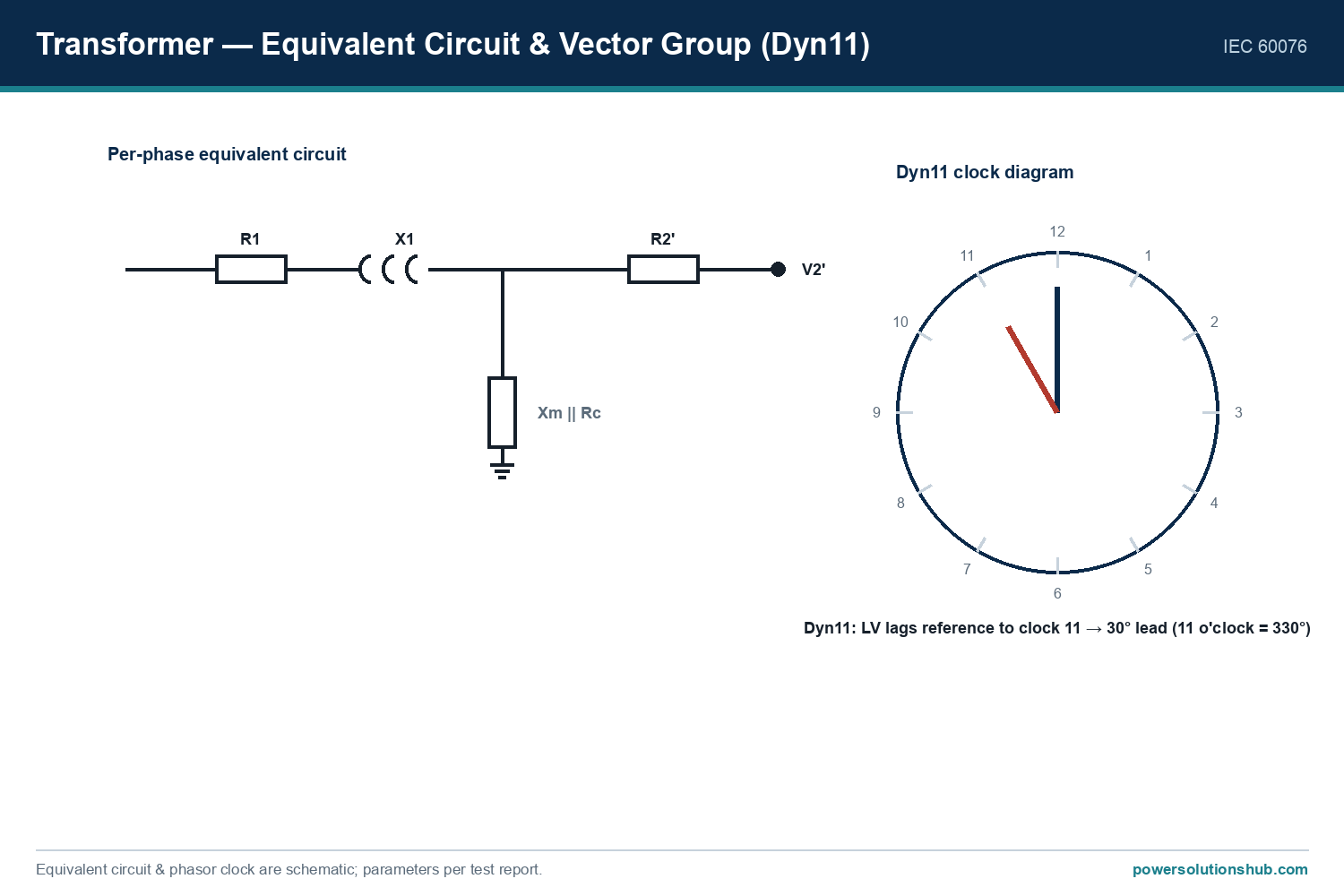
This heat determines the winding hot-spot temperature rise, which in turn dictates the insulation class and the permissible loading. Oil acts as an efficient heat-transfer and dielectric medium simultaneously, allowing higher continuous ratings and better overload tolerance in a given frame size, because natural or forced oil circulation carries heat away from the windings more effectively than air. Dry-type units rely on air convection (AN) or forced air (AF) over cast-resin or vacuum-pressure-impregnated windings, so their winding cross-section and core size are generally larger for an equivalent kVA rating to keep temperature rise within the insulation class limit.
A second engineering variable is the transformer’s rated current, which sizes the busbar, cable, and switchgear feeding it regardless of cooling type:
I = S / (√3 × V)
This current calculation is identical for dry-type and oil-immersed units of the same kVA and voltage — the cooling medium changes thermal and fire behavior, not the fundamental electrical rating.
Worked example: current, loss, and annual energy cost comparison
Step 1 — Rated current. For a 1000 kVA transformer at 11 kV:
I = S / (√3 × V) = 1,000,000 / (1.732 × 11,000) ≈ 52.5 A
This current is the same whether the unit is dry-type or oil-immersed, and it is the figure used to size the incoming and outgoing switchgear feeders.
Step 2 — Illustrative loss comparison. Assume, for illustration only, a dry-type unit with no-load loss of 2.0 kW and a comparably rated oil-immersed unit with no-load loss of 1.4 kW (dry-type cores are commonly designed with somewhat higher no-load loss to reduce size/cost trade-offs; actual figures must come from the manufacturer’s test report).
At 60% average loading (S_actual/S_rated = 0.6), and assuming full-load copper loss of 10 kW for both designs:
Pk(actual) = 10 kW × (0.6)² = 3.6 kW
- Dry-type total loss ≈ 2.0 + 3.6 = 5.6 kW
- Oil-immersed total loss ≈ 1.4 + 3.6 = 5.0 kW
Step 3 — Annual energy cost of the loss differential. Difference = 0.6 kW continuous.
Annual extra energy = 0.6 kW × 8,760 h = 5,256 kWh/year
At an illustrative energy cost of $0.10/kWh, that is ≈ $526/year in additional losses for the higher-loss unit — a figure that should be weighed against the higher capital cost, lower fire risk, and reduced civil works (no oil containment/bund) typically associated with dry-type transformers.
Step 4 — Cast-resin vs oil in a fire-sensitive room. If the same 1000 kVA transformer must sit inside an occupied building basement, the absence of flammable oil (dry-type) removes the need for an oil sump, fire wall rating upgrade, and oil-fire suppression system — a qualitative but often decisive factor even before the loss economics above are considered.
Comparison table: dry-type vs oil-immersed
| Criterion | Dry-Type (Cast Resin / VPI) | Oil-Immersed (Mineral Oil / Ester) |
|---|---|---|
| Cooling medium | Air (natural AN or forced AF) | Liquid dielectric, natural or forced circulation |
| Typical siting | Indoor, occupied buildings, basements | Indoor with fire precautions, or outdoor/pad-mounted |
| Fire behavior | Self-extinguishing resin, no flammable liquid pool | Requires oil containment/bund and fire barriers |
| Relative footprint per kVA | Larger core/winding for equivalent thermal class | Generally more compact for the same rating |
| Maintenance | Low; periodic cleaning and insulation checks | Includes oil sampling, dissolved-gas analysis (DGA), gasket checks |
| Overload/short-term tolerance | Governed by winding insulation class and air cooling limit | Generally higher short-term overload margin due to oil’s heat capacity |
| Environmental exposure | Sensitive to dust/humidity unless sealed/tropicalized | Well suited to outdoor, dusty, high-ambient environments once properly rated |
| End-of-life environmental risk | No oil leakage/spill risk | Requires oil handling, spill containment, and disposal planning |
(Values in this table describe general engineering behavior, not a specific product’s rated figures.)
Selection criteria and common pitfalls
1. Start with the site fire code, not the price list. Many national and local fire codes mandate dry-type transformers for transformers located inside occupied buildings, hospitals, high-rise cores, or metro/rail stations — regardless of loss economics. Confirm this constraint before comparing bids.
2. Check ambient and altitude derating separately for each technology. Air-cooled dry-type units are more sensitive to high ambient temperature and elevation because their cooling relies entirely on air density and convection; oil-immersed units also derate but generally have more thermal buffering from the oil mass. Always request the manufacturer’s derating curve, not a generic assumption.
3. Match cable and switchgear rated current to the calculated I, not to the kVA label. As shown in the worked example, I = S/(√3×V) determines cable cross-section, CT ratio, and switchgear busbar rating — a step often skipped when engineers compare only kVA and voltage class between dry and oil options.
4. Verify insulation class and temperature rise together. A dry-type unit’s continuous rating is only valid if the stated winding temperature rise (measured against a defined ambient) matches the site’s actual ambient — do not compare kVA ratings from two technologies without checking the ambient and insulation class assumptions behind each.
5. Plan for maintenance access differently. Oil-immersed transformers require space and procedures for oil sampling, dissolved-gas analysis (DGA), and eventual oil replacement or filtration; dry-type units need periodic dust removal and insulation resistance testing but no liquid handling. Include this operational difference in the total cost of ownership, alongside the loss-cost calculation shown above.
6. Don’t assume oil always means outdoor-only, or dry-type always means small. Modern oil-immersed transformers can be installed indoors with adequate fire protection, and dry-type transformers are available up to substantial power ratings — the technology choice should follow the site constraint and loss/lifecycle analysis, not a rule of thumb.
Standards and compliance notes
Dry-type power transformers are generally covered by the IEC 60076 series, with IEC 60076-11 addressing dry-type transformers specifically, while oil-immersed transformers fall under the general requirements of IEC 60076-1 together with related parts covering temperature rise, insulation, and testing. Fire behavior classification for indoor installations is typically referenced against relevant fire and environmental classification clauses within the applicable national or IEC framework rather than the switchgear standards (IEC 62271 series), which govern switchgear assemblies — not the transformer itself. Always confirm the specific edition and part number required by the project specification and local authority having jurisdiction.
Related guides
See also our guides on gas-insulated switchgear, ring main units and metal-clad switchgear.
Is a dry-type transformer always safer than an oil-immersed one?
Dry-type units eliminate the risk of an oil fire or oil spill, which is why they are frequently mandated indoors and in occupied buildings. Oil-immersed transformers can still be made safe for indoor use with proper containment, fire barriers, and suppression systems, but the qualitative fire risk profile of the two technologies is genuinely different.
Why do dry-type transformers often need a larger footprint than oil-immersed units of the same kVA?
Because air is a less effective heat-transfer medium than oil, dry-type designs typically require larger winding surface area and more core material to keep the winding hot-spot temperature within the insulation class limit at the same rating.
Does the rated current calculation differ between dry-type and oil transformers?
No. I = S/(√3×V) is a function of kVA and voltage only; the cooling medium does not change the electrical current the switchgear and cables must be sized for.
Can oil-immersed transformers be installed indoors?
Yes, with proper oil containment, fire-rated barriers, and sometimes fire suppression, but many fire codes prefer or require dry-type units for sensitive indoor or occupied locations.
What maintenance does an oil-immersed transformer need that a dry-type doesn’t?
Oil sampling and dissolved-gas analysis (DGA), oil dielectric strength testing, and periodic gasket/seal inspection are specific to oil-immersed units; dry-type transformers instead need insulation resistance checks and dust/humidity control.
Which technology has lower total losses?
It depends on the specific design; the worked example above shows how no-load and load losses combine, and actual figures must always be taken from the manufacturer’s factory test report, not assumed from technology type alone.
Which IEC standard governs dry-type transformers specifically?
IEC 60076-11 addresses dry-type power transformers, while general oil-immersed transformer requirements are covered under IEC 60076-1 and related parts of the IEC 60076 series.
Looking for medium voltage transformers?
Looking for high-quality medium voltage transformers? We provide expert engineering support and reliable products for all your medium voltage needs.
For quotations and requests: info@electricistanbul.com
WhatsApp: +90 501 076 69 91