
Safering RMU switchgear refers to the ABB SafeRing/SafePlus 36 family of gas-insulated, secondary medium-voltage ring main units, built around a sealed stainless-steel SF6 tank that houses all live switching parts to protect personnel and simplify maintenance. This article explains what SafeRing and SafePlus are, how they differ, the compact functional units and sealed-tank technology they are built on, the applicable IEC test standards, environmental design conditions, and the buying criteria procurement engineers should apply when specifying this switchgear for utility, industrial, and infrastructure networks. This guidance is relevant for buyers across the Middle East and Gulf region (including Egypt and Saudi Arabia), North Africa, CIS, and Sub-Saharan Africa, where compact, low-maintenance secondary distribution switchgear is widely used to connect transformer stations, industrial loads, and renewable generation to the medium-voltage grid.
What Is Safering RMU Switchgear?
SafeRing and SafePlus were developed by ABB in Skien, Norway, and introduced to the market in 2000, replacing ABB’s earlier SF6-insulated RGC and CTC product lines. Since launch, the installed base has grown to more than 150,000 switchgears deployed across more than 100 countries worldwide.
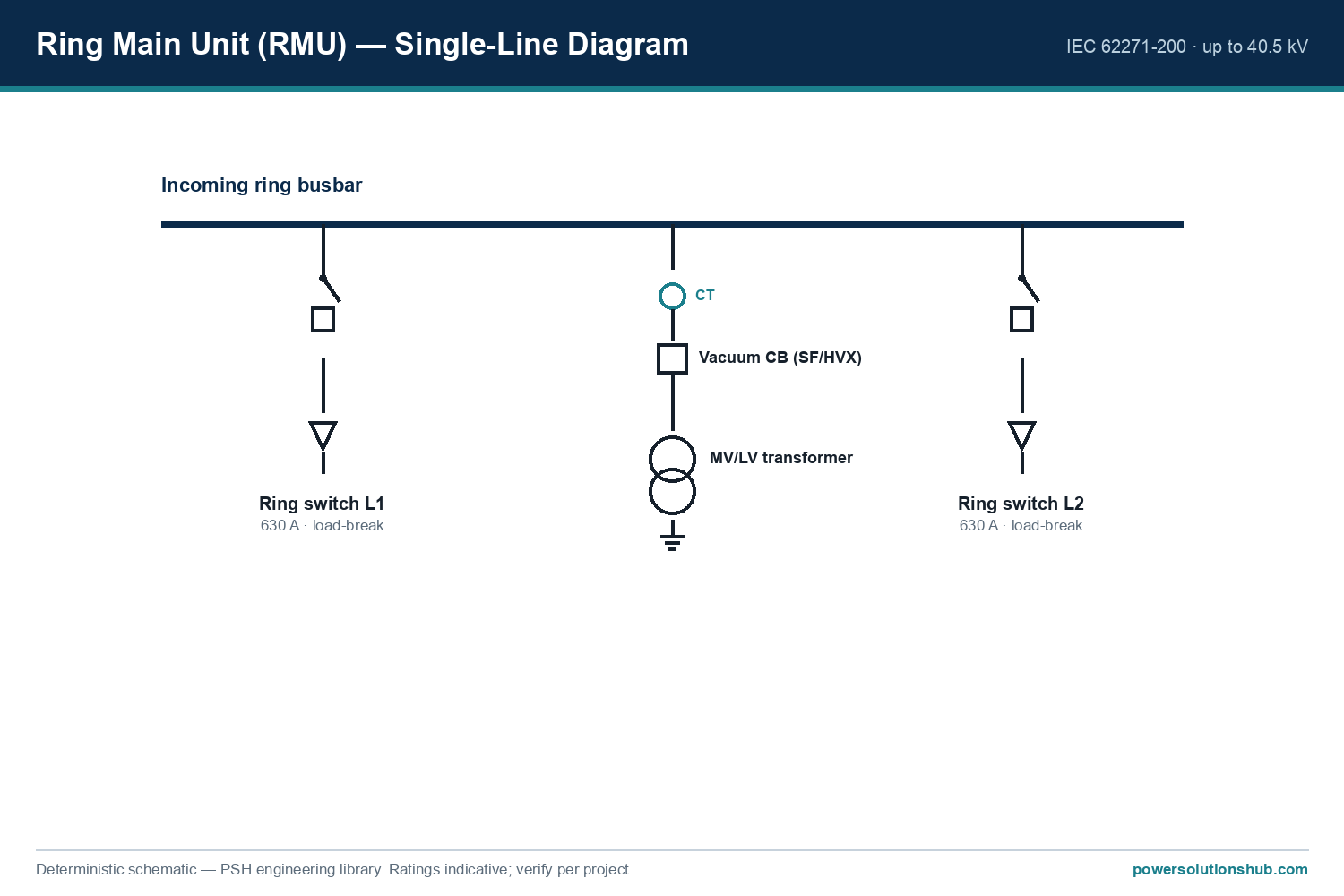
Both products share the same operator interface but serve different application needs: SafeRing is a standardized, high-volume ring main unit optimized for the most commonly required distribution network configurations, while SafePlus is the flexible, modular version of the same platform offering higher ratings and customization, including advanced grid automation for smart RMUs. Functions such as earthing, disconnecting, cable connection, busbar extension, protection, and switching are integrated into compact functional units rather than built as separate switching cells — a design approach that reduces footprint and the number of moving mechanical parts, lowering the risk of mechanical defects.
SafeRing vs SafePlus: Types and Variants
SafeRing — a standardized ring main unit line built on high-volume production, covering the configurations most frequently requested by distribution network operators. It is available with pre-defined configurations for transformer stations, switching stations, and DSO-connected consumer switchgear, enabling fast delivery.
SafePlus — the same switchgear platform re-engineered for flexibility, modularity, and higher electrical capacity. SafePlus can be customized to cover the full range of distribution needs, including smart-grid-ready automation, and supports additional functional units such as transformer protection, fuses, protection relays and control products, remote control, and battery back-up options.
Both variants use a completely sealed system with a welded stainless-steel tank containing all live parts and switching functions, giving high reliability, personnel safety, and a virtually maintenance-free operating life.
How the Sealed Gas-Insulated System Works
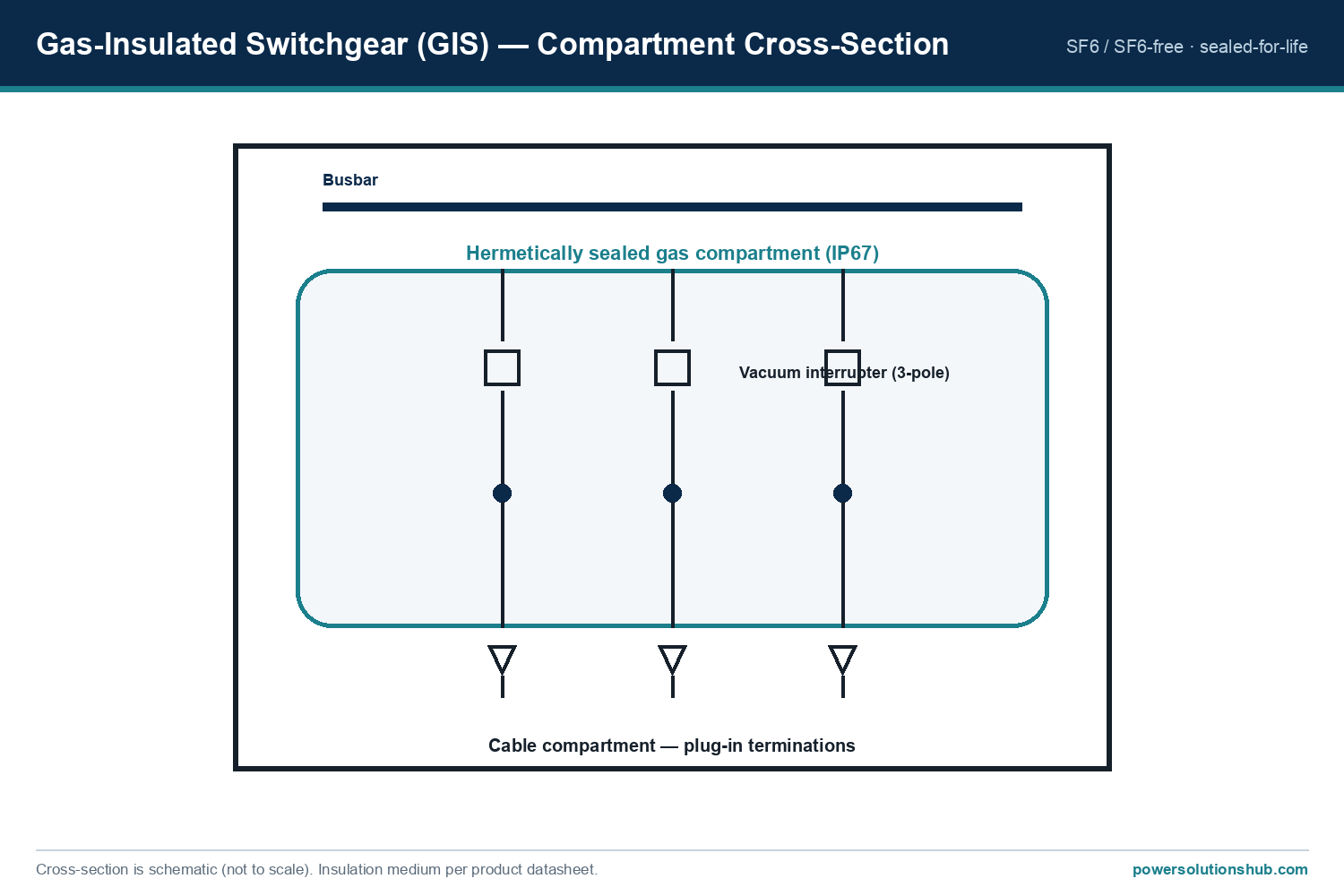
SafeRing/SafePlus 36 uses SF6 gas as the insulation and arc-quenching medium, sealed inside a welded stainless-steel enclosure. The pressure system is defined as sealed-for-life, with an operating lifetime better than 30 years and a gas leakage rate of less than 0.1% per year. All welding is carried out by computer-controlled robots and every enclosure is helium-leak-tested before SF6 filling, with leak testing and gas filling performed inside a vacuum chamber to guarantee a tight seal.
The SF6 enclosure itself carries a degree of protection of IP67, meaning it can be immersed in water and still perform its function reliably. Upper and lower front covers are made of 1.5 mm aluzink with a polycarbonate foil carrying the mimic diagram, while side covers are made of 1.25 mm hot-rolled steel, both finished in RAL 7035 grey. Cable compartments are separated from each other by partition walls and from the rear of the switchgear by a vertical partition, which limits the movement of hot gases in the event of an internal arc.
Personnel Safety and Internal Arc Classification (IAC)
Internal arc faults, although statistically rare, can theoretically arise from insulation defects, incorrect cable installation, damaged interlocks, loose connections, or small animals entering cable compartments. ABB tests the SafeRing/SafePlus enclosure’s ability to withstand such events according to the Internal Arc Classification (IAC) procedure defined in IEC 62271-200.
Two accessibility classes are defined: Accessibility A, intended for authorized personnel only, requires a 300 mm safety distance on accessible sides; Accessibility B, intended for public access areas, requires a 100 mm safety distance. Access direction is further denoted by F (front), L (lateral) and R (rear). Enclosures classified IAC AFL keep hot gases from the internal arc out of the cable compartment via the vertical partition wall, while units classified IAC AFLR may allow hot gases into the cable compartment.
Additional personnel-safety features built into the design include padlockable handles, cover interlocks, and gas pressure relief functions, along with a fully touch-proof enclosure that keeps operators away from live MV parts during normal operation and maintenance.
Selection Criteria for Buyers
When specifying Safering RMU switchgear for a project, procurement and design engineers should evaluate:
- Application fit — SafeRing for standard, high-volume ring main configurations with fast delivery; SafePlus where higher electrical capacity, modularity, or smart-grid automation is required.
- Arc-fault protection level — confirm the IAC accessibility class (A or B) and access direction (F/L/R, AFL or AFLR) required for the installation location and expected personnel exposure.
- Environmental operating envelope — verify ambient temperature range, humidity, and altitude limits match the installation site (see technical data table below).
- Sealed system integrity — confirm the sealed-for-life design, expected operating lifetime, and gas leakage guarantee to minimize lifecycle maintenance.
- Compliance and factory testing — check which IEC test standards the switchgear has been type- and routine-tested against.
- Integrated functional units — confirm availability of transformer/sensor modules, fuses, protection relays, remote control, and battery back-up options needed for the specific network design.
- Environmental footprint — for sustainability-driven tenders, ask for recycling capability data and environmental certification documentation.
Technical Data Summary
| Parameter | Value | Notes |
|---|---|---|
| Market introduction | 2000 | Replaced SF6-insulated RGC/CTC products |
| Installed base | 150,000+ switchgears | In 100+ countries |
| Sealed system operating life | Better than 30 years | Sealed-for-life pressure system |
| SF6 leakage rate | Less than 0.1% per year | |
| SF6 enclosure protection degree | IP67 | Enclosure can be immersed in water |
| Minimum ambient temperature | -25°C | Rated characteristics valid range |
| Maximum ambient temperature | +40°C | |
| Maximum operating altitude | 1500 m above sea level | Contact ABB for higher altitude |
| IAC accessibility A safety distance | 300 mm | Authorized personnel only |
| IAC accessibility B safety distance | 100 mm | Public access areas |
| Total height, high LV compartment version | 2180 mm | 2280 mm for metering module |
| Recycling capability | 88.8% | Per environmental certification |
Applications
Safering RMU switchgear is used across a broad set of sectors: industrial facilities in pulp and paper, cement, textiles, chemicals, food processing, automotive, petrochemical, quarrying, oil and gas pipelines, rolling mills, and mining; utilities and power generation including power plants, transformer and metering stations, main and auxiliary switchgear, wind turbines, solar/PV plants, and hydro power plants; transport infrastructure such as airports, ports, railways, and underground transport systems; and general infrastructure including hotels, shopping centers, hospitals, commercial buildings, and large civil works.
Standards and Compliance
SafeRing/SafePlus is designed and type-tested according to a defined set of IEC standards: IEC 62271-1 (common specifications for high-voltage switchgear and controlgear), IEC 62271-100 (alternating current circuit-breakers), IEC 62271-102 (disconnectors and earthing switches), IEC 62271-103 (switches for rated voltages above 1 kV up to and including 52 kV), IEC 62271-105 (switch-fuse combinations above 1 kV up to and including 52 kV), IEC 62271-200 (AC metal-enclosed switchgear and controlgear above 1 kV up to and including 52 kV), and IEC 60529 (degrees of protection provided by enclosures, IP code). The switchgear is additionally tested together with Compact Secondary Substations according to IEC 62271-202, including tests performed on CSS from various manufacturers.
Every manufactured unit undergoes standard routine testing according to IEC 62271-200, including visual inspection, mechanical and electrical sequence operations, secondary wiring checks, power-frequency withstand voltage testing, partial discharge measurement, main circuit resistance measurement, secondary insulation testing, and gas tightness control. Manufacturing is carried out in Norway under ISO 14001 environmental certification.
Related guides
See also our guides on gas-insulated switchgear, metal-clad switchgear and air-insulated switchgear.
What does “Safering RMU switchgear” mean?
It refers to the ABB SafeRing/SafePlus 36 range of gas-insulated ring main units used for secondary medium-voltage distribution, built on a sealed SF6 tank that integrates switching, earthing, and cable-connection functions.
What is the difference between SafeRing and SafePlus?
SafeRing is the standardized, high-volume version covering the most common ring main configurations with fast delivery, while SafePlus is the flexible, modular version of the same platform offering higher ratings and customization, including smart RMU automation. Both share the same operator interface.
How long does the sealed gas system last without maintenance?
The pressure system is sealed for life, rated for an operating lifetime better than 30 years, with an SF6 leakage rate of less than 0.1% per year, resulting in a virtually maintenance-free gas system.
What protects personnel during an internal arc fault?
The metal enclosure is type-tested for Internal Arc Classification (IAC) per IEC 62271-200, using accessibility classes A (300 mm safety distance, authorized personnel) or B (100 mm safety distance, public access), and access directions front/lateral/rear, along with a vertical partition wall that limits hot gases reaching the cable compartment in AFL-classified units.
What ambient conditions can the switchgear operate in?
Rated characteristics are valid from -25°C minimum to +40°C maximum ambient temperature, at altitudes up to 1500 m above sea level, in a normal, non-corrosive and uncontaminated atmosphere.
Which IEC standards apply to this switchgear?
SafeRing/SafePlus is tested to IEC 62271-1, -100, -102, -103, -105, and -200, plus IEC 60529 for enclosure protection, and is also tested with Compact Secondary Substations under IEC 62271-202.
Looking for Safering RMU Switchgear?
Looking for high-quality safering rmu switchgear? We provide expert engineering support and reliable products for all your medium voltage needs.
For quotations and requests: info@electricistanbul.com
WhatsApp: +90 501 076 69 91