
The Relion series is ABB’s family of numerical protection, control, measurement and supervision relays for medium-voltage feeders, in which REF601, REX615 and REX640 represent entry-level, standard, and advanced feeder-protection relay classes built around IEC 61850-based substation communication. This article explains how the three relay classes differ, what protection and control functions a typical feeder relay in this family provides, how to select between them, and where they fit into MV switchgear projects across the Middle East and Gulf region (including Egypt and Saudi Arabia), North Africa, the CIS, and Sub-Saharan Africa.
What Is a Relion Series Protection Relay?
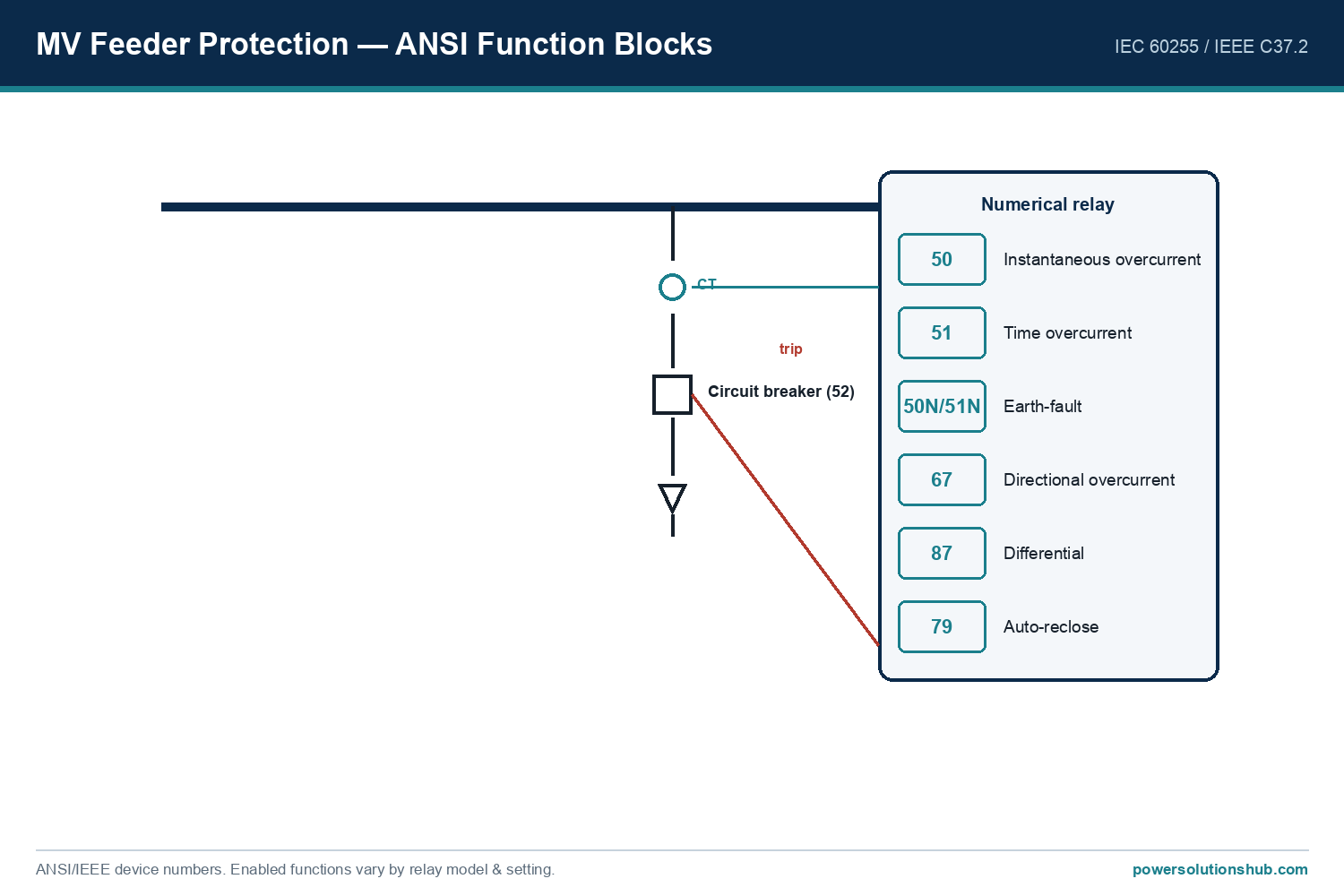
A Relion-series relay is a microprocessor-based intelligent electronic device (IED) that combines overcurrent, earth-fault, and related protection functions with control, measurement, disturbance recording, and communication capabilities for a single MV feeder bay or busbar section. Within the family, REF601 is positioned as a compact, cost-optimized feeder protection unit; REX615 is a re-engineered, standard-configuration feeder protection relay guided by the IEC 61850 standard for communication and interoperability of substation automation devices ; and REX640 sits at the higher end of the platform, aimed at applications needing extended functionality and flexibility. Because ABB’s own product documentation for this generation of feeder relays is published under the REF615 designation, the technical detail below is grounded in that document and should be read as representative of the 615-class relay within the Relion family; REF601 and REX640 features are described qualitatively where source-verified figures are not available.
Relion Relay Classes at a Glance
REF601 — a basic-tier feeder protection relay intended for simpler distribution feeder applications where a compact footprint and core overcurrent/earth-fault protection are the priority. Detailed numeric ratings for REF601 are not covered in the source document referenced here and should be confirmed against the specific REF601 datasheet before specification.
REX615 — the standard-configuration feeder protection relay described in ABB’s REF615 product guide. It is designed for protection, measurement and supervision of utility substations and industrial power systems, providing main protection for overhead line and cable feeders in distribution networks, and back-up protection where an independent, redundant protection system is required . It supports isolated neutral, resistance earthed, compensated and solidly earthed network types depending on the configuration selected .
REX640 — positioned as a more advanced feeder/bay-level relay in the same platform generation, intended for applications requiring greater functional depth and flexibility than the standard 615-class relay; specific numeric ratings for REX640 are outside the scope of the source document used for this article and should be verified directly with ABB technical documentation.
Standard Configurations and Protection Functions (REX615 Reference)
The REX615-class relay is available in four alternative standard configurations, labelled A, B, C and D, which combine directional or non-directional earth-fault protection with a common core of overcurrent and supervisory functions . Configurations A and B include directional earth-fault protection, intended mainly for isolated or compensated networks, while configurations C and D provide non-directional earth-fault protection for directly or low-impedance earthed networks .
Across all four standard configurations, the relay includes:
- Three-phase non-directional overcurrent protection with low-set, two high-set instances, and an instantaneous stage
- Negative-sequence overcurrent protection (two instances), phase discontinuity protection, and thermal overload protection
- Circuit-breaker failure protection and three-phase inrush current detection
- Optional arc protection using up to three light-detection sensors for switchgear compartments
Configurations A and B additionally provide directional and non-directional earth-fault low/high-set stages, cross-country earth-fault detection, and transient/intermittent earth-fault protection, while configurations C and D add non-directional sensitive earth-fault protection .
Control, Measurement and Recording Capabilities
The relay provides control of one circuit breaker via dedicated push-buttons, with interlocking schemes configured through the signal matrix tool in the engineering software . Two interlocking modes are available: basic interlocking, where circuit-breaker closing is enabled through a binary input acting as a master interlocking signal, and extended interlocking, where the interlocking scheme is implemented inside the relay configuration based on primary-equipment position information .
Measurement functions continuously track phase currents, symmetrical current components, residual current, and — where directional earth-fault protection is fitted — residual voltage, together with maximum demand, thermal overload level, and phase unbalance .
The disturbance recorder captures up to 12 analog and 64 binary signal channels, with recordings triggerable by threshold crossing or by rising/falling binary-signal edges . The event log stores up to 50 time-stamped event codes in non-volatile memory , and the relay retains records for the four most recent fault events, including current/voltage values and start-time stamps, using DFT, RMS or peak-to-peak measurement modes .
Circuit-breaker condition monitoring covers spring charging time, SF6 gas pressure, travel time and inactivity time, supporting preventive maintenance scheduling , while trip-circuit supervision continuously checks trip-circuit availability in both open and closed breaker positions and detects loss of control voltage .
Inputs, Outputs and Communication
| Parameter | Specification |
|---|---|
| Phase-current inputs | Rated 1/5 A |
| Optional residual-current inputs | 1/5 A or 0.2/1 A (sensitive earth-fault use) |
| Residual-voltage input range | 100, 110, 115, 120 V |
| Binary input threshold range | 18…176 V DC (parameter-selectable) |
| Current inputs (total) | Four current inputs |
| Trip-circuit supervised outputs | Two double-pole power-output contacts with trip-circuit supervision |
| I/O extension module | Seven binary control inputs |
| Communication protocols | IEC 61850 with GOOSE messaging, Modbus |
Access to the relay is protected by a four-level, role-based authentication system covering viewer, operator, engineer and administrator roles, applied consistently across the front-panel HMI, web-browser interface, and engineering tool . A built-in self-supervision system continuously checks relay hardware and software integrity and will block protection functions on detection of a permanent fault, to prevent incorrect operation .
Selection Criteria: Choosing Between REF601, REX615 and REX640
When specifying a Relion-family feeder relay for an MV project, buyers should weigh:
- Network earthing type — directional earth-fault protection suits isolated or compensated networks, while non-directional earth-fault protection fits directly or low-impedance earthed systems .
- Functional depth required — REF601 for compact, cost-sensitive feeder applications; REX615 for standard utility/industrial feeder protection with configurable directional/non-directional schemes; REX640 where extended functionality beyond the standard configuration set is needed.
- Arc-flash protection needs — if fast, sensor-based arc-fault tripping is required for switchgear compartments, confirm the optional arc-protection interface is available on the chosen relay and communication module .
- Circuit-breaker interlocking complexity — simple master-interlock schemes can use basic interlocking; multi-bay or busbar-protection-by-interlocking schemes typically need extended interlocking logic within the relay.
- Communication architecture — verify IEC 61850/GOOSE and Modbus support align with the substation automation system already deployed or planned.
- Recording and diagnostics depth — projects needing detailed post-fault analysis benefit from the multi-channel disturbance recorder, event log and fault-record storage described above.
Sound practice standards and compliance for this relay class rest on adherence to IEC 61850-based communication and interoperability principles, alongside the manufacturer’s own type-test documentation; no switchgear-specific IEC 62271 series requirements apply to relay selection itself, since protection relays are secondary equipment rather than primary switchgear.
Applications
Relion-series feeder relays are applied across:
- Utility distribution substations protecting overhead line and cable feeders
- Industrial power systems requiring independent, redundant back-up protection
- Incoming and outgoing feeder bays in metal-enclosed switchgear, including busbar protection by interlocking between incoming and outgoing feeder relays
- Retrofits and new-build MV substations across the Middle East and Gulf region (including Egypt and Saudi Arabia), North Africa, the CIS, and Sub-Saharan Africa, where robust feeder protection and IEC 61850-based communication support utility and industrial modernization programs.
Related guides
See also our guides on medium voltage switchgear, gas-insulated switchgear and ring main units.
What is the difference between REF601, REX615 and REX640?
They represent different tiers within ABB’s Relion feeder-protection family: REF601 is a compact entry-level relay, REX615 is the standard-configuration relay documented with directional/non-directional earth-fault options and a broad protection function set, and REX640 targets applications needing more advanced functionality than the standard 615-class configurations.
Does REX615 support both directional and non-directional earth-fault protection?
Yes — depending on the standard configuration ordered (A/B for directional, C/D for non-directional), the relay is preconfigured for the corresponding network earthing arrangement .
How many fault events and disturbance records can the relay store?
The relay stores records for the four most recent fault events and provides a disturbance recorder with up to 12 analog and 64 binary channels, plus an event log capacity of 50 time-stamped event codes .
What communication protocols does the Relion feeder relay support?
It supports IEC 61850 with GOOSE messaging for substation automation interoperability, along with Modbus .
Can the relay provide arc-flash protection?
Yes, an optional arc-protection function using up to three light-detection sensors can be added to protect the circuit-breaker, busbar and cable compartments of metal-enclosed switchgear, via the optional communication module interface .
What circuit-breaker monitoring functions are included?
The relay monitors spring charging time, SF6 gas pressure, travel time, and inactivity time to support preventive maintenance planning, together with continuous trip-circuit supervision in both open and closed breaker states .
Are numeric specifications for REF601 and REX640 the same as REX615?
Not necessarily — this article’s numeric figures are drawn from ABB’s REF615 product documentation. REF601 and REX640 belong to the same Relion platform philosophy but should be specified against their own datasheets, since exact I/O counts, memory capacities and communication options can differ by relay class.
Looking for Relion Series Protection Relays (REF601, REX615, REX640)?
Looking for high-quality relion series protection relays (ref601, rex615, rex640)? We provide expert engineering support and reliable products for all your medium voltage needs.
For quotations and requests: info@electricistanbul.com
WhatsApp: +90 501 076 69 91