
Impact of Generators on Short Circuit Current in Power Systems
In power system analysis, calculating short circuit current at any point in the network requires careful consideration of all contributing sources. Among these, synchronous and asynchronous generators play a particularly important role. Because of their internal construction, generators significantly influence the magnitude and behavior of short circuit current through armature reaction, field flux dynamics, and leakage reactances in both the stator and rotor.
When a short circuit occurs, a generator does not behave like a simple voltage source with fixed impedance. Instead, its effective reactance changes over time due to the physical response of the magnetic field. This time-dependent behavior is characterized by three distinct reactance values: subtransient reactance, transient reactance, and steady-state reactance. These parameters determine how the generator short circuit current evolves from the instant the fault occurs until it reaches a stable value.
Synchronous Generator Behavior During Short Circuits
A synchronous generator’s response to a short circuit is governed by the interaction between the stator current and the rotor field. Immediately after the fault, the armature reaction causes a rapid change in the magnetic flux. This leads to very high initial current values that decay in stages.
The first stage is the subtransient period, lasting only a few cycles. During this time, the effective reactance is at its lowest (subtransient reactance, typically denoted as X”d), resulting in the highest short circuit current. Following this, the transient period begins, where the reactance increases to the transient value (Xd’). Finally, the current settles into the steady-state value determined by the synchronous reactance (Xd).
This staged decay is critical because the highest mechanical and thermal stresses on equipment occur during the initial cycles. Protection engineers must account for these peak values when selecting circuit breakers and designing protection schemes.
Generator Close-in Short Circuit Analysis
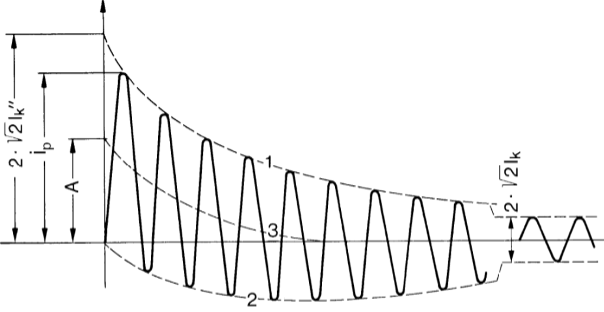
When a short circuit occurs close to the generator terminals, the generator’s internal impedances dominate the fault current calculation. In this scenario, the subtransient period is relatively short. The high initial current caused by low subtransient reactance decays rapidly because the armature reaction quickly weakens the main field flux.
As the field weakens, the generator’s internal voltage drops, effectively increasing its impedance. Consequently, both the peak (asymmetrical) short circuit current and the symmetrical rms value decrease faster than in systems without local generation. This rapid decay means that while the initial current is very high, it stabilizes relatively quickly. Protection devices located near the generator must therefore be rated for these elevated initial values, even if the steady-state current is lower.
Generator Remote Short Circuit Analysis
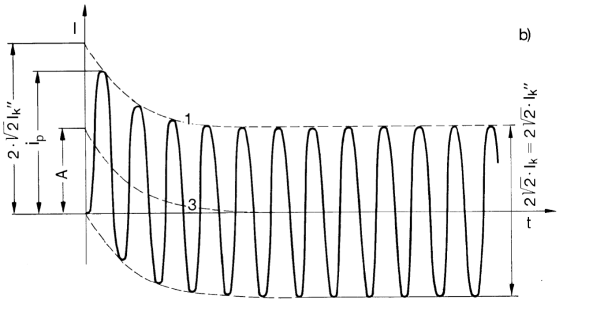
In contrast, when a short circuit occurs far from the generator, the impedance of the network between the generator and the fault location becomes much larger than the generator’s own impedance. In this case, the generator’s contribution to the total short circuit current is relatively small.
Because the network impedance limits the fault current, the initial peak and the steady-state values are much closer to each other. The subtransient and transient effects of the generator are masked by the dominant network impedance. As a result, the short circuit current does not show the dramatic initial spike and rapid decay seen in close-in faults. Instead, it remains relatively stable from the beginning of the fault.
This difference has important practical implications. In networks with distributed generation, engineers must perform detailed studies to determine whether a fault is electrically “close” or “remote” to each generator. The location directly affects the required breaking capacity of circuit breakers and the coordination of protective relays.
Importance for Protection System Design
Accurate modeling of generator short circuit behavior is essential for proper protection coordination and equipment sizing. Circuit breakers must be capable of interrupting the highest possible asymmetrical current that can occur during the subtransient period. Similarly, protection relays must be set correctly to detect faults quickly while maintaining selectivity.
Ignoring the time-varying reactances of generators can lead to under-rated equipment or incorrect relay settings, both of which compromise system reliability and safety. Modern short circuit analysis software allows engineers to model subtransient, transient, and steady-state conditions separately, providing a realistic picture of fault current evolution.
Impact of Generators on Short Circuit Current Calculations
Understanding how synchronous generators affect short circuit current through their time-dependent reactances is fundamental for reliable power system design. Whether the fault occurs near or far from the generator, proper consideration of subtransient, transient, and steady-state periods ensures that protection systems are correctly dimensioned and that equipment can withstand the mechanical and thermal stresses of faults.
Looking for Generator Short Circuit Analysis for your project?
Looking for detailed generator short circuit studies, protection coordination, or correctly rated switching equipment for systems with synchronous or asynchronous generators? We provide expert engineering support and reliable solutions tailored to your power system requirements.
For quotations and requests: info@electricistanbul.com
Whatsapp: +90 501 076 69 91