
The Schneider RM6 is a compact, SF6 gas-insulated ring main unit (RMU) for medium-voltage secondary distribution, rated up to 24 kV and built around modular functional units that combine switching, transformer protection and earthing in a sealed enclosure. It belongs to the ring main unit (RMU) family — see the RMU pillar for selection across brands.
This guide covers the RM6’s configurations (functional units), technical ratings, selection criteria and typical applications, so you can specify the right unit for a distribution substation across the Middle East and Gulf — including Egypt and Saudi Arabia — North Africa and CIS markets.
What the RM6 is (and where it fits)
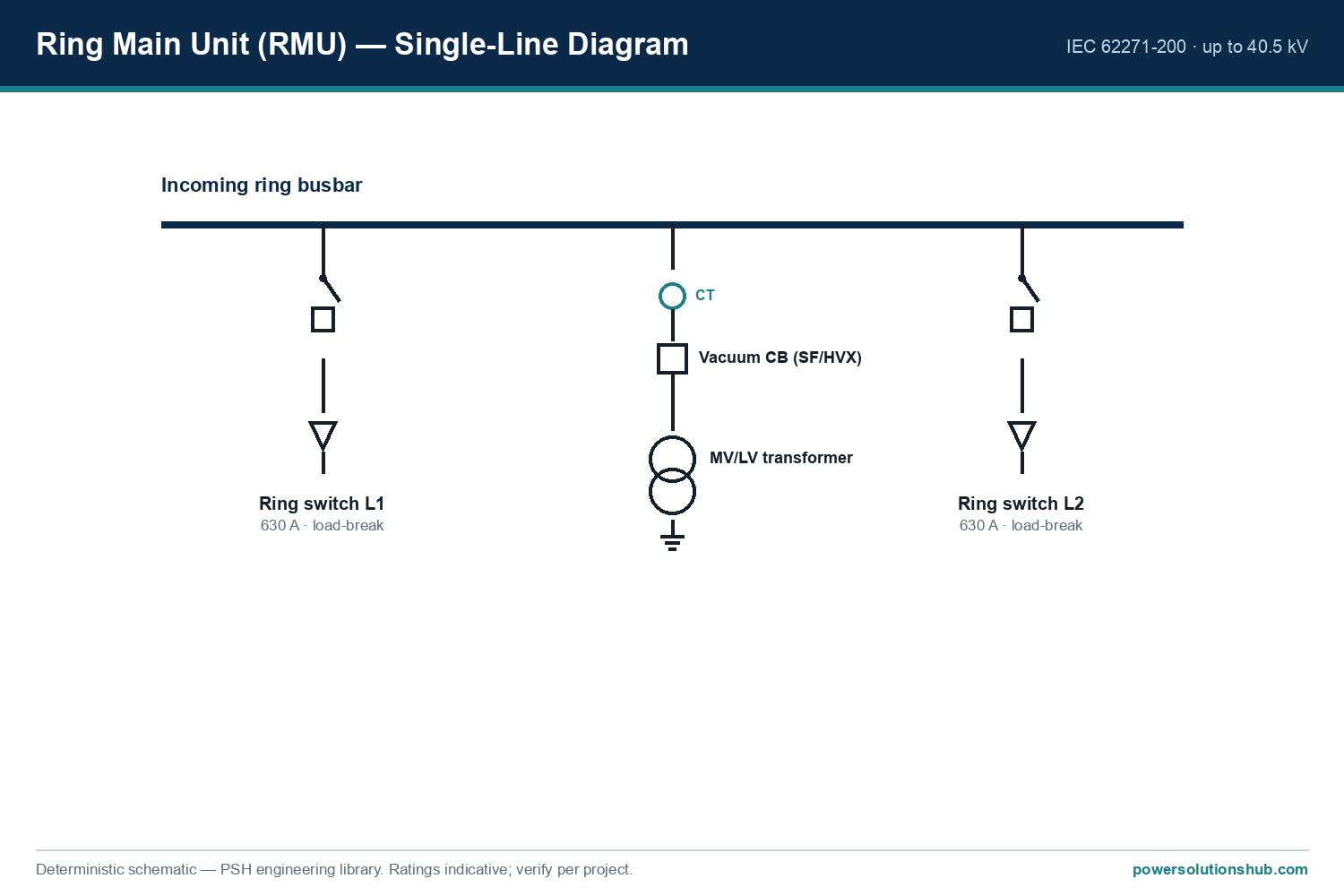
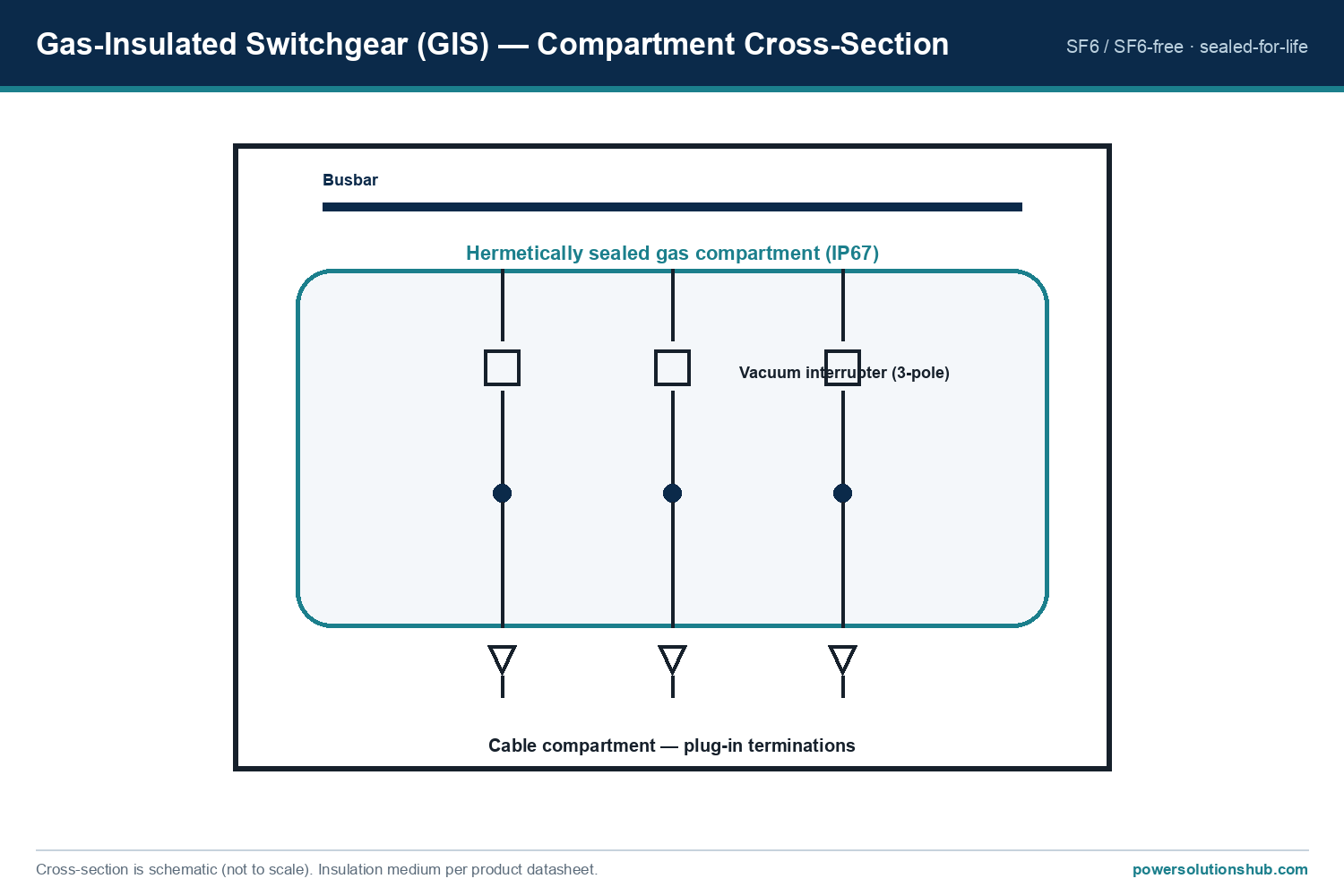
A ring main unit sits at the secondary distribution level: it connects a substation into the MV “ring”, switches the incoming/outgoing cables, and protects the MV/LV distribution transformer. The RM6 does this in a sealed, gas-insulated tank — the live parts sit in SF6, so the unit is compact and largely maintenance-free for its service life.
It links directly to the wider medium-voltage switchgear family: where primary switchgear feeds large loads, the RM6 is the workhorse of compact secondary substations and kiosks.
Configurations — RM6 functional units
The RM6 is assembled from standard functional units (modules), so you build the exact single-line you need. The core functions from the catalogue are:
- I — line switch (incomer/feeder): a network point with a switch-disconnector, rated 400 A or 630 A.
- Ic — bus coupler by switch-disconnector.
- Q — fuse-switch combination: transformer protection by a switch + MV fuses, for transformers up to 2 000 kVA (limited to 200 A).
- D / B — circuit-breaker function: transformer or feeder protection by a 630 A circuit breaker with a protection relay, for transformers up to 8 000 kVA.
Units are ordered by extensibility: NE (non-extensible), RE (right-extensible), LE (left-extensible) and DE (double-extensible), so a substation can grow on site. Transformer feeders are protected either by the fuse-switch (Q) for smaller ratings or by a circuit breaker with a self-powered VIP-series protection relay for larger ratings.
Technical specifications
All values below are taken from the Schneider RM6 catalogue; confirm the exact figures against the ordering configuration for your project.
| Parameter | Value |
|---|---|
| Rated voltage Ur | 12 / 17.5 / 24 kV |
| Rated frequency | 50 or 60 Hz |
| Rated normal (busbar) current | 400 A / 630 A |
| Short-circuit breaking capacity Isc | up to 25 kA |
| Short-time withstand duration tk | 1 s or 3 s |
| Peak making capacity Ima (switch & earthing) | up to 62.5 kA peak |
| Internal arc classification | AFLR 20 kA, 1 s (IEC 62271-200) |
| Insulation | SF6, sealed-for-life tank |
| Switchgear classification | PM (IEC 62271-200) |
| Switch-disconnector class | M1 / E3, 100 CO cycles (IEC 62271-103) |
The RM6 complies with IEC 62271-200 (AC metal-enclosed switchgear for rated voltages above 1 kV up to 52 kV) with an internal-arc classification of AFLR 20 kA for 1 s, and its switch-disconnectors follow IEC 62271-103 at class M1/E3 (100 close-open cycles).
Busbar current vs. ambient temperature
Rated current derates with ambient temperature — a key point for hot-climate projects. For the 630 A busbar:
| Ambient temperature | 40 °C | 45 °C | 50 °C | 55 °C | 60 °C |
|---|---|---|---|---|---|
| 630 A busbar — usable Ir | 630 A | 575 A | 515 A | 460 A | 425 A |
In Gulf and North-African installations where indoor temperatures routinely exceed 45 °C, this derating should be applied before confirming the rated current.
Selection criteria
- Transformer rating → protection type. Up to 2 000 kVA, a Q (fuse-switch) unit is typically sufficient; above that, up to 8 000 kVA, use a circuit-breaker (D/B) unit with a protection relay.
- Rated current. Choose 400 A or 630 A busbars, then apply the ambient-temperature derating above.
- Short-circuit level. Confirm the network’s prospective fault current against the RM6’s Isc (up to 25 kA) and making capacity.
- Extensibility. Pick NE/RE/LE/DE to match whether the substation will be extended later.
- Voltage class. 12, 17.5 or 24 kV per the network’s rated voltage.
How the RM6 is built and extended
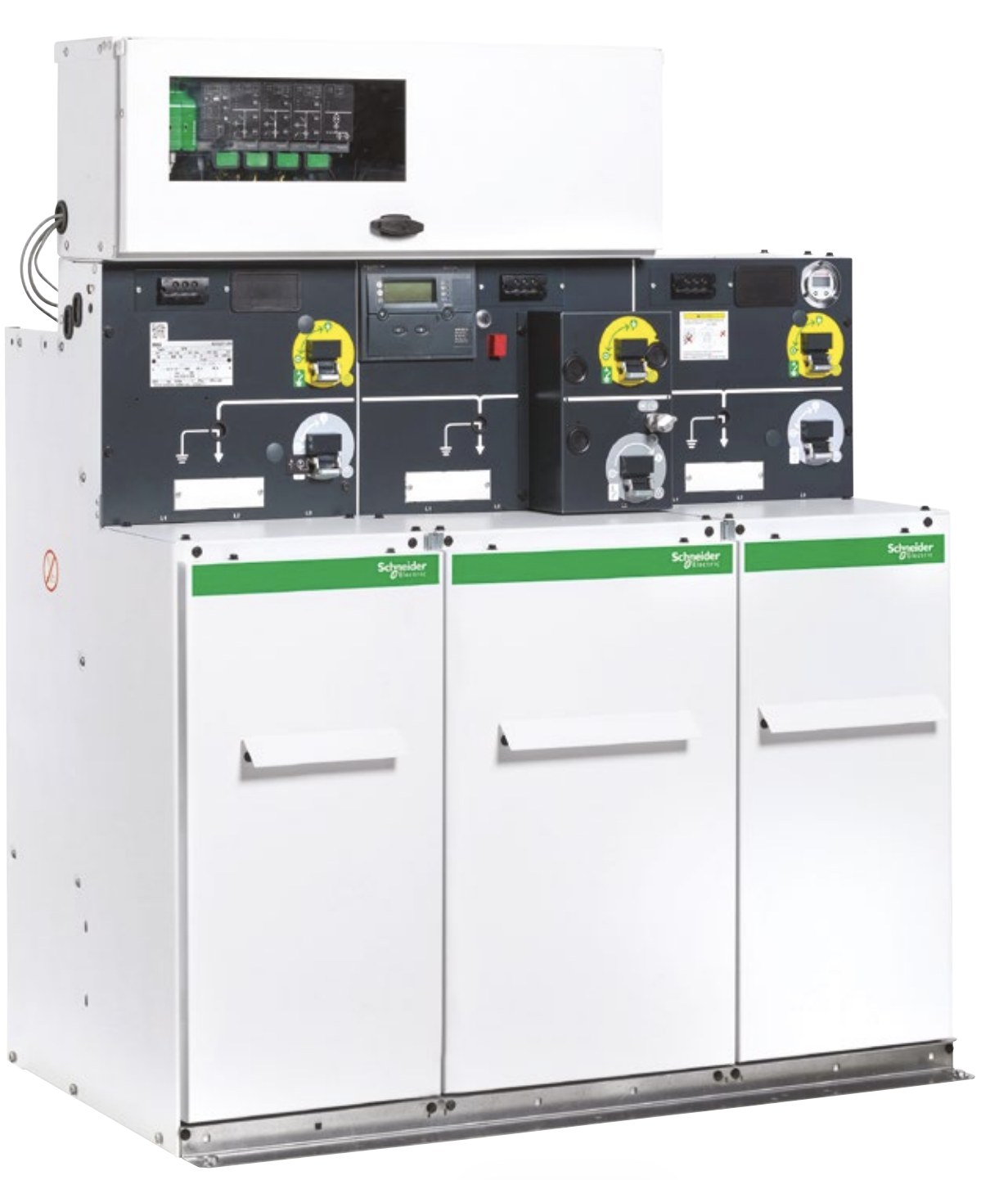
Because the RM6 is modular, a substation is specified as a string of functional units — for example a two-incomer, one-transformer layout is an I-I-Q (two ring switches plus a fuse-switch transformer feeder), while a protected feeder substation might be I-I-D (two ring switches plus a circuit-breaker feeder). The extensibility code chosen at order time (NE, RE, LE, DE) decides whether more modules can be bolted on later without replacing the unit: a DE (double-extensible) unit can grow on either side as the network develops. This “build-what-you-need, extend-later” approach is a large part of why RMUs dominate secondary distribution.
Interlocking is built in: the earthing switch has a short-circuit making capacity, and mechanical interlocks make it impossible to earth a circuit that is still energised — a safety feature required by IEC 62271-200 and reflected in the unit’s simple front mimic diagram.
Applications
The RM6 is used in compact secondary substations, kiosks and building distribution — utilities, industry, infrastructure and renewable connection points — anywhere a sealed, space-saving RMU is needed to ring-connect and protect an MV/LV transformer. In practice it sits at the point where an MV distribution ring drops down to a 1 000–2 000 kVA (fuse-switch) or larger (circuit-breaker) transformer, feeding a low-voltage board. Its low centre of gravity and sealed tank also make it suitable for demanding environments, including IACS-compliant marine installations.
Its protection is coordinated with downstream devices; for the protection side, see medium-voltage protection relays. Within the gas-insulated RMU family it competes directly with ABB SafeRing/SafePlus and Siemens 8DJH; the RM6’s differentiator is its wide, freely combinable functional-unit range and on-site extensibility.
What voltage and current is the Schneider RM6 rated for?
The RM6 is rated for 12, 17.5 and 24 kV, with busbar currents of 400 A or 630 A and a short-circuit breaking capacity up to 25 kA.
Is the RM6 SF6-insulated?
Yes — the RM6 is a gas-insulated ring main unit; its live parts are enclosed in a sealed SF6 tank, making it compact and maintenance-free for its service life.
What is the RM6’s internal arc classification?
The RM6 is classified IAC AFLR 20 kA for 1 s to IEC 62271-200.
What do the RM6 functional units (I, Q, D) mean?
I is a line switch-disconnector, Q is a fuse-switch for transformer protection (up to 2 000 kVA), and D/B is a circuit-breaker function with a protection relay (transformers up to 8 000 kVA).
How do I protect the transformer with an RM6?
Use a Q (fuse-switch) unit for transformers up to 2 000 kVA, or a circuit-breaker unit with a protection relay for ratings up to 8 000 kVA.
Looking for Schneider RM6 Ring Main Units?
Looking for high-quality Schneider RM6 gas-insulated ring main units? We provide expert engineering support and reliable products for all your medium voltage needs.
For quotations and requests: info@electricistanbul.com
WhatsApp: +90 501 076 69 91